
2026 AI Pedestrian Detection System Buyers Guide
- John Buttery

- Jan 18
- 4 min read

Validating AI forklift safety systems in real conditions
Every industrial site I’ve visited has had close calls. Sometimes it’s a pedestrian stepping into a forklift aisle, other times it’s a driver losing sight around a blind corner. These near misses rarely make it to the logbook — until an injury or worse forces attention.
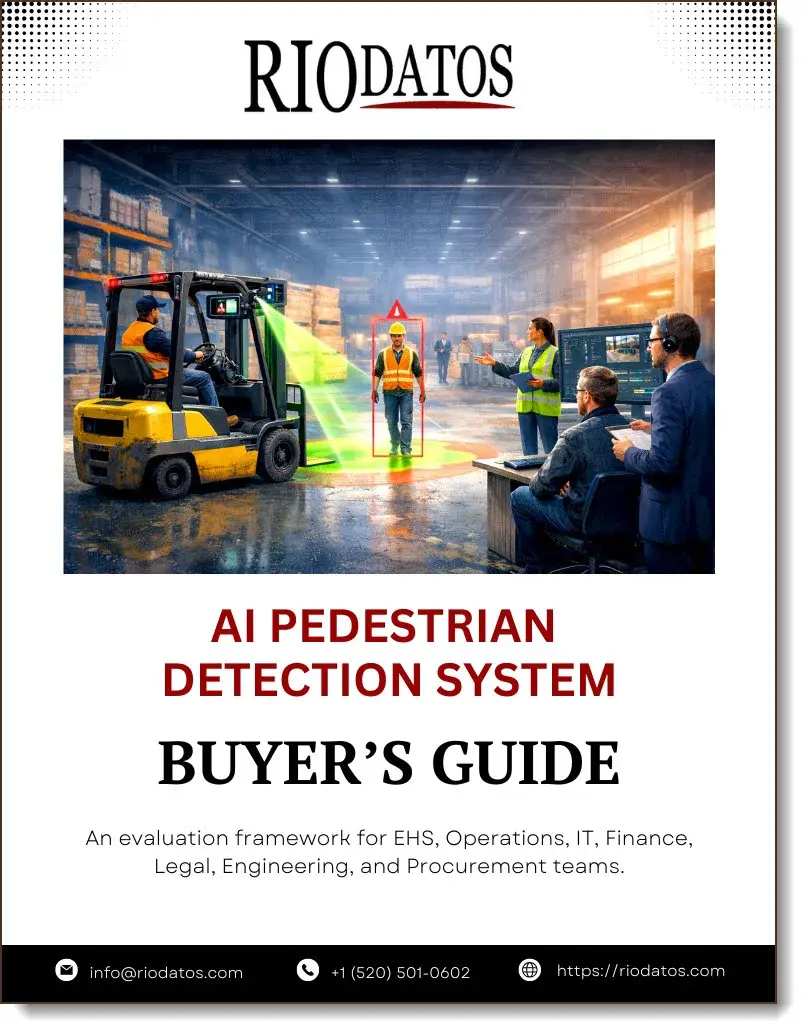
That’s exactly why the 2026 AI Pedestrian Detection System Buyers Guide exists. Not to sell technology, but to help responsible teams test, validate, and implement real-world safety improvements that don’t break workflows or overwhelm operations.
It’s not just a product choice. It’s a business-critical safety decision. And more teams are realizing it can’t be made in isolation.
Why We Need a 2026 AI Pedestrian Detection System Buyers Guide
Traditional safety tools, mirrors, tape lines, and signage, serve a purpose. But they rely entirely on human consistency in environments designed for movement, not stillness. Even well-trained operators can’t see around a racking corner or through a congested dock.
An AI pedestrian detection system changes that. These systems mount directly to forklifts, using edge AI and vision to detect pedestrians in real time with no tags, no Wi-Fi, no infrastructure.

“AI pedestrian detection systems have become a critical safety layer in environments where vehicles and people work side by side.”
What makes the difference isn’t just the technology. It’s how and where it’s validated. That’s the core insight behind this buyer’s guide.
What’s Inside the 2026 AI Pedestrian Detection System Buyers Guide
This guide isn’t just for safety teams. It’s built for every stakeholder with a piece of the decision. Here’s how each team plays a role:
EHS teams assess risk reduction and safety defensibility
Operations protect uptime and workflow continuity
IT verifies cybersecurity and system isolation
Legal manages AI policy and liability
Procurement avoids hidden costs and vendor lock-in
Finance justifies spending with clear ROI
Engineering ensures fast, simple installation
Plant managers balance all of the above under pressure
Each page of the 2026 AI Pedestrian Detection System Buyers Guide outlines objectives by role — helping align decision-makers early, not late.
Real-World Evaluation: The Only Test That Matters
Too many pedestrian detection systems are judged in clean environments or scripted demos. But risk lives in real conditions:
Low light and unpredictable foot traffic
Variable vehicle speeds and operator habits
Dock doors, ramps, and blind intersections
That’s why validation must happen in your facility, with your equipment, and your operators.
Key evaluation elements:
Operator response and alert fatigue
Accuracy without tags or beacons
Compatibility across forklift types
Fully offline operation (no IT infrastructure)
Legal defensibility in case of an incident
“This Buyers Guide helps cross-functional teams evaluate pedestrian detection systems based on real operating conditions and operator acceptance, not individual product features.”

How Riodatos Supports Validation
Riodatos offers a practical way forward: validate one forklift, under your conditions, before rolling out anything system-wide.
This approach supports:
Real operating condition testing — no simulations or test labs
Reduced deployment risk — confirm before you commit
Operator-driven feedback — adoption starts with trust
Cross-functional clarity — EHS, Ops, IT, Legal all aligned early
Explore the Validate One Forklift process, or contact Riodatos to get started. You can also schedule a 30-minute session with John Buttery to walk through options directly.
Call to Action
Start with a single-machine evaluation to confirm performance before scaling.
Use the 2026 AI Pedestrian Detection System Buyer’s Guide to align stakeholders and expectations.
Review the Riodatos product suite to understand your technical fit, or Book an On-Site walkthrough to explore real-site validation and support options.
Conclusion
Technology doesn’t prevent incidents — systems and processes do. But when you choose the right technology and validate it effectively, safety becomes something you can scale with confidence.
That’s what the 2026 AI Pedestrian Detection System Buyers Guide offers: a defensible, role-based framework that makes sure your next safety investment isn’t just a checkbox — it’s a turning point.
“The goal is to make informed and defensible safety decisions — not just test technology, but prove safety at the point of risk.”

About Riodatos
Riodatos is an industrial safety technology company focused on real-world pedestrian detection performance, not demos or theory. We sell, deploy, and support proven pedestrian detection systems across active industrial environments where forklifts, vehicles, and people interact every day.
Riodatos works directly with EHS and operations teams to evaluate, validate, and deploy pedestrian detection technology under real operating conditions. According to John Buttery, CEO of Riodatos, “Our approach emphasizes first-unit validation, measurable performance, operator adoption, and repeatable scale across mixed fleets and multi-site operations.”
Unlike vendors that lead with staged demonstrations, Riodatos leads with evidence. We help organizations select the right technology, install it correctly, validate it under stress, and scale it with confidence. The result is safer facilities, stronger buy-in, and capital investments backed by data rather than promises.
Description - 2026 AI Pedestrian Detection System Buyers Guide: how EHS, Operations, IT, Legal, and Finance teams validate forklift safety systems in real conditions.
Meta - The 2026 AI Pedestrian Detection System Buyers Guide supports cross-functional teams with real-world evaluation, validation, and deployment strategies.
Excerpt - The 2026 AI Pedestrian Detection System Buyers Guide helps cross-functional teams evaluate and validate forklift safety solutions before scaling.
Quick Read
📘 2026 AI Pedestrian Detection System Buyers Guide 🔒 Every EHS team wants safety. But the real decision-makers span IT, Legal, Ops, and Finance.
📊 This guide shows how to align them — and prove safety before you scale.
✓ Incidents are underreported — risks are real and growing
✓ AI systems detect pedestrians with no tags or infrastructure
✓ Works offline: no data leaves the forklift
✓ No integration with IT systems or surveillance concerns
✓ Built for legal defensibility and measurable ROI
✓ Evaluation framework supports every department
✓ One-machine validation prevents overcommitting
✓ Simple installs with no vehicle modification
✓ Role-based decision support from plant to procurement
✓ Backed by real-world testing, not marketing demos
🧭 Safety tech only works when everyone’s on board. The buyer’s guide gets you there — without assumptions, without surprises.
---


