
Cameras for EHS Managers: A Powerful Safety Training Tool
- John Buttery

- Feb 15
- 12 min read
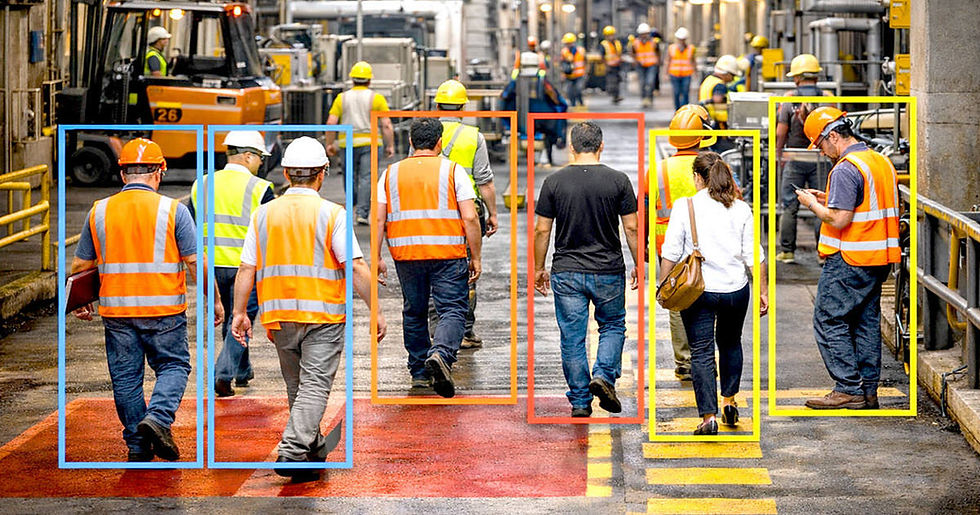
Most warehouses already have full camera coverage. AI turns that footage into a measurable, non-invasive safety intelligence layer.
Why Cameras for EHS Managers Are the Most Underused Safety Asset
Most industrial sites already have full camera coverage through their existing camera infrastructure. But nearly all that footage is wasted on safety insights.
Walk into the average warehouse, and you'll find dozens of cameras mounted across loading docks, racking zones, pedestrian corridors, and blind intersections.
Most of those cameras have been there for years, powered and functional, quietly recording. Yet less than 5 percent of that footage is ever reviewed for proactive safety insight. That's not a hardware gap. That's a gap in how we think about safety intelligence.
Cameras are still viewed by many EHS teams as an incident investigation tool, a reactive source of truth used after something has gone wrong. Meanwhile, those same teams invest in new wearable devices, retrofitting detection systems, and AI pilots, often overlooking that their most comprehensive, site-wide risk-monitoring system is already in place.
That shift in mindset is overdue.
The core reality is this:
Most facilities already have 100 percent visual coverage via cameras.
Those cameras are already paid for, installed, and widely accepted.
EHS teams typically use them only after incidents, not to prevent them.
Today, that's changing. With modern AI analytics, existing cameras can now operate as a non-invasive safety sensor layer, continuously scanning for proximity risks, unsafe behaviors, and environmental hazards without disrupting workflow or requiring operator interaction.
This transforms cameras from passive archives into real-time hazard detection and risk-intelligence systems. It becomes:
Continuous: Monitoring risk across all zones and shifts, not just flagged events
Measurable: Providing quantitative data on near misses, behavior patterns, and zone conflicts
Defensible: Creating a documented record of hazard identification and corrective action
EHS leaders don't need more hardware. They need better intelligence than what they already have. That's not just a cost-efficiency win. It's a strategic reframing of how safety is monitored, measured, and managed at scale.

Why EHS Teams Resist New Safety Technology (And Why Cameras Are Different)
Safety leaders are constantly being pitched the next big solution. Yet many hesitate to adopt innovative technology, not because they're indifferent to risk, but because they know exactly how fragile operational balance can be. Even well-intentioned upgrades can introduce friction, trigger resistance, or derail productivity.
The reality is that most EHS teams operate under real constraints. They are accountable to operations, IT, legal, labor, and finance—all of whom have valid concerns when it comes to introducing unfamiliar systems. In many cases, it's not the safety value at issue, but the implementation burden.
Common barriers include:
Production disruption
IT approval bottlenecks
Labor resistance
Capital expenditure scrutiny
"Pilot fatigue" after too many limited trials with unclear ROI
Union or workforce concerns about surveillance or "Big Brother" monitoring
These concerns are legitimate. That's why AI-enabled camera analytics represent such a different proposition. They bypass nearly all the usual objections because they don't require physical interaction, system overhauls, or cultural shifts.
Unlike most safety systems, Camera analytics:
Do not require wearables
Do not involve forklift modifications
Do not require process redesign
Do not ask operators to learn or use anything new
Running in parallel to operations without affecting the workflow
Analyze environmental patterns and safety behaviors, not individual performance
By working with existing infrastructure, this approach avoids the resistance typically triggered by new hardware rollouts. It allows safety teams to observe and measure risk without disrupting work.
Camera analytics observe operations without changing them, which is what makes them both effective and widely acceptable. Reliable detection performance depends on appropriate camera placement, resolution, and lighting conditions.
From Video to Intelligence: What Changes with AI-Enabled Cameras
Most facilities already have extensive camera systems in place. For years, these systems have been used the same way: as a record of what happened. After an incident, someone pulls the footage, scrubs through the timeline, and pieces together what went wrong.
This is how traditional cameras have functioned:
Records incidents
Supports investigations
Reactive by design
It has value, but only after the fact. The footage is static and silent unless someone goes looking for it. It does not prevent risk. It simply helps explain it once it's too late to change the outcome.
AI-powered workplace safety analytics completely change that dynamic. By applying machine learning models to existing cameras, these systems capture unsafe events 24/7 and can surface patterns and detect risks in real time. The footage becomes a stream of structured, actionable data.
With AI, Cameras now:
Detects behavioral and movement patterns
Quantifies unsafe actions like near misses and zone violations
Flags elevated risk levels before incidents occur
Converts video into data streams that can be tracked and measured
These augment rather than replace human review. It unlocks a layer of intelligence inherent in existing footage, transforming passive recordings into visibility into risk-leading patterns—though like any AI system, it may produce occasional false positives that require human verification.
The value is not the video itself. The value lies in the ability to measure behavior consistently over time.

The Core Advantage: Non-Invasive Safety Measurement
Most safety systems ask something from the workforce. They rely on wearable devices, operator alerts, or procedural compliance to function as intended. But any system that relies on people remembering, carrying, activating, or reacting introduces risk due to human variability.
Cameras for EHS managers avoid that entirely. It requires no interaction from workers. The system passively observes the environment and identifies risk conditions without changing how people move, behave, or interact with equipment.
This means:
No device adoption risk
No changes to standard operating procedures
No dependency on individual compliance or participation
It works equally well for everyone on site:
Employees
Contractors
Visitors
Temporary labor
That universality matters. In dynamic environments where people are constantly moving in and out—across shifts, job types, and experience levels—the most reliable safety layer is one that functions independently of human memory or cooperation.
Cameras for EHS managers represent the safest system approach because it does not rely on individuals remembering to use or activate it.
The 15 Quantitative Safety Metrics EHS Teams Can Measure Using Existing Cameras
Most safety decisions are made using a mix of experience, observations, and after-action reports. While effective, it often leaves enterprise EHS teams exposed to blind spots or reliant on anecdotal evidence when trying to justify changes or defend decisions.
By applying analytics to existing cameras, EHS teams can measure leading indicators across three risk categories. These metrics are not theoretical. They are drawn from observed behavior and real-time movement patterns.
A. Collision and Proximity Risk
Pedestrian–vehicle proximity events
Frequency of near-miss interactions
Repeat conflict zones by location
Time-of-day risk clustering
Directional movement conflicts, cross-traffic, and blind corner exposure
B. Behavioral and Compliance Risk
Pedestrian presence in restricted zones
Unauthorized access to high-risk areas
Improper use of designated walkways
Standing or stopping in known danger zones
Duration of exposure in unsafe areas
C. Facility and Process Risk
Congestion density trends over time
Workflow bottlenecks near active equipment
Shifts in traffic flow after layout changes
Repeating risk patterns tied to specific tasks or teams
Increases in risk tied to seasonal demand or production peaks
These metrics provide a level of detail and consistency that human observation cannot. They allow teams to prioritize interventions, evaluate the impact of changes, and communicate risk in clear, quantifiable terms. This enables proactive AI-powered safety rather than reactive responses.
These are not opinions. They are measurable, timestamped indicators of risk.
How EHS Teams Use This Data in Practice
Safety data value depends on actionability. Once EHS teams begin collecting metrics through AI-enabled Cameras, the insights prove immediately usable. The data becomes a foundation for more targeted, defensible decisions across safety, operations, and training.
Six ways teams apply this intelligence:
1. Risk-Based Facility Modifications
Justify physical changes like guardrails, mirrors, barriers, or rerouted walkways
Prioritize capital improvements based on actual exposure levels, not anecdotal reports
A beverage distributor identified 47 near-miss events in a single loading dock corner over two weeks. They installed a $12,000 barrier that eliminated 90 percent of conflicts in that zone
2. Targeted Training Programs
Focus training on specific observed behaviors instead of generic safety modules
Validate whether training made a difference by comparing pre- and post-training data
3. Process Improvement
Identify unsafe task sequences based on repeated exposure or conflict patterns
Adjust workflows to reduce unnecessary cross-traffic or congestion
Confirm the effect of those changes without waiting for a reportable incident
4. Contractor and Visitor Risk Oversight
Monitor the exposure of non-employees who are not part of standard training programs
Identify repeat violations by role or location without requiring direct confrontation
Enforce safety standards consistently across all personnel types
5. Benchmarking and Continuous Improvement
Compare safety performance across shifts, departments, or buildings
Identify high-performing behaviors on the safest teams and replicate them
Use objective data to track improvements over time
6. Root Cause Analysis Without Blame
Investigate incidents using pattern recognition and exposure history
Identify whether issues stem from environmental conditions or layout problems
Shift conversations away from fault and toward system-level corrections
Safety intelligence from existing cameras converts directly into operational value. It empowers EHS teams to shift from reactive response to predictive management.
Compliance, Audits, and Legal Defense
For many executives, the value of safety data is measured by how well it holds up under scrutiny. When an inspection, audit, or legal challenge arises, the difference between a defensible and a reactive safety posture often comes down to documentation.
Cameras for EHS managers provide continuous, timestamped evidence that risk is being monitored proactively. This creates a safety record that is automatic, consistent, and available when needed.
It demonstrates:
Due diligence in hazard monitoring
Active identification of environmental and behavioral risks
Clear records of corrective actions tied to measurable exposure
This creates a strong defense posture in situations such as:
OSHA inquiries
Insurance claims
Legal disputes
One client avoided a two-million-dollar OSHA citation by presenting continuous hazard monitoring data during an unplanned audit. The ability to show that risk was being tracked, even if no intervention had yet occurred, changed the nature of the inspection entirely.
There are also longer-term advantages:
Insurance premium leverage, as some carriers now offer discounts for sites with AI-enabled risk monitoring
Third-party validation, since the data can be shared with insurers, auditors, or clients for contractor safety assessments
Camera analytics do more than reduce risk. They establish verifiable evidence that risk was actively managed.

Why This Approach Scales Across Facilities
For EHS leaders responsible for multiple sites, the challenge extends beyond single-location improvement. It's creating a system that can adapt, scale, and deliver consistent value across a wide range of environments, equipment, and operating cultures.
One of the strongest advantages of AI-powered EHS solutions is that they don't require upfront standardization. There is no need to replace or align camera hardware across all sites before starting. Teams can deploy analytics using their existing Cameras infrastructure. Camera integrations is flexible and site-specific.
This allows teams to:
Deploy analytics site-by-site, based on readiness or priority
Compare risk profiles across different facilities using consistent metrics
Identify which locations demonstrate the safest behaviors or the fewest exposures
Roll out targeted improvements where risk is highest, rather than spreading effort evenly
Scalability comes not from uniform equipment, but from a consistent method of measuring risk. With this approach, each facility can move at its own pace while still contributing to a larger safety intelligence framework.
Common Objections (And How to Address Them)
Modern technology raises concerns across the organization. Operations, IT, and labor groups raise valid questions. Addressing these objections directly builds alignment and avoids stalled deployments.
Common concerns and practical responses:
"This is just surveillance."
This concern usually comes from labor groups or worker representatives. The key is to reframe the system as environmental monitoring, not employee tracking. The analytics detect hazardous patterns in movement, behavior, and layout that pose risks to everyone on site without assigning blame or evaluating individual performance. Organizations must still ensure compliance with applicable privacy regulations and maintain transparent data handling practices.
"We don't have IT resources."
Many AI-enabled Cameras platforms are cloud-based and require minimal IT support. They do not involve installing or managing on-premises servers and integrate via standard video protocols. In most cases, deployment does not require complex configuration or long approval cycles.
"Our cameras are too old."
Modern analytics platforms support cameras with at least 720p resolution; performance improves with higher resolution, wider angles, and adequate lighting. Many cameras installed in the past decade meet baseline requirements, but sites with legacy analog systems or poor lighting may require encoders, adjustments, or selective upgrades to achieve optimal results.
"We have privacy concerns."
This is a fair question, especially in environments with a strong labor presence. The important distinction is that these systems do not introduce new surveillance. They use footage from existing cameras and convert it into risk intelligence. No new data is collected, and no additional monitoring is added. The facility's privacy profile remains unchanged.
Addressing these concerns directly builds trust and reduces resistance.
Cost Reality: Why This Is One of the Lowest-Cost Safety Upgrades Available
Cost is often the first hurdle when evaluating new safety technology. Most solutions require significant investment in hardware, training, or infrastructure. AI-enabled Cameras analytics are different. They build on what you already have.
No major capital expenditure is required.
No forklift retrofits
No wearable inventory
No infrastructure overhaul
Uses existing cameras and video systems
This leverages sunk costs. Facilities have security camera infrastructure. AI-powered EHS analytics add safety functionality without requiring new hardware or deployment.
Return on investment comes from multiple directions:
Risk reduction through early detection of unsafe behavior
Incident avoidance that prevents costly downtime or injury
Legal exposure mitigation with documented monitoring
More efficient, targeted training
Potential insurance premium reductions as carriers begin to reward proactive safety
The biggest investment in cameras and infrastructure has already been made. The intelligence layer is incremental and incurs subscription or licensing costs for the analytics platform. This often makes it one of the more cost-effective ways to upgrade site safety compared to hardware-heavy alternatives.

The Strategic Shift: From Incident Response to Continuous Risk Intelligence
Most safety programs are designed around incidents. They activate when something goes wrong, then document what happened, why, and how to prevent recurrence. This approach is inherently reactive and episodic.
Traditional EHS operates in this cycle:
Reactive
Incident-driven
Documentation-focused
AI-enabled cameras shift how safety is managed and measured. Analytics provide a live view of emerging risk based on observed patterns. This creates a continuous improvement model.
With analytics, safety becomes:
Proactive
Pattern-driven
Intelligence-focused
This shift allows safety performance to become:
Quantifiable, with metrics tied to real behaviors and exposures
Defensible, with timestamped records of monitoring and response
Predictive, with early indicators of risk based on trend detection
It also opens the door to forward-looking capabilities:
Predictive safety and SIF prevention, moving from a focus on what happened to what may happen next
Integration with broader EHS systems, incident platforms, or executive dashboards
Visibility at the leadership level, where safety performance becomes a KPI, not just a compliance requirement
This evolution brings EHS into closer alignment with other strategic functions:
Operations, through shared data on workflow safety
Finance, through measurable ROI on risk reduction
Legal, through stronger documentation and exposure management
Executive leadership, through performance metrics tied to organizational outcomes
It's not just a technological upgrade. It's a structural change in how safety leadership thinks, acts, and leads.
Closing Thought
Safety leadership's future doesn't rest on new equipment. It rests on extracting meaningful intelligence from existing infrastructure. Most facilities already have the infrastructure. Cameras are mounted, powered, and recording. The missing element isn't visibility. It is an interpretation.
AI-enabled Cameras transforms static footage into real-time risk insights on pedestrian movement, machine operations, changing conditions, and exposure patterns. This insight requires no workflow disruption, cultural resistance, or capital planning. It requires a shift in mindset.
The goal extends beyond efficient incident response. It's seeing risk before reportable events occur. Track safety as operations tracks output or finance tracks costs. Create a system that adapts, scales, and informs decision-making from floor to boardroom.
Environmental intelligence replaces procedural enforcement. Measurement replaces guesswork. Safety becomes something to lead with, not just answer for.
The question isn't whether your facility has the infrastructure to continuously measure safety risk. It's whether you're using it. Your facility has the visibility. The missing element is insight into what matters most.
"The safest system is the one that already exists but now sees what matters."
About Riodatos
Riodatos is an industrial safety technology company focused on real-world pedestrian detection performance, not demos or theory. We sell, deploy, and support proven pedestrian detection systems across active industrial environments where forklifts, vehicles, and people interact every day.
We work directly with EHS and operations teams to evaluate, validate, and deploy pedestrian detection technology under real operating conditions. According to John Buttery, CEO of Riodatos, "Our approach emphasizes first-unit validation, measurable performance, operator adoption, and repeatable scale across mixed fleets and multi-site operations."
Unlike vendors that lead with staged demonstrations, Riodatos leads with evidence. We help organizations select the right technology, install it correctly, validate it under stress, and scale it with confidence. The result is safer facilities, stronger buy-in, and capital investments backed by data rather than promises.
Quick Read (LinkedIn)
⚠️Your facility already has cameras. But most of that video isn’t protecting anyone. 📊 AI turns existing footage into continuous EHS risk intelligence.
🔍 The Reality
Warehouses are covered in cameras, but not in safety intelligence. Most video footage goes unused while EHS teams invest in new equipment, deploy wearables, and still end up reacting after incidents.
🤖 What AI Actually Does
• Turns existing video into continuous, automated risk data
• Works with cameras you already have — no new hardware required
• Requires no workflow changes or operational disruption
📈 What You Can Measure
• Pedestrian–vehicle proximity and near-miss patterns
• Congestion and high-risk interaction zones
• Safety behaviors and compliance trends (focused on risk, not people)
🛠 Why It Matters
• Validates the impact of training and safety interventions
• Supports facility redesign with tangible evidence
• Creates a defensible record for audits, insurance, and legal protection
It’s not surveillance. It’s the safety intelligence layer your facility already has.
---
Metadata: Cameras for EHS Managers is now a proactive safety tool. AI-powered video analytics turn existing footage into behavior-based training, risk data, and audit support.
Description: Cameras for EHS Managers is evolving into a powerful training and safety intelligence platform. AI transforms passive footage into measurable, site-wide risk insights.
Excerpt: Cameras for EHS Managers has moved beyond incident review. Learn how teams use AI video analytics to train workers, reduce exposure, and defend safety decisions.
Title: Cameras for EHS Managers: A Powerful Safety Training Tool
URL Slug: cameras-for-ehs-managers
Keyword Phrase: cameras for EHS managers


