
AI Camera Systems and Construction Site Liability Documentation
- John Buttery

- Apr 26
- 9 min read
Updated: Apr 28
How timestamped video evidence changes what happens after an incident — and before the next one

Introduction
Most safety managers think about AI cameras as prevention tools. That framing is correct. Early detection, in-cab alerts, and pedestrian warnings are the primary reasons sites deploy these systems. But there is a second dimension that does not get discussed enough: what the footage does after something goes wrong.
When an incident occurs on a construction site, the immediate pressure is to understand what happened. Supervisors are on the phone. The safety manager is walking the scene. Someone is already asking whether OSHA needs to be notified. And in the middle of all that, the honest answer to "what actually happened?" is often incomplete. Witnesses have different accounts. The equipment has been moved. The conditions at the time are already changing.
AI camera systems create a continuous, timestamped record of conditions, equipment position, operator behavior, and human-machine proximity. That record exists whether or not anyone planned to use it for documentation purposes. The sites that have it are in a fundamentally different position than those that do not, not because they avoided the incident, but because they can show precisely what happened, what the conditions were, and what the pattern looked like in the days and shifts before.
What Construction Sites Typically Have When an Incident Occurs
Witness Accounts and Their Limitations
Human memory is not a reliable documentation. That is not a criticism of the people involved; it is how memory works under stress. Witnesses to a construction incident frequently report different sequences of events, different positions for the equipment and the worker, and different accounts of whether a warning was given. By the time statements are collected, sometimes hours after the event, the details have already been filtered through shock, uncertainty, and concern about what the account might mean.
This is not a failure of integrity. It is a structural limitation of relying on human recall to precisely reconstruct fast-moving events. The equipment was moving. The worker was moving. Multiple things were happening at once. No single person saw it all from an angle that captured everything relevant.
Paper-Based Inspection Records
Pre-shift inspections, toolbox talk sign-in sheets, and equipment maintenance logs establish that procedures exist and were followed at specific times. They do not establish what was happening at 2:17 PM on a Tuesday when a loader backed into a work zone. Static records answer compliance questions. They do not reconstruct events.
The Documentation Gap
"The gap between what procedures say should happen and what actually happens on a live site is where most incidents occur."
Every site has written procedures. Spotters are required. Horn signals are defined. Pedestrian exclusion zones are marked. The documentation gap is the distance between those procedures and the actual behavior of equipment operators and ground workers during a busy shift under schedule pressure. That gap is invisible without continuous observation, and most sites have no way to measure it until something goes wrong.
Construction Site Liability Documentation: What AI Camera Systems Add to the Record
Timestamped Video From Multiple Angles
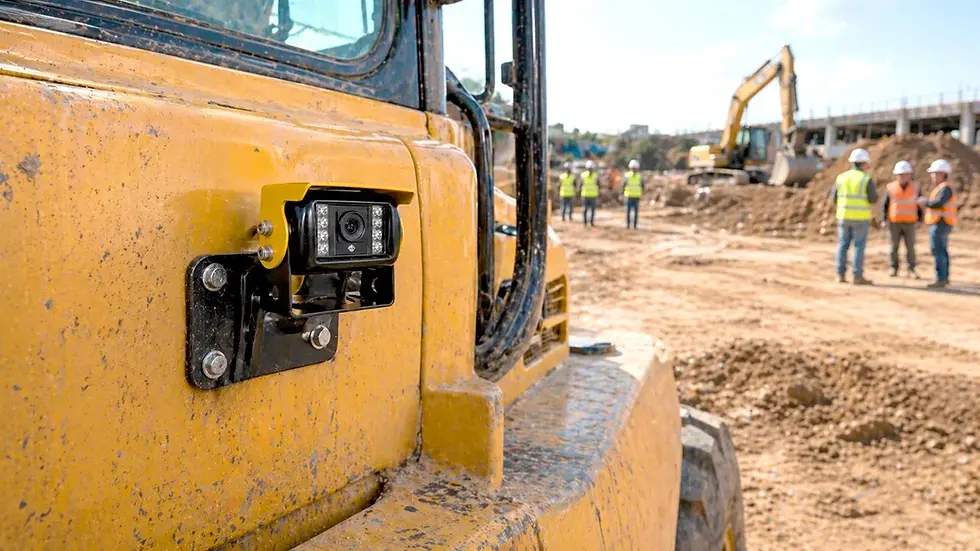
A four-camera AI system mounted on a loader captures front, rear, left, and right simultaneously, with timestamps accurate to the second. When an incident occurs, the footage shows what was happening in the thirty seconds before, the moment of the event, and the immediate aftermath. It shows whether the operator activated a reverse warning. It shows whether the pedestrian entered the zone from a direction the operator could not see. It shows the actual distance between the machine and the worker at the moment of contact or near-contact.
That level of precision is not available from any other source. It does not depend on memory, and it does not change over time.
Equipment Position and Pedestrian Location
AI camera systems with detection capability log not just video but detection events — the system recorded a pedestrian at this position, at this distance, at this time. For equipment with in-cab alert functionality, the log also shows whether the operator received a warning and how the machine responded. That structured data sits alongside the video, creating a reconstruction of the event that is difficult to dispute.
Near-Miss History in the Same Zone
One of the most operationally significant aspects of continuous documentation is what it reveals about pattern. If a pedestrian-equipment conflict occurred at a specific intersection on a Wednesday afternoon, the footage from the preceding two weeks may show three or four near-misses at the same location that were never reported. That pattern matters for understanding why the incident happened. It also matters for demonstrating whether the hazard was recognized and what corrective actions were or were not taken.
Operator Behavior Data
Speed, proximity violations, alert acknowledgment, and directional patterns are all visible in the footage and in detection logs. Over time, this data identifies which operators consistently operate within safe separation distances and which ones do not. That distinction is important both for targeted coaching before an incident and for accurate reconstruction after one.
How That Documentation Changes the Investigation
Root Cause Analysis With Actual Evidence
Traditional incident investigation relies on reconstructing events from physical evidence, witness statements, and procedural records. The result is usually a plausible account of what happened, but plausible is not the same as verified. AI camera footage allows investigators to watch the event unfold. Root cause analysis that starts from verified facts rather than reconstructed accounts is faster, more accurate, and less likely to misattribute cause.
Subcontractor Accountability
On a construction site with multiple subcontractors operating simultaneously, establishing who was where and when is genuinely difficult. Crew lists, access logs, and daily reports give partial answers. Camera footage gives precise ones. When a pedestrian violation occurs in a zone where two subcontractors are working, the footage identifies which crew member from which company was involved, not by inference but through direct visual record.
"Accountability without documentation is just opinion. The footage either shows what happened or it doesn't."
Differentiating a Safety Failure From a Procedural One
Not every incident is the result of a safety program failure. Sometimes a worker makes a decision that no procedure could have anticipated. Sometimes equipment fails in ways no inspection would have predicted. The ability to distinguish between a systemic program failure and an individual situational decision has significant implications for how an incident is understood, reported, and addressed. Footage makes that distinction possible in a way that witness accounts alone cannot.
The Claims and Dispute Reality
What Typically Gets Disputed
Construction incident claims frequently involve disputes about the sequence of events, the position of equipment and personnel, whether warnings were given, and whether safety procedures were in place and followed. These disputes extend the resolution timeline and increase costs for all parties. They also produce outcomes that may not accurately reflect what actually happened, because the available evidence does not support a clear reconstruction.
How Video Evidence Compresses the Timeline
When footage is available, many disputes resolve faster. The sequence of events is visible. The positions are documented. The alert history is logged. Parties on all sides of an investigation are working from the same factual record rather than competing reconstructions. That compression of the dispute timeline has direct operational value; faster resolution means less disruption to the site, the safety program, and the organization.
What Safety Programs Are Expected to Demonstrate
Insurers and risk managers increasingly look beyond lagging indicators, incident rates and recordable counts toward evidence that a safety program is actively identifying and correcting hazards. Compliance rate trends, near-miss documentation, corrective action logs, and leading indicators that show hazard exposure is being measured and managed are the kinds of program evidence that support productive conversations with carriers. AI camera systems generate that evidence as a byproduct of normal operation, without requiring additional administrative work from the safety team.
What Footage Also Reveals That Nobody Expected
Sites that deploy AI cameras for pedestrian detection consistently discover that the footage surfaces issues no one anticipated when the system was installed.
Unreported Near-Misses
Near-miss reporting on construction sites is chronically underreported. Workers often do not report events they consider minor, or events where they believe reporting will create more problems than it solves. Camera footage captures those events regardless. In most operations, the first review of footage from a newly installed system reveals several near-misses that occurred during normal operations and were never reported. That information is not a liability. It is an opportunity to correct hazards before they produce a recordable event.
Equipment Abuse and Material Damage
Loads dropped. Attachments contacting structures. Roughly reversing under time pressure. These events are visible on camera but often invisible on other monitoring channels. The information supports equipment maintenance decisions, operator coaching conversations, and cost recovery in situations where damage to materials or structures can be traced to specific equipment interactions.
Behavioral Patterns That Precede Incidents
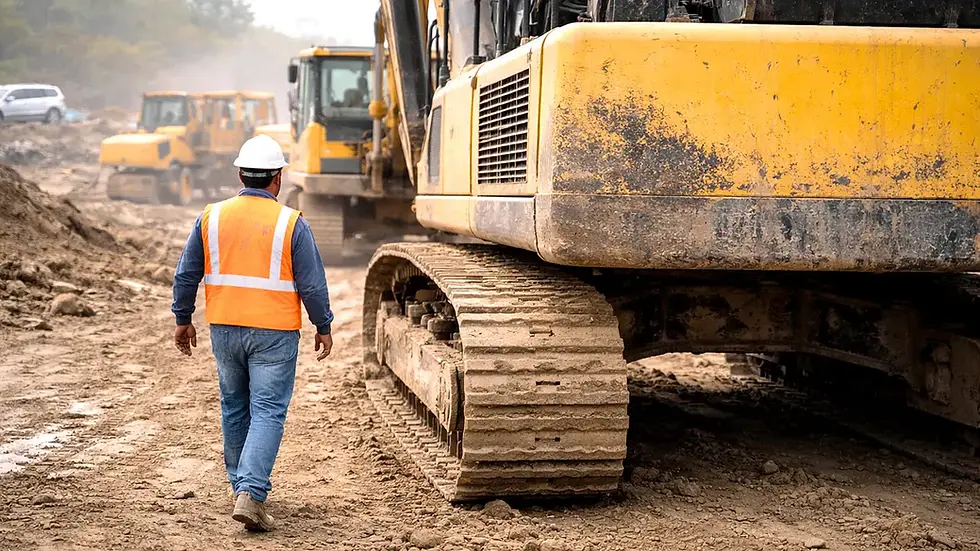
Organizations typically discover that incidents are not isolated events. They are the visible end of a pattern of behavior and conditions that built up over time. Footage from the period before an incident frequently shows the progression: a zone that was increasingly treated as a shortcut, an operator whose separation distances narrowed over several shifts, a pedestrian traffic pattern that evolved away from the designated route. That pattern is only visible if the record exists.
Author Perspective
I have spent thirty years watching what happens to safety programs when something goes wrong on a site. The investigations I have seen go smoothly, where root cause was identified quickly, corrective actions were clear, and the organization moved forward, almost always had one thing in common: there was a record. Not a perfect record, not a record that answered every question, but something concrete that investigators could work from rather than reconstructing events from memory and inference.
The investigations that dragged on, producing contested findings, unresolved liability questions, and lasting damage to relationships among contractors, subcontractors, and owners, usually started from the same place: nobody could say precisely what happened. The documentation gap between procedure and practice was invisible until the incident made it visible, and by then, the conditions that caused it were gone.
The case for AI camera systems in construction has always been strongest when framed in terms of prevention. That framing is correct. But the documentation value, the footage that exists regardless of whether you expected to need it, is a parallel argument that does not get made often enough. More on how I think about this at johnbuttery.com.
Why This Matters Now for EHS and Operations
Construction sites are operating under greater schedule pressure, greater subcontractor complexity, and greater regulatory scrutiny than at any point in the past decade. The combination produces an environment where the gap between written procedures and actual site behavior widens, and where the consequences of incidents, from OSHA citations to project delays to insurance implications, are more significant.
The shift from reactive incident response to proactive exposure measurement is where leading safety programs are moving. That shift requires visibility, real data about what is actually happening on the site, not just what procedures say should happen. AI camera systems provide that visibility as a function of normal operation.
The documentation they generate is not an administrative task. It is a byproduct of the detection function the system is already performing. The sites that recognize both dimensions of that value are building safety programs that are more defensible, more accurate, and more effective at identifying hazards before they produce recordable events.
Conclusion
The documentation argument for AI cameras on construction equipment is not separate from the safety argument, it is the same argument, viewed from a different angle. Detection prevents incidents. Documentation explains them when they occur, reveals the patterns that produced them, and creates the evidentiary record that allows organizations to investigate accurately, respond appropriately, and demonstrate to every stakeholder that their safety program is built on real data rather than assumptions.
"The footage either exists or it doesn't. Everything that follows from an incident is easier when it does."
About Riodatos
Riodatos is a U.S.-based pedestrian safety systems company headquartered in Tucson, Arizona, with domestic inventory and direct support for construction, manufacturing, warehousing, and logistics operations across the Americas. We are an authorized distributor for Proxicam, ZoneSafe, and Inviol. AI-powered pedestrian detection, RFID proximity warnings, and fixed-camera analytics systems are configured and supported for the specific equipment, traffic patterns, and risk profiles of each site we work with.
Our approach emphasizes measurable live performance from the first deployed machine, operator adoption under real-world conditions, and scalable deployment across mixed fleets and multi-site operations. Direct pricing, fast U.S. shipping, certified installation, and English and Spanish support enable safety teams to move from evaluation to protection without the delays and mismatches associated with overseas sourcing.
Quick Read
🦺 AI Camera Systems and Construction Site Liability Documentation - Most sites install AI cameras to protect pedestrians. 👷That's the right reason. But what the footage does after an incident is a separate argument that rarely gets made.
⚠️ Witness accounts conflict — footage doesn't
🛡️ Near-misses that were never reported are visible on the card
🚜 Equipment position and pedestrian location at the exact moment of the event
👷♂️ Subcontractor accountability — who was where, verified
📊 Behavioral patterns in the days before an incident, not just the incident itself
No cloud. No WiFi. No subscription. Pull the SD card from one machine after a week. What you find will change how you think about the rest of your fleet.
The documentation exists whether you plan to need it. The sites that have it are in a different position than those that don't.
---


