
360° AI Vision Systems for Heavy Equipment
- John Buttery

- Apr 19
- 10 min read
How edge-based quad-camera detection is closing the blind-spot gap on forklifts, loaders, and Yellow Iron fleets — without wearables, cloud dependency, or multi-day installation.

Introduction
Struck-by incidents involving heavy equipment are not random. They follow patterns — predictable blind spots, predictable times of day, predictable locations on site. What has been missing, for most of the past decade, is a way to make those patterns visible before someone gets hurt.
For years, the standard answer was a proximity sensor worn by the worker. Put a tag on every person. Alert the operator when a tag enters a defined zone. It was a reasonable idea. In practice, it has proven to be one of the most fragile links in the safety chain.
The shift happening across construction, mining, and logistics in 2026 is not just technological. It is a rethinking of where the safety system should live, on the machine, where it can function regardless of what any individual worker is or is not wearing. This article looks at why 360° AI vision systems for heavy equipment are gaining ground, what the operational case actually is, and what a realistic deployment looks like for mixed fleets operating under real site conditions.
"The systems that hold up in the field are the ones that don't require perfect human behavior to function. Workers forget tags. They remove them. The machine doesn't forget anything."
The Blind Spot Problem That Pedestrian Detection Has to Solve
Where Struck-By Incidents Actually Happen
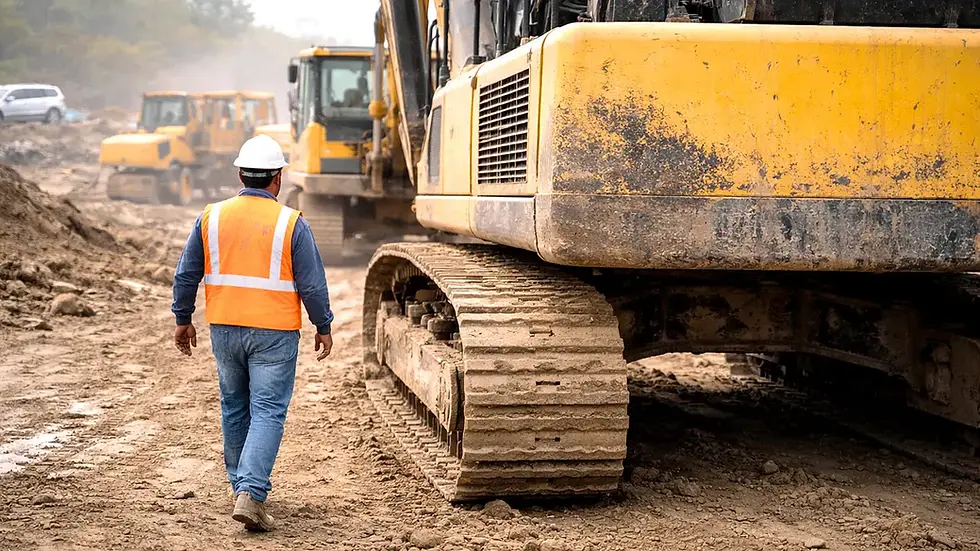
Struck-by incidents involving heavy equipment follow a consistent pattern in post-incident investigation: the worker entered a blind zone that the operator could not see. Not a technology failure. Not a compliance breakdown. A geometry problem — the physical reality that large equipment has areas around it where visibility from the cab is zero or near-zero, regardless of how experienced the operator is or how well the site is managed.
On a wheel loader, the rear blind zone behind the counterweight can extend fifteen to twenty feet. On an excavator, the swing arc exposes both sides simultaneously. On a large haul truck, the operator’s sightlines from the cab eliminate direct visibility of anything within several meters of the vehicle body. These are not edge cases; they are the standard operating geometry of the equipment.
The challenge pedestrian detection technology has to solve is not a behavioral one. It is a coverage one. The question is how to give the operator real-time awareness of pedestrian presence in zones that cameras and mirrors alone cannot reliably cover, across the full range of site conditions, shift patterns, and lighting environments where the equipment actually operates.
Why the Machine Is the Right Place to Put the Detection System
Mounting the detection system on the machine addresses the blind spot problem at its source. A camera positioned to cover the rear quarter of a loader continuously monitors that zone through shift changes, in low light, in dust, in rain, regardless of what any individual worker is or is not carrying. The coverage is tied to the machine geometry, not to the behavior of the people working around it.
Different sites and equipment profiles call for different detection approaches — proximity-based, vision-based, or both. What is consistent across approaches is the underlying requirement: the operator needs to know when someone is in a zone they cannot directly see and has enough time to stop. The technology is the means. Closing the blind spot is the goal.
360° AI Vision Systems for Heavy Equipment: How the Technology Actually Works
Four-Camera Architecture vs. Single-View and Stitched Systems
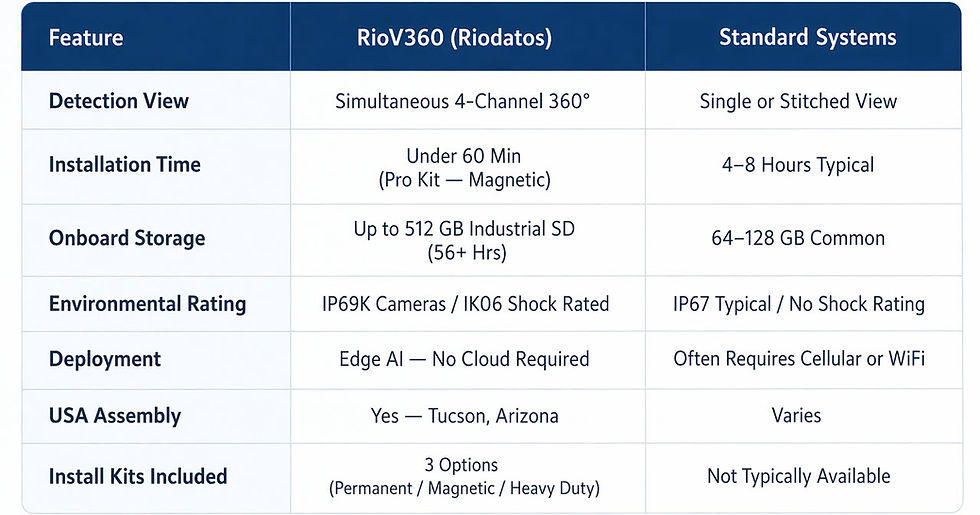
A true 360° system uses four independent cameras, front, rear, left and right, each with its own field of view and its own AI processing channel. Each camera monitors its assigned zone independently. An alert from the rear camera is a rear-zone detection. An alert from the left camera is a left-zone detection. The operator knows where the risk is without looking at a stitched panoramic image and trying to locate a small indicator on a wide display.
Stitched systems, where multiple camera feeds are combined into a single bird's-eye view, have their place for situational awareness and maneuvering. For pedestrian detection alerts, they introduce processing complexity that works against the operator in the moment that matters.
Edge AI Processing: No Cloud, No Cellular, No Latency Risk
Detection happens on the monitor unit itself. There is no data being sent to a server, no cellular connection required, no subscription to maintain, and no exposure to the connectivity gaps that are routine on construction sites, underground mines, and remote industrial locations.
This matters operationally in two ways. First, detection response is immediate, the processing is local. Second, the system continues to function in areas where a cloud-dependent system would go dark. A tunnel, a basement pour, a remote site without reliable signal coverage — these are exactly the environments where struck-by risk is highest and where a cellular-dependent system is least reliable.
Low-Light and Adverse Condition Performance
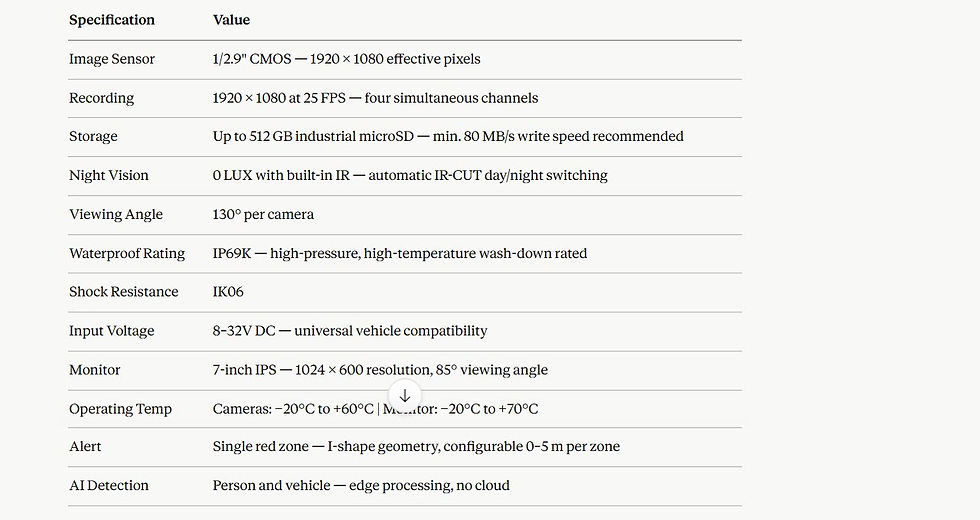
IR-equipped cameras with automatic day/night switching and 0 LUX capability in infrared mode address one of the most consistent risk factors across industrial environments: reduced visibility conditions. Early morning starts, interior operations, dust, rain, and twilight all degrade human visibility before they degrade a properly calibrated camera system.
"The incidents that keep safety directors up at night are the ones nobody saw coming. Low light. A worker coming around the corner of a rack. A reversing loader in a dust cloud. These are exactly the conditions where a camera-based system outperforms a tag."
IP69K waterproofing, rated for high-pressure, high-temperature wash-down, and IK06 shock resistance mean the cameras continue functioning in conditions that eliminate most commercial-grade hardware. Pressure washing. Vibration from rough terrain. Temperature swings from pre-dawn cold to midday heat on an exposed site.

How RioV360 Compares: Key Specifications
Solving the Rental Fleet and Leased Equipment Problem
The Drilling Problem on Non-Owned Equipment
Fleet managers operating leased or rented equipment face a constraint rarely acknowledged in safety technology discussions: they often cannot drill, modify, or permanently alter the vehicle without voiding the warranty or violating the lease agreement. This rules out permanent mounting for a significant portion of the Yellow Iron market.
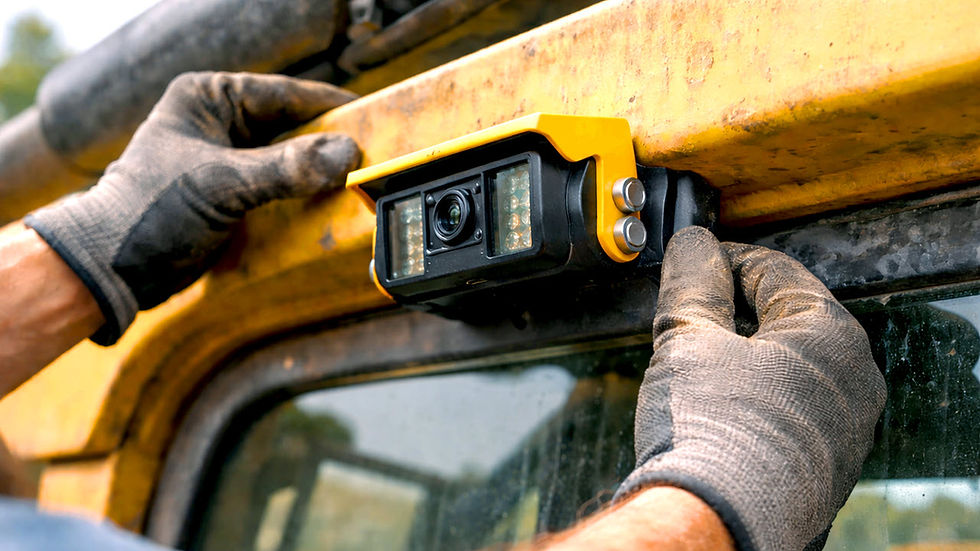
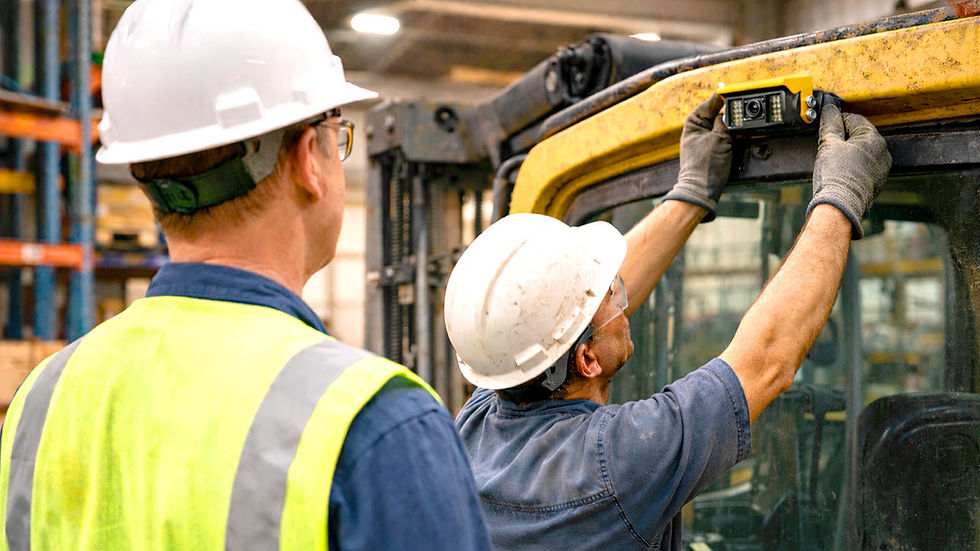
Neodymium magnetic mounting systems, rated at 240 lbs of pull force per magnet assembly, address this directly. Cameras mount to the vehicle's steel structure without drilling. The system can be installed, verified, and operating within the same shift the equipment arrives on site. When the lease ends, the system comes off cleanly. No holes. No warranty dispute. No modification record.
360° AI Vision Systems for Heavy Equipment on Rental Fleets
This is where the Professional Installation Kit. Magnetic becomes particularly relevant. All mounting components, wiring supplies, cable management items, and extension cables needed for a complete four-camera magnetic installation are pre-sorted into labeled bags that align with the installation manual, section by section. An experienced installer working from the kit can complete a full installation in under two hours on most machines. For a rental fleet running high equipment turnover, that changes the economics of deploying safety technology across the whole fleet rather than selectively on owned assets.
The important caveat with magnetic mounting is that the target surface must be ferrous steel. Aluminum structures, fiberglass hoods, heavily painted surfaces, and rubber-coated areas significantly reduce holding force. Testing the target surface before committing to a mounting position is required, not optional.
Why IP69K and IK06 Ratings Matter for Construction and Mining
Technical ratings like IP69K and IK06 appear on specification sheets without much explanation. For equipment operating in construction, mining, and heavy civil work, understanding what those ratings actually mean is relevant to the purchase decision.
IP69K is the highest ingress protection rating in the IEC 60529 standard.
It means the housing withstands direct high-pressure water spray at close range and high temperature, the wash-down conditions used on construction equipment and mining machinery after a shift. IP67, a common rating on commercial cameras, means submersion tolerance but not pressure wash tolerance. Equipment that gets hosed down with a pressure washer at the end of a shift needs to be rated IP69K, not IP67.
IK06 is an impact resistance rating under IEC 62262. It means the housing withstands a defined impact load relevant to equipment that experiences vibration, rock strikes, and contact with materials. A camera housing rated IK06 is not going to lose its seal or crack its lens mount because the machine is running on rough ground all day.
For safety technology expected to function under the same conditions that destroy commercial hardware, these ratings are not marketing language. They are the minimum specifications for the environment.
The Recording Advantage: 1080p Incident Documentation Across All Four Channels
Most camera systems on heavy equipment record either no footage at all, or record only the primary reverse camera at reduced resolution. The operational consequence of this shows up after an incident, when there is limited or no video evidence of what happened, from which direction it occurred, and what the operator's view actually was.
Simultaneous 1080p recording at 25 FPS across all four channels, stored locally on an industrial-grade microSD card, produces a complete incident record from every camera angle. When a claim is filed, when OSHA arrives on site, and when a post-incident review is conducted, the footage exists. All of it. From the front, rear, left, and right simultaneously.
At 512 GB of storage capacity, that represents a substantial rolling window of recorded footage — enough to cover extended operating periods before the oldest footage begins to cycle. The card specification matters: a minimum write speed of 80 MB/s is recommended to sustain four simultaneous 1080p channels without dropped frames or write errors.
"The recording capability is often what closes the conversation with a fleet manager. They've been through an incident without footage. They know exactly what that costs."

RioV360 Quick Specifications
Author Perspective
I spent thirty years in machine control and industrial safety technology before founding Riodatos. A significant part of that time was spent in conversations with fleet managers and EHS directors who were trying to close the gap between what their safety program required on paper and what was actually functioning on the equipment in the yard.
The pattern I saw repeatedly was this: organizations would deploy a safety technology, verify it was installed, and then, usually after an incident, discover that the system had stopped functioning reliably weeks or months earlier. Tag battery dead. Camera view blocked by a modified bumper. Alert threshold set so sensitive it was triggering constantly and had been silenced by the operator. The technology was present. It wasn't working.
What drives my approach at Riodatos is that question — not whether a system passes a demonstration, but whether it will still be functioning correctly six months after installation under real operating conditions. More background on that at johnbuttery.com.
The move toward vision-based AI detection for heavy equipment is, in my view, structurally correct. Not because it is newer technology, but because it removes the most fragile dependency in the system: the requirement that every worker, every shift, without exception, wear a functioning device. That is a dependency that construction and mining environments cannot reliably maintain at scale.
Why This Matters Now for EHS and Operations Leadership
The regulatory and liability environment around struck-by incidents in construction and mining has tightened in the past two years. OSHA enforcement of struck-by fatalities, which consistently rank among the top four causes of construction fatalities, has increased in both frequency and citation severity. Insurance carriers writing general liability and workers' compensation for heavy construction and mining operations are increasingly asking specific questions about pedestrian detection technology during underwriting and renewal.
The organizations getting ahead of this are not waiting for an incident. They are treating the absence of machine-mounted detection technology on Yellow Iron as a measurable exposure, something that shows up in a risk assessment rather than an accident report.
The shift from lagging to leading indicators in safety management is well established. Vision-based AI detection is one of the clearest practical examples of what leading indicator management looks like at the equipment level: the system continuously measures pedestrian-proximity events, whether or not they result in contact. That data on how often, which zones, which machines and which times of day is the exposure picture that traditional incident reporting cannot provide.
How Riodatos Approaches Deployment
The standard recommendation for organizations evaluating 360° AI vision systems for heavy equipment is to perform single-machine validation before committing to a fleet-wide deployment. Install on one vehicle. Run it under live operating conditions for thirty to sixty days. Measure performance against your actual site conditions, shift patterns, pedestrian traffic density, lighting, dust, vibration profile and operator response.
What that process typically surfaces is site-specific configuration requirements that no demonstration or specification sheet can predict. Detection zone geometry that works in a warehouse may need to be adjusted for an outdoor loading area. Mounting positions that clear the load on a forklift may need to be modified for a telehandler with a different mast geometry.
The Professional Installation Kits, available in Permanent, Magnetic, and Heavy Duty configurations, are designed to support that single-machine validation without requiring a specialized installer or multi-day commitment. Each kit contains all mounting components, wiring supplies, and cable management items needed for a complete installation, pre-sorted into labeled bags aligned with the installation manual.
Validate one machine before you scale. Start at riodatos.com/pricing, explore the full product range at riodatos.com/products, or schedule a direct conversation at calendly.com/john-buttery-riodatos/30min.
Conclusion
The case for 360° AI vision systems on heavy equipment is not primarily a technology argument. It is an operational argument. The systems that will still be functioning and generating reliable alerts eighteen months after installation are the ones that do not depend on consistent human behavior to remain active.
What the industry is learning, site by site, is that the exposure was always there. The struck-by risk existed before any technology was deployed. What changes with machine-mounted vision AI is not the risk itself, but the visibility of it; the ability to see, measure, and respond to pedestrian-proximity events in real time, under real-world conditions, on the machines that are actually operating.
"The goal was never to add technology. The goal was to close the gap between what the safety program assumed was happening and what was actually happening on the floor."
About Riodatos
Riodatos is a U.S.-based industrial safety technology company headquartered in Tucson, Arizona, specializing in AI-powered pedestrian and vehicle detection systems for heavy equipment in construction, mining, warehousing, and logistics operations across the Americas.
Riodatos is the manufacturer of the RioV360, including supplies, configurations, installations, and support for pedestrian detection and proximity systems tailored to site-specific equipment, traffic patterns, and operational risk profiles. With domestic inventory, direct U.S. pricing, and English and Spanish support, Riodatos helps safety teams deploy protection that performs under real conditions rather than demonstration conditions, and scale it across mixed fleets and multi-site operations without overseas delays or mismatched technology. Learn more at riodatos.com or contact the team directly.


