
Pedestrian Detection for Mixed Fleets
- John Buttery

- Apr 15
- 9 min read

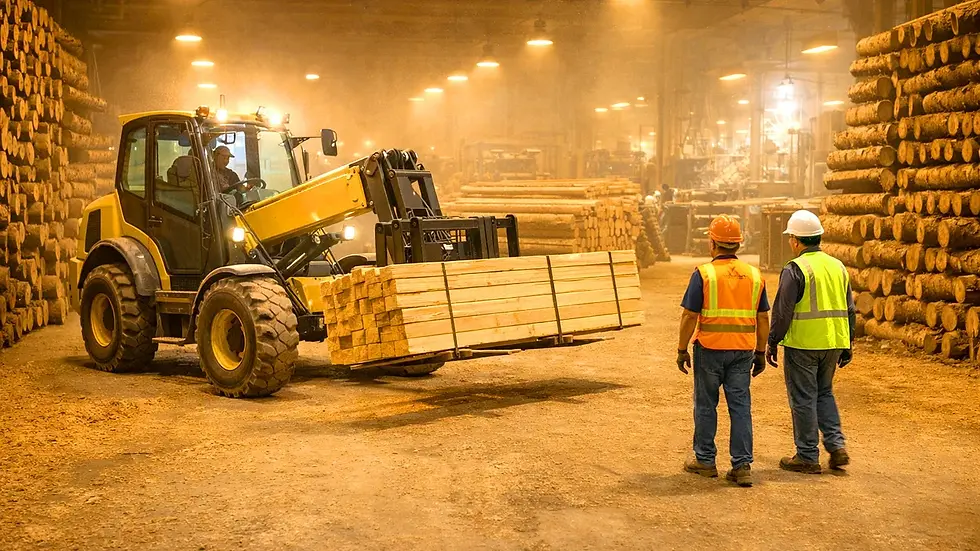
Walk into a sawmill, a pulp facility, or a plywood plant, and the hazard picture looks nothing like a standard forklift safety conversation. There are wheel loaders, rough-terrain forklifts, telehandlers, pickup trucks, skid steers, and utility vehicles all moving through the same yard on the same shifts, sharing the same pedestrian corridors.
The forklift may be the most studied machine in industrial safety, but in large processing operations, it's one of 20 vehicle types that create exposure every day.
That diversity fundamentally changes the detection problem. A system purpose-built for a managed forklift fleet, one that integrates at the manufacturer level and depends on a relatively uniform vehicle population, starts to fracture the moment you try to apply it across a mixed operation.
You end up with partial coverage, multiple vendor relationships, and gaps wherever the unusual equipment falls outside the defined scope.
Pedestrian detection for mixed fleets is a different engineering and operational challenge than single-platform fleet safety. It requires a system that genuinely doesn't care what it's mounted on — one that installs consistently, behaves consistently, and builds a safety picture across the entire vehicle population, not just the machines that fit neatly into a vendor's product design.
Pedestrian Detection for Mixed Fleets in Large Processing Operations
The Vehicle Population Is Never Uniform
A large sawmill doesn't have a forklift fleet. It has a vehicle census. A single facility might run counterbalance forklifts, rough terrain forklifts, wheel loaders, telehandlers, skid steers, tractors, golf carts, pickup trucks, and service vehicles. All in continuous operation across shared pedestrian zones.
Each machine type has a different cab configuration, power source, sight lines, and movement pattern. Some operate on defined haul roads. Many don't. Hazard exposure is not evenly distributed across machine types, and it doesn't align with the categories most detection products were designed around.
In most operations, the incident log reflects a small fraction of actual exposure.
The near-misses that get reported are the ones that were witnessed or felt serious enough to document. The rest disappear into the shift without a record, the close passes, the late brakes, the pedestrian who stepped back just in time.
Why Single-Platform Solutions Break Down at Scale
The telematics and detection vendors that have built strong products for managed forklift fleets have done so by integrating at the machine level. That integration path works well in a distribution center running a single brand of counterbalance trucks. It depends on known variables, a reasonably uniform vehicle population, and an integration pathway supported by the manufacturer.
Apply that model to a mixed operation running equipment from eight different manufacturers across four decades of production, and the approach fractures. Multiple systems. Multiple vendor relationships. Per-machine licensing that compounds across a 100-vehicle fleet. And still, the older loader, the utility cart, the tractor on loan from the yard crew.
"When you look at a facility like this, you stop thinking about pedestrian detection by machine type and start thinking about it by zone and movement pattern. The machine is almost secondary."
The operational safety team ends up with partial coverage presented as a complete solution. That gap between what the system covers and what the fleet actually includes is where unmonitored exposure accumulates.
What Brand-Agnostic Detection Actually Requires
Pedestrian detection for mixed fleets that works at scale has a short list of practical requirements. Power input range wide enough to handle both 12V light vehicles and 24–48V industrial equipment. Camera and monitor mounting that adapts to different cab configurations without custom fabrication per machine type. Alert logic that behaves the same way regardless of what's underneath it, so operators across different machines develop consistent reflexes.
Installation complexity is a real cost driver at scale. If every machine type requires a different procedure, a different harness, a different configuration file, the per-unit cost climbs fast and deployment consistency suffers. Standardization across the fleet is what makes large-scale, multi-site deployment practical, and what makes ongoing maintenance manageable.
The Black Box Case for Fleet-Wide Recording
There is a second value layer in fleet-wide detection that rarely surfaces in initial evaluations: continuous incident video across every machine.
A system running four cameras with onboard recording, no cloud dependency, no WiFi required, functions as a black box for every vehicle it covers. If something happens in the yard, the footage exists. Timestamped, from multiple angles, on an SD card reviewable on any laptop within minutes of an incident.
In a large processing operation with 80 or 100 vehicles moving through shared pedestrian zones, that documentation capability changes the liability and investigation picture entirely. You don't reconstruct what happened from witness accounts. You watch it.
"The footage doesn't just support the investigation. In most cases, it closes it. You go from a week of uncertainty to a clear answer in twenty minutes."
This is a particularly strong argument for mixed fleet operations, where the vehicle involved in an incident may be an unusual machine type that would otherwise be difficult to reconstruct. The camera doesn't know what it's mounted on. It just records.

Near-Miss Visibility Across the Full Fleet
What organizations consistently discover when they deploy cameras across a mixed vehicle population is that their exposure picture was significantly incomplete. Activations occur at intersections that weren't on the hazard map. Certain machine types, or certain operators, generate a disproportionate share of close-proximity events. Shift patterns emerge that weren't visible in incident logs.
None of that information was hidden. It was happening every day. It simply wasn't being captured.
What we see across facilities with diverse vehicle populations is that the gap between the documented hazard map and the actual activation map is larger than most safety teams expect. The locations management flagged as high-risk are often not where the camera data concentrates. The real exposure points are where informal traffic patterns have developed outside the defined lanes, and those patterns remain invisible until the cameras run continuously.
A camera-based detection system running fleet-wide changes the measurement baseline. Every activation is logged. Every close-proximity event is timestamped. Over weeks and months, a real picture of exposure frequency develops, one that reflects actual conditions rather than reported incidents.
Explore how ProxiCam AI pedestrian detection delivers fleet-wide activation logging and continuous onboard recording for mixed vehicle populations.

The Cost Equation When the Fleet Has 100 Machines
Pedestrian detection across a 100-vehicle mixed fleet is a fundamentally different financial conversation than a 20-unit forklift installation. Per-unit economics matter in a way they simply don't when piloting two or three machines.
Systems that require subscription fees, cloud connectivity, or per-machine licensing create ongoing cost structures that compound at scale. A fleet of 80 vehicles paying a monthly per-unit fee looks very different on a three-year total cost basis than the same fleet running a hardware-only solution with no recurring charges.
The second cost variable is installation. Hardware that adapts to multiple vehicle types without specialized integration work reduces both initial deployment cost and ongoing maintenance complexity. When a machine is replaced or a new type is added to the fleet, the same system installs the same way. That consistency has real financial value when you're managing a vehicle population, not a uniform fleet.

What Deployment Data Shows Across Large Processing Sites
Across facilities with diverse vehicle populations, processing plants, large construction sites, ports and rail yards. few patterns appear consistently.
The highest-risk zones are rarely where site management assumed. The hazard map built from incident history points to one set of intersections. The camera activation data points to a different set. The gap between the two is where unreported exposure has been accumulating, often for years.
Equipment type matters far less than movement pattern. A slow-moving utility cart in a high-pedestrian-density zone generates more activation events than a fast loader on a dedicated haul road. Risk depends on behavior and traffic geometry, not onmachine category. That insight is only available when the cameras are running across the whole fleet.
The value of fleet-wide documentation compounds over time. The first month of footage is informative. Six months of footage across the full vehicle population is a fundamentally different operational intelligence resource, one that supports operator coaching, procedure review, contractor accountability, and liability defense simultaneously.
For operations that also need fixed-point monitoring at high-risk intersections and yard entries, Inviol fixed CCTV safety analytics provides site-wide AI detection that complements vehicle-mounted systems.
Author Perspective
I've walked through processing facilities with vehicle populations that would surprise most safety technology vendors. Not a forklift fleet. A vehicle census. Loaders, telehandlers, rough terrain forklifts, standard counterbalance forklifts, golf carts, pickup trucks and farm tractors pressed into service. Each one moving through shared space with people on foot, on every shift.
The question those operations are asking isn't which detection system works best for a single-machine class. It's what can actually cover the whole fleet without creating five parallel systems, five vendor relationships, and gaps everywhere the unusual equipment falls through. That's the harder question, and it doesn't get asked enough in the pedestrian detection conversation. More of my thinking on these topics is at johnbuttery.com.
"The facilities with the most complex vehicle populations are often the ones who've been told their situation is too complicated to solve cleanly. It rarely is."
Why This Matters Now for EHS and Operations Teams
The shift in how safety performance is measured, from lagging indicators like incident rates toward leading indicators like exposure frequency, near-miss visibility, and activation patterns, puts a new premium on continuous, fleet-wide data. A system covering a single machine type or a manufacturer's equipment line cannot produce that picture.
Pedestrian detection for mixed fleets isn't a niche requirement. It's the actual condition at a large share of industrial facilities. Operations that recognize this and build fleet-wide coverage are constructing a safety intelligence foundation that incident-log-based programs cannot match. The question isn't whether the exposure is happening. It's whether it's being captured.
Read more about evaluating detection systems in live conditions before scaling or explore our full range of pedestrian and proximity detection products.
Call to Action
If your facility runs more than two or three vehicle types and pedestrian protection is under evaluation, start with a single-machine assessment in live conditions — your actual yard, your actual traffic, your actual operators. That's where a real performance picture develops, not in a controlled demonstration environment.
Contact the Riodatos team to discuss how fleet-wide pedestrian detection works in practice across mixed vehicle populations: riodatos.com/contact.
If you'd prefer a direct conversation first, book 30 minutes here. No sales process — just a practical discussion about your operation and what coverage actually requires.
Begin the evaluation process at riodatos.com/validate-one-forklift.
When evaluating any vendor for fleet-wide coverage, the most direct question to ask is this: Does your system install the same way on every machine type in your yard? The answer tells you whether the product was designed for your situation or for someone else's.
Conclusion
Large processing operations, sawmills, plywood plants, pulp facilitiesand ports have a pedestrian safety challenge thatthe standard forklift-focused detection market doesn't fully address. The vehicle population is too diverse, the brands too mixed, the machine types too varied for single-platform solutions to cover the exposure that actually exists.
Pedestrian detection for mixed fleets works at scale when it installs consistently across machine types, records continuously, and builds an exposure picture that reflects real operating conditions — not just the incidents that made it into the log. That's a different product requirement than what most of the market is designed around. It also happens to be the requirement that matches what large mixed-fleet operations are actually dealing with.
"The facilities that solve this well don't treat it as a forklift problem. They treat it as a fleet problem. That shift in framing changes everything about the solution."
About Riodatos
Riodatos is a U.S.-based industrial safety technology company headquartered in Arizona, with domestic inventory and direct operational support across the Americas. We are an authorized distributor for Proxicam AI pedestrian detection, ZoneSafe proximity warning systems, and inviol fixed CCTV safety analytics and manufacturer of the RioV360 — a 360° AI pedestrian and vehicle detection system assembled in the USA.
We sell, configure, install, and support solutions tailored to site-specific equipment populations, traffic patterns, and operational risk profiles across warehouses, factories, construction sites, processing facilities, and logistics operations throughout the Americas.
Our focus is measurable live performance, operator adoption, and scalable deployment across mixed fleets and multi-site operations. Direct pricing, fast U.S. shipping, certified installation, and English and Spanish support allow safety teams to move from evaluation to protection without unnecessary delays.


