
Inviol CCTV AI Safety Analytics for Industrial Facilities
- John Buttery

- Mar 25
- 9 min read

How fixed-camera AI intelligence turns dormant camera infrastructure into site-wide exposure data your EHS program can actually use
Most industrial facilities have more cameras than they have answers. The cameras are mounted above dock doors, along racking aisles, and near entry points. Sometimes dozens of them, covering nearly every corner of a site. And in most operations, almost all of that footage goes unwatched until something goes wrong.
The footage contains information that no training program or audit schedule can replicate: what actually happens between people and equipment, on every shift, in every zone, thousands of times before anything gets recorded as an incident. The problem isn't that the cameras aren't running. It's that the footage isn't being read.
Inviol CCTV AI safety analytics for industrial facilities changes that equation. It layers an AI detection engine directly onto existing camera infrastructure, no rip-and-replace required, and converts passive video recording into structured, measurable exposure intelligence that EHS teams can act on in real time and over time.
What Inviol CCTV AI Safety Analytics for Industrial Facilities Actually Does
The distinction that matters most isn't about camera hardware. It's about what happens after the image is captured. Standard CCTV records. Inviol interprets, classifies behavior, flags exposures, tracks zone-level patterns, and feeds structured data into reports that EHS managers and operations leaders can use to make decisions.
"The value isn't in the footage itself. It's in what the system understands about what it's seeing—and how consistently it sees it."
Inviol is a fixed CCTV AI platform built specifically for site-wide industrial safety analysis. It connects to existing camera feeds and applies AI detection across the full facility footprint, identifying pedestrian-vehicle interactions, zone compliance behavior, speed patterns, and PPE presence at monitored positions, not just near a single machine or in a single area.
Fixed-Camera Intelligence vs. Vehicle-Mounted Detection
It's worth being clear about what Inviol is and isn't designed to do. A vehicle-mounted system like Proxicam, a stereo-vision AI detection camera for forklifts, operates from the machine's perspective—generating real-time in-cab alerts when pedestrians enter the machine's danger zone. That's a proximity and collision-avoidance capability built for the operator in the moment.
Inviol operates at a different layer. It sees the facility as a whole and tracks behavior across zones over time. These are not competing approaches. In most of the facilities we work with, they're complementary: the vehicle-mounted layer handles the immediate machine-level alert, and the fixed AI layer gives EHS and operations management the site-wide behavioral picture they need to understand where risk is accumulating and whether interventions are working.
What Inviol Detects Across Your Facility
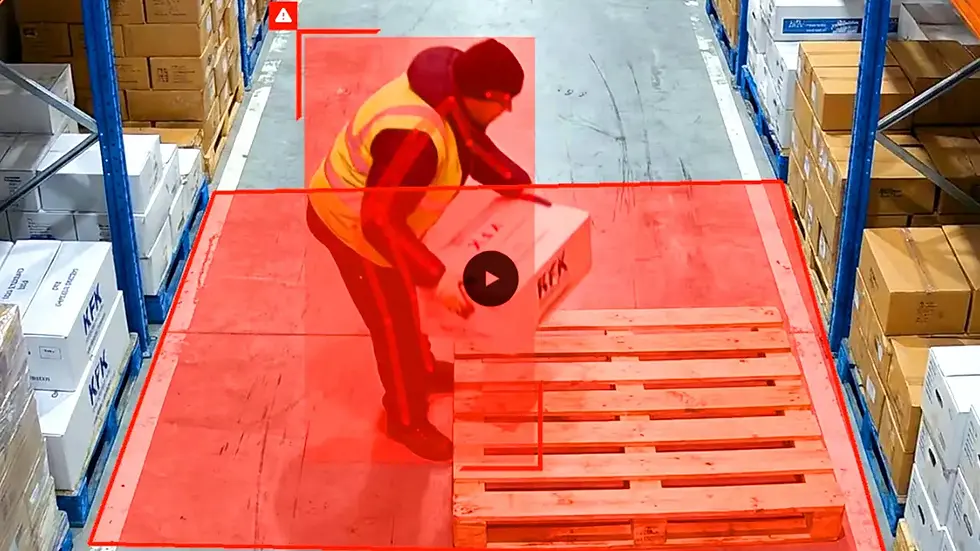
Across industrial environments where Inviol is deployed, detection capabilities consistently target the behaviors that generate the highest pedestrian-vehicle exposure:
Pedestrians entering or crossing active forklift traffic lanes without authorization
Vehicles exceeding posted speed limits in zones where pedestrians are present
Absence of required PPE at monitored entry points or work positions
Pedestrian congregation in high-risk areas during active equipment movement
Compliance with designated walkways near loading, unloading, and staging zones
What makes Inviol CCTV AI safety analytics for industrial facilities operationally valuable isn't just that it detects these events. It's that it detects them consistently, across every shift, without the attention fatigue that limits what human-monitored feeds can realistically catch.
The Exposure Problem That Recording Alone Cannot Solve
Most industrial operations don't have an incidental problem. They have an exposure problem. Incidents are rare by definition. Exposures—moments where the conditions for an incident are present—happen dozens or hundreds of times per shift, and almost none of them appear in any data unless someone was injured.
Standard CCTV captures every one of those moments. Without AI analytics layered on top, they remain invisible. There's no count. No zone-level frequency. No pattern across shifts. No comparison between sites. The footage exists, but the information it contains never becomes actionable.
"You can walk a facility for twenty years and still not know how many times per day someone nearly got hurt in a place nobody was watching."
Organizations that implement Inviol typically discover that their highest-risk interactions aren't occurring where they assumed. The blind corner near the staging area may be generating twice as many pedestrian-vehicle interactions as the main aisle, but because nothing was measured there, it wasn't prioritized.
That's not a failure of observation. It's a structural limitation of reactive safety programs that lack visibility into incidents.
From Lagging Metrics to Leading Indicators
Injuries and near misses are lagging indicators. They tell you what already happened. Exposure frequency, zone-level behavior patterns, and pedestrian-vehicle interaction counts are leading indicators—they tell you where risk is accumulating before it materializes into something that gets counted.
inviol CCTV AI safety analytics for industrial facilities makes that shift operationally possible. When EHS teams can show operations management a heat map of pedestrian-vehicle interaction frequency, or a chart showing which shift generates the most non-compliant zone entries, the safety conversation moves from anecdote to evidence. That changes how resources are allocated, how retraining is targeted, and how facility layout changes are justified to leadership.
For EHS professionals managing multiple warehouses or distribution sites, the ability to compare site-level behavioral performance using consistent metrics, not just incident counts, becomes indispensable once it's available. The Riodatos services page covers how we approach site assessment and system configuration with each client as part of that process.

Deploying Inviol: Working with Existing Camera Infrastructure
One of the most practical questions EHS and operations managers ask when evaluating this category is whether existing cameras need to be replaced. In most cases, the answer is no.
Inviol is designed to connect to existing CCTV infrastructure. The platform processes live video feeds through its AI detection engine without requiring cameras to be swapped out. A facility with 30 cameras already installed doesn't face a hardware replacement cost—it faces a configuration and calibration project, which is meaningfully different in scope and in capital commitment.
Zone Definition and Site-Specific Policy Configuration
Every warehouse runs differently. Loading zones, pedestrian walkways, forklift corridors, and staging areas vary by facility design, shift structure, and product type. inviol's configuration process maps the AI detection layer to the site's actual operational layout, defining which areas are designated pedestrian-only, which are shared-use during certain hours, and which require specific PPE. Those definitions drive what gets flagged, what gets reported, and what thresholds trigger alerts or coaching workflows.
This is where the site-specific integration work matters. A correctly configured Inviol deployment reflects your operational policies, not a generic safety template. That alignment is what determines whether the system generates useful data or just noise.
From Detection to Evidence-Based Coaching
Detection without follow-through has limited operational value. What makes Inviol CCTV AI safety analytics for industrial facilities meaningful is what happens after an event is identified. In a well-implemented deployment, flagged events feed into a structured coaching workflow. Supervisors receive event data, video clips, and behavioral context that enable a specific, evidence-grounded conversation with the worker involved.
That's fundamentally different from a general safety briefing or a reactive post-incident review. It's a targeted intervention at the behavior level, tied to what actually happened, with footage to support it.
"Coaching that comes from evidence, not from someone's memory of what they think they saw, lands differently. It's harder to dismiss."

Author Perspective
I've spent more than thirty years working across technology and industrial safety. First building and scaling a technology company, later working directly with major forklift safety technology manufacturers, and now running Riodatos as an independent distributor and systems integrator. Across all of that, one pattern has stayed consistent: the facilities with the best safety outcomes aren't necessarily the ones with the most rules. They're the ones that can see what's happening.
Visibility is the foundation. Without it, every intervention, training, signage, audit, equipment upgrade, operates on assumptions about risk that may or may not match reality. Inviol CCTV AI safety analytics for industrial facilities is one of the most direct tools available right now for replacing those assumptions with actual data.
I find it particularly compelling that fixed-camera AI complements the vehicle-mounted detection layer so cleanly. Inviol shows the EHS manager where interactions occur most frequently, which zones generate the most exposure, and whether behavioral patterns are improving or deteriorating over time. Those are answerable questions. I've written more about this at johnbuttery.com and in greater depth on LinkedIn for those who want additional context on the thinking behind the work we do.
Why This Matters Now for EHS and Operations Leaders
The operational and regulatory pressure on industrial safety programs has not eased. OSHA enforcement, workers' compensation costs, and the competitive cost of downtime from incidents continue to push safety investment up the priority list. At the same time, the workforce dynamics in many facilities, high turnover, mixed experience levels, and multilingual teams make training-only approaches increasingly difficult to sustain at scale.
This is the environment in which Inviol CCTV AI safety analytics for industrial facilities becomes genuinely strategic rather than just tactical. When exposure frequency is measured continuously, you can identify where training is working and where it isn't. When zone-level behavior is tracked across shifts, you can target supervisor coaching where it will have the highest impact. When you can show a measurable reduction in high-risk pedestrian-vehicle interactions over a quarter, you have something concrete to bring to leadership.
What we're seeing across facilities is a shift in how EHS professionals understand their role. The tools now exist to move from reactive safety management—responding to incidents and near misses—to proactive exposure management: knowing where risk accumulates and intervening before it results in harm. That shift is worth pursuing. More resources are available on the Riodatos blog, including articles on how to evaluate detection technology before you commit and how fixed and proximity systems compare.

Four Ways to Move Forward
If you're evaluating whether Inviol CCTV AI safety analytics for industrial facilities makes sense for your operation, here are four grounded ways to engage:
1. Review your current camera coverage. Before anything else, understand what your existing CCTV infrastructure actually covers. In many facilities, gaps and blind spots are more significant than assumed. A site-level camera audit is a useful first step that requires no technological commitment.
2. Define your highest-exposure zones. If you have incident or near-miss data, use it to identify where pedestrian-vehicle interactions are most concentrated. If you don't, start with loading and unloading areas, main aisle intersections, and anywhere forklift and foot traffic regularly share space. Those are the zones most facilities identify as highest priority once they start measuring.
3. Talk through your specific site conditions. Every facility has its own configuration of equipment types, traffic patterns, shift structures, and risk profiles. The Riodatos contact page is the fastest way to have a direct conversation about what makes sense for your operation. No obligation, no sales script—just a practical exchange about your site and what the technology can realistically do.
4. Validate in live conditions before you scale. We consistently recommend evaluating technology in real operating conditions before committing to a full deployment. A single-zone or defined-area pilot lets you measure actual detection performance, system reliability, and workflow integration before expanding. You can schedule a 30-minute call to start there if that's easier, or visit our validation approach page for more on how we structure those engagements.

The Role Riodatos Plays
At Riodatos, we don't resell technology and step back. We configure, install, and support Inviol in the specific context of your facility—defining zones aligned with your operational policies, integrating with your existing camera layout, and validating that the system detects what it should before we consider the deployment complete.
We recommend starting with a pilot in live conditions, long enough to generate meaningful behavioral data. That approach reduces the risk of deploying a system that looks right on paper but doesn't perform in your specific environment.
It also gives your team time to understand how to use the data, which is often the step that determines whether a safety technology investment improves outcomes or just generates reports nobody reads. The goal we work toward with every Inviol installation is measurable change: fewer high-risk interactions in identified zones, clearer behavioral data for coaching conversations, and a safety program that operates on evidence rather than assumption.
Conclusion
The cameras are already there. In most industrial facilities, the infrastructure to support site-wide behavioral monitoring has been in place for years. It just wasn't connected to anything that could make sense of what it was seeing. Inviol CCTV AI safety analytics for industrial facilities closes that gap—converting passive recording into continuous exposure intelligence that EHS and operations leaders can act on.
What changes when that data becomes available isn't just the safety program. It's the quality of the conversation between safety, operations, and leadership. Risk stops being something discussed after incidents occur and starts being something measured, tracked, and managed before it results in harm. That's the shift worth making.
"The day you stop waiting for something to go wrong and start measuring how often things almost go wrong—that's when safety management actually becomes safety management."
About Riodatos
Riodatos is a U.S.-based distributor and systems integrator of AI-powered pedestrian detection and proximity safety systems for industrial environments, headquartered in Arizona with domestic inventory to support rapid deployment across the Americas. We are an authorized distributor for Proxicam, ZoneSafe, and Inviol—supplying, configuring, installing, and supporting each system tailored to the specific equipment types, traffic patterns, and risk profiles of each client's site.
Our work spans warehouses, distribution centers, manufacturing facilities, cold storage, construction environments, and logistics operations across the Americas, with a consistent focus on measurable real-world performance, operator adoption, and scalable deployment across mixed fleets and multi-site operations.
Direct pricing, fast U.S. shipping, certified installation, and English/Spanish support allow safety teams to prioritize protection without navigating overseas delays or mismatched technology. We're doers, not consultants—and we stand behind what we install.


