AI Industrial Predictive Maintenance - The Future of Equipment Reliability
- John Buttery

- Mar 5
- 6 min read

Introduction
How AI industrial predictive maintenance is transforming reliability engineering, reducing downtime, and giving industrial organizations visibility into machine behavior.
In industrial operations, equipment reliability is the backbone of productivity. When machines run smoothly, production flows, supply chains remain stable, and maintenance teams can focus on optimization rather than emergency repairs. But when critical equipment fails unexpectedly, the consequences ripple quickly across the operation.
A single machine failure can halt production lines, create costly repairs, and expose workers to hazardous conditions. For decades, most organizations attempted to manage this risk through reactive or preventive maintenance. Machines were either repaired after they broke down or serviced on a fixed schedule, either by time or by usage.
Today, both approaches are proving insufficient for the complexity of modern industrial environments.
AI industrial predictive maintenance introduces a new operating model. Instead of waiting for failures or performing maintenance based on assumptions, organizations can continuously monitor equipment and identify early signs of deterioration before a breakdown occurs. Sensors, machine learning algorithms, and industrial connectivity combine to reveal previously invisible patterns in machine behavior.
This shift represents more than a technology upgrade. It reflects a broader transformation in how industrial operations understand reliability, risk, and machine performance.
“Most equipment failures are not sudden events. They are the final stage of a long chain of detectable signals.”
What AI Industrial Predictive Maintenance Actually Means
AI industrial predictive maintenance refers to a maintenance strategy that uses artificial intelligence, sensor data, and advanced analytics to detect early signs of equipment deterioration and predict potential failures.
Instead of relying on fixed maintenance schedules, predictive systems evaluate the actual operating condition of machines. Sensors collect continuous data about vibration patterns, temperature changes, acoustic signals, electrical currents, and rotational behavior. Machine learning models analyze these signals and compare them to known patterns associated with mechanical wear or failure.
When abnormal behavior appears, the system generates alerts that allow maintenance teams to investigate and intervene before equipment reaches a critical failure state.
In practical terms, AI industrial predictive maintenance shifts maintenance operations from reactive firefighting toward data-driven reliability engineering.
Organizations gain the ability to observe how machines behave over time, identify emerging risks, and plan maintenance activities based on real equipment conditions rather than estimates.
The Technology Stack Behind AI Industrial Predictive Maintenance
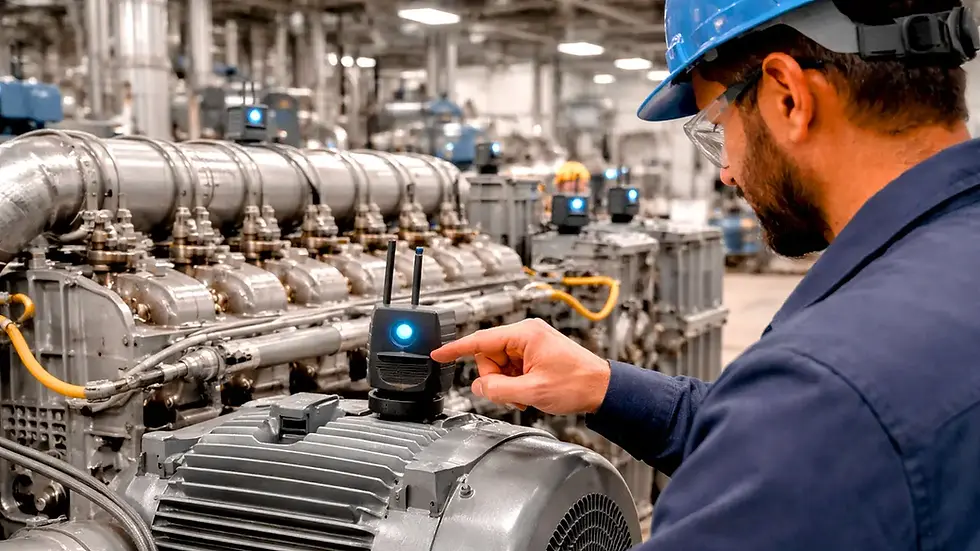
AI-driven industrial predictive maintenance relies on several interconnected technologies that work together to capture, analyze, and interpret machine behavior.
Condition Monitoring Sensors
Sensors provide the raw data that predictive maintenance systems rely on. Installed directly on equipment, they capture key indicators of machine health, including vibration patterns, acoustic emissions, temperature fluctuations, magnetic flux signals, and electrical current behavior.
These signals represent the physical state of mechanical components such as bearings, shafts, gears, and lubrication systems.
Modern wireless sensor networks have made large-scale monitoring possible by reducing installation complexity. Instead of installing complex wiring systems across facilities, sensors can be attached directly to machines and transmit data wirelessly to monitoring platforms.
Industrial IoT Connectivity
Once sensors collect machine data, it must be transmitted and aggregated. Industrial IoT networks provide the communication infrastructure that connects equipment to analytics platforms.
Edge gateways inside the facility collect data from sensors and transmit it to centralized monitoring systems. These gateways can also perform initial processing, enabling faster analysis and reducing the amount of data that must be transmitted to cloud systems.
The result is a scalable monitoring architecture capable of observing hundreds or thousands of machines simultaneously.
AI and Machine Learning Analytics
Artificial intelligence provides the analytical engine behind predictive maintenance systems.
Machine learning models are trained to understand normal operating behavior for different types of equipment. By analyzing historical and real-time data, these models can identify subtle deviations from expected patterns.
Over time, AI systems learn to recognize specific mechanical signatures associated with failure modes such as bearing wear, lubrication degradation, mechanical imbalance, shaft misalignment, or overheating.
This allows predictive maintenance systems to forecast potential failures days, weeks, or even months before they occur.
The Industrial Equipment Most Often Monitored
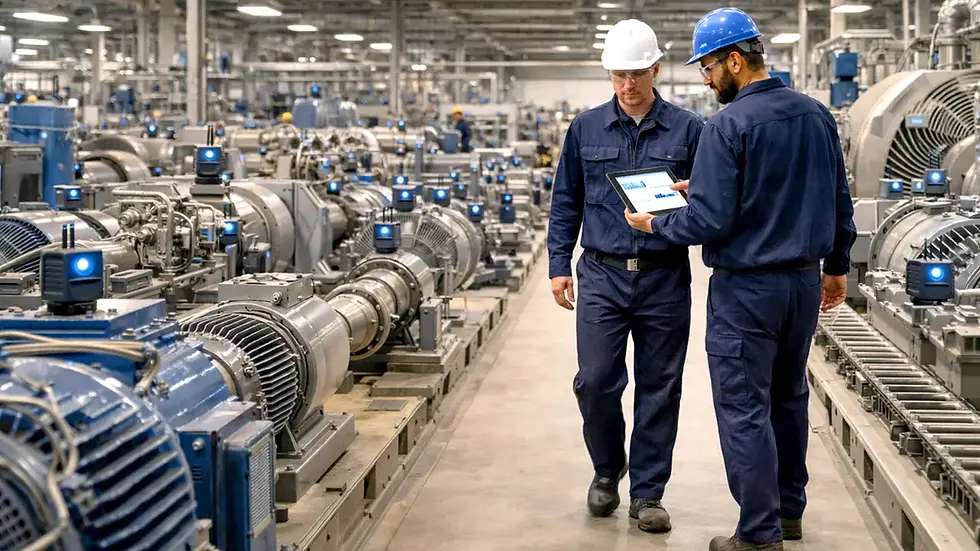
Predictive maintenance systems typically focus on equipment where failure carries the highest operational cost. In most industrial facilities, that means rotating machinery.
Electric motors, industrial pumps, compressors, gearboxes, turbines, industrial fans, and conveyor systems operate continuously and experience significant mechanical stress. These machines also contain components that degrade gradually under load, making them ideal candidates for condition monitoring.
Many failures originate in relatively small components such as bearings or lubrication systems. Over time, microscopic wear produces changes in vibration patterns that can be detected long before mechanical failure occurs.
AI industrial predictive maintenance systems analyze these signals continuously and identify early warning signs that maintenance teams can address before problems escalate.
“What predictive monitoring reveals is that machines rarely fail without leaving a trail of signals behind.”
Operational and Safety Benefits

Organizations implementing AI industrial predictive maintenance frequently report improvements across several operational metrics.
One of the most immediate impacts is reduced unplanned downtime. By detecting early signals of deterioration, maintenance teams can schedule repairs before equipment fails during production.
Maintenance resources also become more efficient. Instead of performing unnecessary service on healthy equipment, teams can focus on machines that actually require attention.
Predictive monitoring can also improve operational safety by identifying deterioration before catastrophic failures occur.
Across industries, reliability engineers increasingly view predictive maintenance as both a productivity tool and a risk management strategy.
Building Operational Intelligence Around AI Industrial Predictive Maintenance
As organizations adopt AI industrial predictive maintenance, many discover that predictive monitoring creates an entirely new layer of operational visibility.
Maintenance teams begin to identify patterns that were previously invisible. Vibration anomalies may appear during certain production cycles. Seasonal operating conditions may influence equipment loads. Some machines may consistently experience higher mechanical stress due to process conditions.
These insights allow organizations to shift from basic maintenance management toward broader operational intelligence.
“Once teams begin observing machine behavior continuously, they stop reacting to failures and start understanding why failures happen.”
AI Industrial Predictive Maintenance Knowledge Cluster
Organizations researching AI industrial predictive maintenance often need deeper understanding across several related topics. Building expertise in this area typically involves exploring multiple aspects of predictive monitoring technologies.
Condition Monitoring Sensors for AI Industrial Predictive Maintenance
How vibration, acoustic, and temperature sensors detect early mechanical anomalies in industrial equipment.
Industrial IoT Platforms for AI Industrial Predictive Maintenance
How edge gateways, connectivity infrastructure, and cloud analytics enable scalable machine monitoring across facilities.
AI Failure Detection Models in AI Industrial Predictive Maintenance
How machine learning algorithms analyze machine behavior and identify early failure signatures.
Together, these topics form a connected knowledge framework that supports the effective implementation of AI-based predictive maintenance programs across industrial operations.
Author Perspective
In conversations with maintenance teams across different industries, one theme appears consistently. Most organizations already know which machines are critical to their operations.
They know which motors stop production lines or which pumps create cascading problems when they fail.
What AI industrial predictive maintenance provides is visibility around those machines.
Instead of waiting for failures or relying solely on periodic inspections, teams can continuously monitor equipment behavior and detect subtle changes that indicate emerging problems.
“The biggest shift isn’t automation—it’s awareness. Once teams can see machine behavior clearly, reliability becomes something they can actively manage.”
For broader research and perspectives on industrial technology, I occasionally share insights through. https://johnbuttery.com
Where Riodatos Fits
As interest in AI industrial predictive maintenance continues to expand, many industrial organizations are evaluating monitoring platforms, analytics systems, and sensor technologies that can provide deeper insight into equipment health.
At Riodatos, we are exploring opportunities to support organizations as they evaluate and deploy advanced industrial monitoring technologies across real operational environments.
This includes working with selected technology partners and helping companies validate predictive monitoring platforms before committing to large-scale deployments.
More information about Riodatos can be found at https://www.riodatos.com
Conclusion
Industrial reliability has always depended on understanding how machines behave under real operating conditions.
AI industrial predictive maintenance makes that understanding possible at scale. By combining sensors, analytics, and machine learning, organizations can monitor equipment continuously, detect early signals of deterioration, and intervene before failures disrupt operations.
As industrial systems become more connected and data-driven, predictive maintenance is likely to become a foundational capability for reliability engineering.
“The future of maintenance isn’t reacting faster to failures. It’s preventing failures from happening at all.”
Quick Read
AI Industrial Predictive Maintenance - The Next Era of Equipment Reliability
⚠️ Equipment failures rarely happen without warning⚙️ Machines show signals long before breakdown🧠 The challenge has always been seeing those signals early enough
AI industrial predictive maintenance is changing that.
🚨 Why this matters now
• Unplanned downtime still costs the industry billions each year
• Critical rotating equipment runs continuously under heavy loads
• Traditional maintenance schedules often miss real failure signals
📊 What AI industrial predictive maintenance enables
• real-time machine health monitoring
• anomaly detection in vibration and temperature signals
• predictive forecasting of component failures
• reliability insights across thousands of industrial assets
Across industries, the shift is clear. Maintenance is moving from reactive repair → predictive intelligence.
---