
Advanced Industrial Safety Solutions for Vehicles
- John Buttery

- Feb 28
- 5 min read

Understanding how Advanced Industrial Safety Solutions reduce exposure in real working environments
Industrial vehicles keep operations moving—but they also concentrate risk in motion. In warehouses, construction sites, manufacturing plants, and logistics hubs, the real issue is not just accidents. It’s exposure: how often people and machines occupy the same space.
Advanced Industrial Safety Solutions are no longer optional add-ons. They are becoming operational intelligence tools that help EHS and operations teams move from reacting to incidents to measuring and reducing exposure in real time.
In this article, I’ll explain how these systems work in real-world conditions, what makes them effective, and how to implement them in a way that actually changes behavior—not just compliance.
Understanding Advanced Industrial Safety Solutions
Advanced Industrial Safety Solutions combine detection, alerting, intervention, and data visibility into a layered protection strategy. Modern systems do more than beep—they measure proximity, track interaction frequency, and reveal high-risk zones.
In most operations, risk clusters in predictable patterns:
Blind corners in racking aisles
Loading docks with mixed pedestrian access
Temporary traffic changes during peak shifts
Maintenance zones where routines are disrupted
“What we’re seeing across facilities is that incidents are rarely random. They follow exposure patterns that were already there.”
Detection Technologies: Seeing What Operators Can’t

Detection systems identify obstacles and pedestrians before operators can react.
Common technologies include:
Ultrasonic sensors for short-range detection in tight aisles
Radar sensors for longer-range monitoring in yards and construction zones
Infrared sensors for detecting human heat signatures
AI-based camera systems such as Proxicam (forklift-mounted, 360° detection with in-cab alerts) provide operator awareness in blind zones, while fixed AI CCTV platforms like Inviol monitor site-wide exposure patterns rather than individual vehicles.
The shift here is critical: from “Did we have a collision?” to “How often are people entering high-risk zones?”
Warning Devices: Immediate Risk Communication

Warning systems translate detection into action:
Audible alarms and directional sounders
Visual indicators and projected warning lights
In-cab alerts and seat vibrations
But effectiveness depends on context. In high-noise manufacturing, visual alerts may outperform sound. In open yards, wearable tag systems like ZoneSafe (RFID-based pedestrian detection) create clear vehicle-to-worker communication without relying on line-of-sight.
“An alert only works if people trust it. Too many false alarms, and it becomes background noise.”
Control Systems: Intervention When Reaction Isn’t Enough

Control technologies reduce reliance on human reaction:
Automatic braking
Speed governors in pedestrian-heavy zones
Steering or path-assist systems
These interventions are especially important in fatigue-prone environments—long shifts, seasonal peaks, or overnight operations.
Organizations typically discover that speed compliance improves significantly when technology reinforces posted limits. Not through enforcement—but through environmental consistency.
Operator Monitoring: Human Factors Matter

Human error remains a major factor in vehicle incidents.
Monitoring tools may include:
Fatigue detection
Distraction alerts
Behavior tracking
The goal is not surveillance—it’s early intervention. When combined with exposure data, EHS teams gain insight into patterns like:
Near-miss frequency per shift
High-risk zones by time of day
Repeated interaction hotspots
This is where advanced industrial safety solutions become leading indicators instead of lagging reports.
The 5 Point Framework Within Advanced Industrial Safety Solutions
A structured 5-point approach strengthens implementation:
Operator Training – Practical system usage, not just policy review
Vehicle Maintenance – Ensuring sensors and alerts remain functional
Workplace Design – Separating pedestrian and vehicle flow
Safety Technology Integration – Layered systems working together
Safety Culture and Compliance – Reinforcing safe behaviors daily
Technology alone does not create safety. It amplifies disciplined systems.
“In most operations, the breakthrough isn’t the hardware. It’s finally seeing risk clearly enough to change it.”
Practical Implementation in Real Conditions
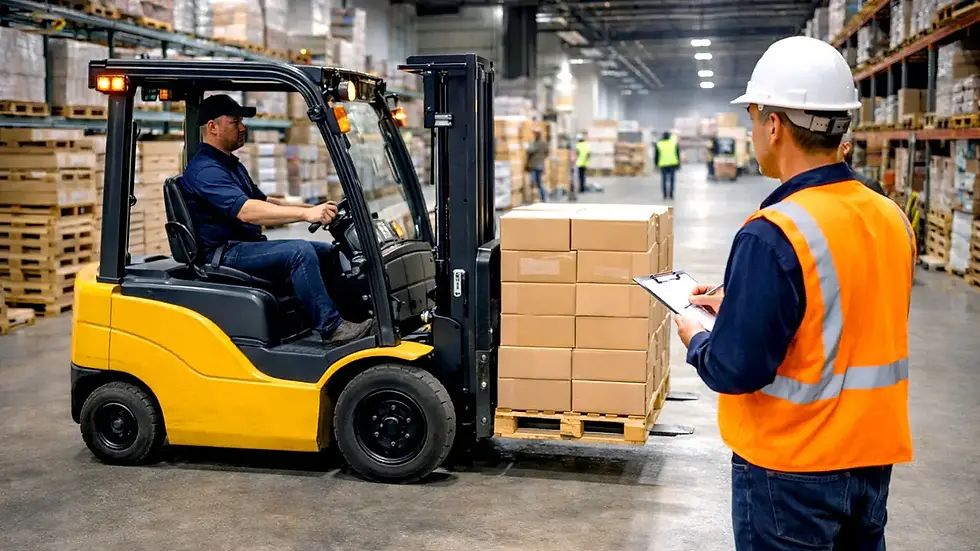
Before scaling across fleets, I strongly recommend validating on one machine in live conditions.
At Riodatos, we guide teams through this approach via single-forklift evaluation:https://www.riodatos.com/validate-one-forklift
This allows you to measure:
Exposure frequency
Near-miss visibility
Operator adoption
High-risk zone mapping
From there, scaling decisions are evidence-based—not assumption-driven.
You can also speak directly with our team: https://calendly.com/john-buttery-riodatos/30min, or reach us here: https://www.riodatos.com/contact
Why This Matters Now
Regulatory pressure is increasing—but more importantly, operational complexity is rising. Facilities are busier. Mixed fleets are common. Labor turnover is higher.
Advanced Industrial Safety Solutions help shift:
Incidents → Exposure measurement
Lagging indicators → Leading visibility
Compliance → Operational intelligence
Reaction → Prediction
Across industries—warehousing, manufacturing, logistics, construction—the common theme is visibility. When exposure is measurable, it becomes manageable.
For deeper insights on testing safety systems before full rollout, see: https://www.riodatos.com/post/demo-pilot-or-buy-the-ehs-guide-to-testing-forklift-pedestrian-detection-systems
You can also explore broader safety discussions at: https://www.riodatos.com/blog
Author Perspective
Over the years, I’ve seen facilities invest heavily in safety hardware—only to realize months later they never measured whether exposure actually decreased.
The turning point usually comes when teams begin reviewing interaction frequency rather than waiting for incident reports. That’s when safety becomes strategic. For more on operational safety philosophy, I recommend thoughtful leadership perspectives, such as those at https://johnbuttery.com.
Conclusion
Industrial vehicle safety is not about adding devices—it’s about understanding the risk of interaction. Advanced industrial safety solutions provide visibility into real-world exposure patterns, allowing organizations to prevent incidents before they occur.
The goal is not perfection. It is a measurable reduction in risk.
“When you can see exposure clearly, you stop managing accidents—and start managing conditions.”
About Riodatos
Riodatos is a U.S.-based company headquartered in Arizona with domestic inventory and certified installation support. As an authorized distributor of Proxicam, ZoneSafe, and inviol pedestrian and proximity detection systems, we supply, configure, install, and support solutions tailored to real operational environments across warehouses, manufacturing facilities, construction sites, and logistics hubs throughout the Americas.
We focus on measurable live performance, operator adoption, and scalable deployment across mixed fleets and multi-site operations—helping teams avoid mismatched technology or overseas delays. With direct pricing, fast U.S. shipping, and English/Spanish support, safety teams can prioritize protection with confidence.
👷♂️ Advanced Industrial Safety Solutions for Vehicles 🛡️ Industrial vehicle risk isn’t random—it follows exposure patterns.
📊Here’s what Advanced Industrial Safety Solutions actually changes:
Measure exposure frequency—not just incidents
Detect pedestrians in blind zones
Control speed in high-risk areas
Reveal high-interaction zones by shift
Turn lagging indicators into leading intelligence
⚠️ What we’re seeing across facilities is clear: when teams can see risk, they reduce it. Advanced Industrial Safety Solutions aren’t about hardware. They’re about visibility.
---
#industrialsafety #workplacesafety #forkliftsafety #ehs #operations #riskmanagement #warehouse #construction #logistics #safetytechnology


