
AI CCTV Safety Monitoring: The Best EHS Coaching Tool

How fixed AI camera systems turn real-time detection events into the most specific, actionable coaching material an EHS team can have.

Introduction
The traditional safety review happens in reverse. Something goes wrong, or nearly does, and then the investigation begins. The corrective action follows. The cycle repeats. For operations with active pedestrian-vehicle traffic, this sequence carries a hidden cost: the pattern becomes visible only after the exposure has already accumulated across thousands of unreported interactions.
AI CCTV safety monitoring interrupts that sequence. It applies real-time detection to existing fixed cameras, surfacing unsafe conditions and near-miss events as they occur rather than after the damage is done. The operational difference is not just technical. It changes when information arrives, and that timing determines whether intervention is possible.
This article looks at the conditions under which fixed AI camera systems deliver genuine safety value, the realities EHS managers encounter during and after deployment, and what organizations are learning when they measure the behavioral baseline against what their programs assumed it was.
The Visibility Gap That AI CCTV Safety Monitoring Is Built to Close
Industrial facilities have carried a structural measurement problem for decades. The events that drive injury patterns, zone violations, near-miss proximity events, and repeated behavioral shortcuts occur at a volume and frequency that manual observation cannot track. Heinrich's Safety Triangle, long used in EHS frameworks, estimates roughly 300 near-miss events for every serious injury in the underlying pattern. Those events are where prevention is possible. They are also the events least likely to reach a reporting form.
Most safety programs are built on lagging data. Incident reports, audit findings and near-miss logs are dependent on voluntary submission. These describe what happened at the top of the triangle. They say very little about what is accumulating at the base on any given shift.
Fixed cameras have been part of the industrial environment for years. The obstacle was never hardware — it was analysis. Reviewing hours of recorded footage to identify behavioral patterns is not something any safety team can sustain over time. AI CCTV safety monitoring changes what those cameras can produce by running continuous detection and flagging relevant events without requiring human review of full recordings.

What the Injury Data Shows About Pedestrian Exposure
The scale of pedestrian risk in facilities running powered industrial equipment is not a niche concern. OSHA estimates that between 35,000 and 62,000 forklift-related injuries occur annually in U.S. workplaces, with pedestrians represented in a disproportionate share of the fatal incidents. Transportation and material moving occupations recorded the highest number of fatal work injuries of any occupational group tracked by the Bureau of Labor Statistics in 2024. OSHA estimates roughly 70% of these incidents are preventable with consistent safety measures.
That preventability figure carries operational weight. It suggests the exposure is not random; it is patterned. It concentrates around predictable locations: loading dock entries, aisle intersections, staging areas and areas where vehicle and pedestrian traffic converge. And it correlates with predictable conditions: shift transitions, high-throughput periods, temporary staffing and layout changes after equipment moves.
AI CCTV safety monitoring can make that pattern countable. Not after the quarter closes, but during the shift when the pattern is forming.
Where Complacency Accumulates
The highest-risk moments in a facility often feel the least dangerous to the people in them. An operator who has cleared an intersection hundreds of times without incident stops perceiving it as a decision point. A pedestrian who knows the forklift schedule starts timing their movements through shared aisles rather than watching for the machine. The exposure builds quietly in the space between written procedure and actual behavior, and that space is where AI CCTV safety monitoring has the clearest operational value.
"The events that concern me most aren't the visible ones. They're the habits that have formed because nothing bad has happened yet."
Periodic audits and safety walks capture behavior as it appears when someone with authority is present. Continuous detection captures behavior as it actually exists on a standard shift.
How AI CCTV Safety Monitoring Works in Real Operations
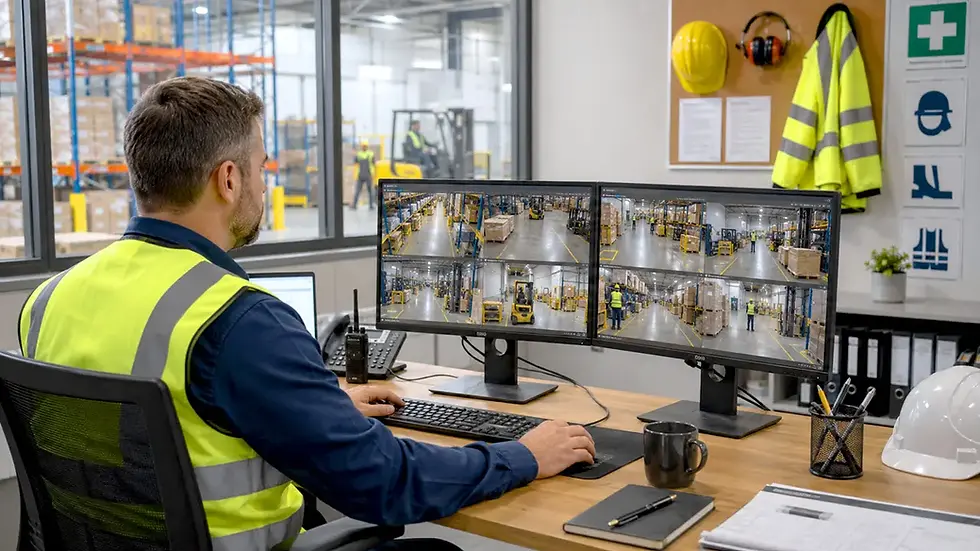
Working With What's Already Installed
One practical advantage that matters for facilities with existing infrastructure is that modern AI CCTV safety monitoring systems do not require wholesale hardware replacement. Systems like inviol connect to existing IP cameras via standard RTSP feeds and work across most major NVR configurations. Processing runs on a compact on-site unit, keeping most footage local and moving only flagged clips and event data off-site. That architecture matters for operations with data governance requirements or privacy obligations.
This is a structural distinction from vehicle-mounted detection systems, which cover the machine's field of view but not the broader environment. Fixed AI CCTV safety monitoring covers the spaces where risk accumulates, the intersection, the pedestrian corridor and the loading area, rather than tracking a single piece of equipment. Both layers address different questions, and for many operations, both are relevant. The comparison between vision- and proximity-detection approaches is a useful reference for understanding where each layer adds the most value.
The Detection Categories That Matter
In warehousing, manufacturing, and logistics environments, the events AI CCTV safety monitoring flags most consistently include: pedestrians entering high-risk or restricted zones, vehicle speed in controlled areas, proximity between moving equipment and workers on foot, PPE compliance across defined coverage areas, and exclusion zone entries. These are not rare events in high-throughput operations. Their frequency is typically surprising even to EHS managers who believe their programs are performing well.
What we're seeing across facilities is that the first few weeks of live monitoring regularly surface near-miss volumes that exceed what experienced safety managers expected. The behavioral baseline on the floor is often meaningfully different from what the procedures assume it to be.
Turning Detection Into Coaching
The detection event is the starting point, not the outcome. The more durable benefit is the coaching material it generates — short, specific video clips from the actual facility, tied to real operational conditions, available the same day they occur. That is different from generic training scenarios and considerably more effective at changing behavior. It is also the mechanism that connects AI CCTV safety monitoring to the base of the Heinrich Triangle: near-miss visibility becomes the raw material for behavioral intervention.
If you're evaluating how fixed camera systems fit into a broader safety technology approach, the Riodatos blog has additional context on deploying layered detection across mixed fleets.
Where Fixed AI Camera Systems Add the Most Value
Not every facility is an equally strong candidate for AI CCTV safety monitoring. The conditions that amplify its value are worth understanding before committing to a configuration.

High-Density Environments With Variable Daily Conditions
Distribution centers, active manufacturing floors, cold storage with tight aisle configurations, and logistics yards with continuous loading and unloading all fit the profile in which this technology performs well. The common characteristic is a high density of pedestrian-vehicle interactions combined with day-to-day variation in traffic patterns. The U.S. Government Accountability Office's 2024 report on warehouse safety found injury rates in e-commerce warehouses running more than double the all-industry average — and explicitly noted that OSHA needs updated guidance for identifying and assessing these hazards. The data gap the GAO identified is precisely what continuous AI monitoring begins to close.
"You can't build a leading indicator program on lagging data. At some point, you need information about what's happening on the floor in real time — not a report on what happened last quarter."
Transitional Periods and Elevated Exposure
Seasonal staffing surges, post-restructuring layout changes, and new equipment introductions all create windows of elevated near-miss exposure. Procedure knowledge is incomplete. Environmental familiarity is low. Supervisory capacity is stretched. AI CCTV safety monitoring provides consistent coverage that doesn't scale down when operational pressure is highest — and that is often exactly when it matters most.
Multi-Site Programs Seeking Standardized Risk Data
For EHS leaders overseeing safety across multiple locations, risk data typically arrives in inconsistent formats with varying definitions from different site managers. AI CCTV safety monitoring on a common platform produces standardized event data that can be compared across facilities and tracked across time. That makes it possible to identify which sites carry disproportionate exposure, where coaching interventions are producing measurable improvement, and where resources need to shift.
Honest Limits
AI CCTV safety monitoring adds a layer of visibility. It does not replace trained operators, sound physical design, or a functioning reporting culture.
Detection quality depends on camera placement, scene lighting, and configuration. A camera positioned to cover a dock entry will perform differently from one covering a wide open floor with variable lighting and high equipment density. Operations that invest in thoughtful placement and staging see meaningfully better results than those that treat deployment as plug-and-play.
The coaching loop requires consistent follow-through. The system surfaces events. What the facility does with them determines whether behavior changes. Operations that integrate flagged clips into toolbox talks, shift briefings, and direct coaching conversations see measurable improvement in observed behavior. Operations that allow event queues to accumulate without action retain data they are not using.
Privacy deserves a real conversation and not a policy notice. Facilities with union agreements or workforce compositions that make video monitoring sensitive should address this directly before implementation, rather than after. Most modern AI CCTV safety monitoring systems include face de-identification and on-site footage processing in their standard configuration, which resolves most common concerns. But it requires honest communication with the workforce as a condition of effective deployment.
If you are thinking about piloting this technology on a specific piece of equipment or in a defined zone before a broader commitment, this article on proving safety technology before you scale is a useful framework for structuring that evaluation.

Author Perspective
My background is in industrial safety technology, including machine control, GNSS, and proximity detection, across mining, construction, and heavy manufacturing for nearly three decades. The consistent pattern I have observed is that facilities with the strongest long-term safety outcomes are not the ones with the most procedures. They are the ones with the clearest, most current picture of what is actually happening on the floor. Visibility comes before improvement. You cannot systematically reduce what you have not measured.
What strikes me about AI CCTV safety monitoring as a category is that it makes a previously unanswerable question answerable: what is the actual behavioral baseline on a normal operating day? Not what the audit found. Not what the last training covered. What is happening at 6:45 AM on a Tuesday when throughput pressure is high, and attention is divided across the shift? That answer used to require dedicating staff to full-time floor observation. It no longer does.
More of my thinking on the shift from compliance-based to intelligence-based safety programs is at johnbuttery.com.
Why This Matters Now for EHS and Operations Leaders
The regulatory environment around warehouse and industrial safety is moving. The 2024 GAO report specifically called on OSHA to strengthen its inspection framework and guidance for warehouse hazards — a signal that the compliance baseline for these environments is not static. Operations that have already built systematic near-miss visibility into their programs will be better positioned than those still relying on manual observation and incident-based reporting.
There is also a workforce dimension worth taking seriously. Injury rates in warehousing and logistics run significantly above the all-industry average, and that gap is visible to prospective employees and staffing partners. Facilities that can demonstrate a genuine, measurable commitment to proactive safety, not just posted procedures and annual training sessions, are building something that matters for retention, not only compliance.
The shift from lagging to leading indicators has been discussed in EHS practice for years. The practical tools to execute that shift at scale are now available. AI CCTV safety monitoring is one of the clearest examples of what that looks like in operation.
If you are beginning to evaluate whether this technology fits your environment, contact Riodatos to discuss your specific site conditions before settling on a configuration. The deployment questions — camera placement, detection categories, integration with existing reporting workflows — matter more than the technology in isolation.
The Role Riodatos Plays in Evaluation and Deployment
Technology purchasing decisions in industrial safety are frequently made with limited real-world context. Vendor demonstrations happen in controlled environments. Pilots run under favorable conditions. The performance gap between those situations and actual operational conditions is where most deployment problems originate.
Riodatos structures its engagement to close that gap before committing to full deployment. That means evaluating system performance under live conditions, real shifts, actual traffic patterns and the environmental variables specific to the facility, rather than relying on generic demonstrations. For operations evaluating AI CCTV safety monitoring alongside vehicle-mounted detection for forklifts and powered equipment, Riodatos can configure both layers and assess which combination addresses the highest-exposure events at a given site.
That evaluation process is outlined at riodatos.com/pilot. If you are ready to move from research to a site-specific conversation, schedule a call here.
Conclusion
The most compelling argument for AI CCTV safety monitoring is not the detection capability itself. It is the operational shift that capability makes possible. When a safety program can see what is happening at the base of Heinrich's Triangle, it can act on that information systematically. Near-miss data stops being a compliance record and becomes the primary input to behavioral change. Over time, that changes the incident pattern.
The facilities making real progress on pedestrian and equipment safety are not doing something conceptually new. They are applying long-standing EHS principles with better information, at greater frequency, and with specific coaching material drawn from their own operational conditions. AI CCTV safety monitoring is, at its core, an information problem that now has a practical solution.
"The goal was never to increase surveillance. It was to understand where risk actually lives — clearly enough to do something meaningful about it."
About Riodatos
Riodatos is a U.S.-based industrial safety technology company headquartered in Arizona, with domestic inventory and direct support for operations across the Americas. In addition to its flagship vehicle detection system, RioV360, Riodatos is an authorized distributor for inviol, Proxicam, and ZoneSafe — supplying, configuring, installing, and supporting fixed AI CCTV safety-monitoring and pedestrian-detection solutions tailored to the specific equipment, traffic patterns, and risk profiles of each facility.
We work across warehouses, manufacturing plants, construction sites, and logistics operations, avoiding the mismatched technology and overseas fulfillment delays that slow EHS teams down. Our emphasis is on measurable live performance, operator adoption, and scalable deployment across mixed fleets and multi-site programs.
Direct pricing, fast U.S. shipping, certified installation, and English and Spanish support let safety teams focus on protection rather than procurement.
Sources
Safety Culture — Heinrich's Safety Triangle: https://safetyculture.com/topics/workplace-safety/safety-triangle
Bureau of Labor Statistics — Census of Fatal Occupational Injuries 2024: https://www.bls.gov/news.release/cfoi.nr0.htm
U.S. Government Accountability Office — Warehouse Safety Report, 2024: https://www.gao.gov/products/gao-24-106413
National Safety Council — Injury Facts, Occupational Profile: https://injuryfacts.nsc.org/work/industry-incidence-rates/occupational-profile/


