
360° AI Detection for Construction Loaders: 10 Reasons to Install This Week
- John Buttery

- Apr 25
- 9 min read
Why are construction sites installing AI pedestrian detection and 360° video recording on loaders before the next shift, not next quarter?

There is a version of this decision that gets made after something goes wrong. A near-miss, an incident, an OSHA visit. Most safety teams know that version well. This article is about the other version, the one where the system goes on before anything happens, and stays useful long after the hazard season passes.
The RioV360 is a four-camera AI pedestrian and vehicle detection system with 360° 1080p on-device video recording. It ships from Arizona, installs in a few hours, and requires no subscription, cloud connection, or IT involvement. You can order it this week at riodatos.com/riov360 and have it running on a loader before the week is out.
What follows are ten concrete reasons construction operations are making that decision right now, not as a pilot, not as a procurement exercise, but as a working installation on one machine.
1. Construction Loaders Create the Conditions AI Detection Was Built For
The Blind Spot Problem Is Structural
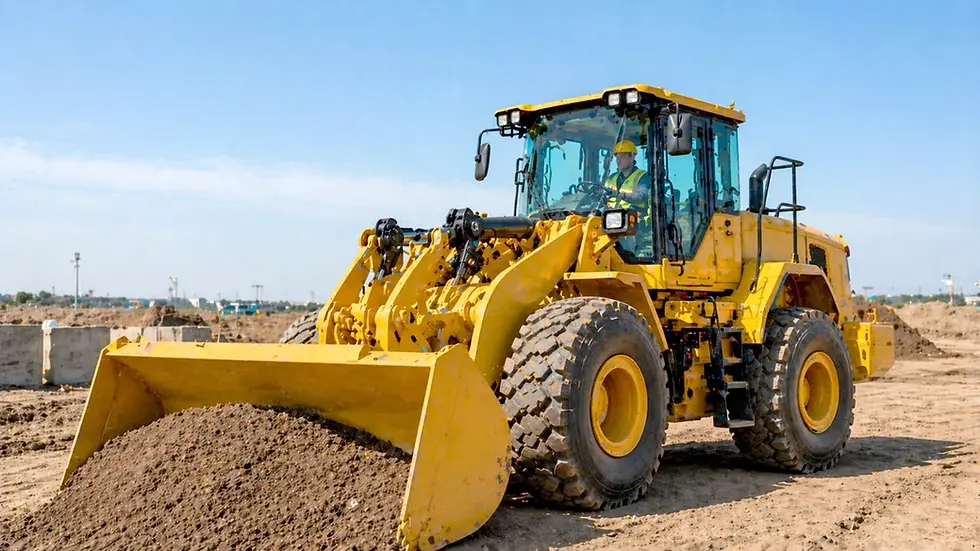
A wheel loader or skid steer on an active construction site does not operate in a controlled environment. It moves through zones shared with ground crews, delivery vehicles, subcontractors, and equipment arriving and departing throughout the day. The operator has meaningful forward visibility. Rear and lateral coverage is a different matter entirely.
The cab design, boom geometry, and counterweight placement on most loaders create blind zones that no amount of operator training fully resolves. This is not a behavior problem. It is a geometry problem, and AI detection addresses it at the source.
Why AI Outperforms Cameras Alone
A standard camera system shows the operator what is there. An AI detection system processes what the camera sees and alerts the operator when a person or vehicle enters a defined zone, before the operator has to look, interpret, and react. In a construction environment where the operator is managing a bucket, terrain, and a radio simultaneously, that distinction is the margin between a close call and an incident.

2. The Video Record Changes Everything After an Incident
What Investigators Actually Need
When something happens on a construction site, a near-miss, a strike, a property damage event, the first question from every party involved is the same: what does the footage show? OSHA investigators, insurance adjusters, project owners, and legal counsel all converge on that question. The loader without a recording system has no answer. The one with RioV360 has up to 56 hours of continuous 1080p footage from four angles, stored on-device, accessible without cloud accounts or IT retrieval procedures.
The Absence of Footage Is Its Own Problem
"In most operations, the absence of recorded evidence is interpreted as the absence of awareness, and that interpretation carries real consequences in claims and investigations."
On sites where RioV360 is installed, the footage record is available for every shift, every zone, every interaction. That record does not require anything to go wrong to be useful. It documents normal operations, operator patterns, and site conditions in ways that inform how the site is managed going forward.
3. Four Cameras Cover What One Can't
360° Is Not a Feature. It's a Coverage Requirement.
RioV360 mounts four cameras, front, rear, left and right, each recording continuously at 1080p. The system does not rely on the operator to select a view or activate a camera. All four are live, all four are recording, and all four feed the AI detection layer simultaneously.
On a loader moving through a tight cut, reversing toward a staging area, or swinging through a turn, the exposure exists in multiple directions at once. A single rear camera addresses one of those exposures. Four cameras address the operational reality.

4. No Subscription. No Cloud. No IT Dependency.
Why That Matters on a Construction Site
Construction operations do not run on reliable connectivity. Sites move. Cellular coverage gaps are common. IT infrastructure that works at the home office does not follow the loader into a cut or a remote earthmoving zone. Systems that depend on cloud connectivity for recording, alerts, or configuration introduce a failure point that construction environments regularly trigger.
RioV360 records entirely on the device. There is no monthly subscription, no cloud account to provision, and no IT ticket required to install or access it. The system works where the machine works, regardless of what the network is doing.
The Procurement Advantage
"The systems that get approved fastest are the ones that don't require three departments to agree first."
Under $2,000, no recurring cost, no IT integration, and ships within days. RioV360 is structured to move through procurement without the friction that delays most safety technology decisions. Many construction companies can approve this on a single purchase order without a capital expenditure process.
5. It Ships Fast and Installs in Hours
The Week of Deployment Is Real
RioV360 ships from Arizona with a Professional Installation Kit included. For operations with in-house maintenance capabilities, installing a loader typically takes a few hours. For sites that prefer outside support, Riodatos provides installation guidance and can connect teams with certified installers.
The practical implication: a decision made this week can result in a running system on a loader before the week closes. That is not a typical timeline for safety technology. Most systems involve demos, pilots, procurement cycles, and configuration calls that push deployment out by months.
6. AI Pedestrian and Vehicle Detection, Not Just Cameras
Detection Is the Active Layer
The distinction between a camera system and a detection system is operational, not technical. A camera shows. A detection system acts. It processes the image, identifies a person or vehicle, calculates proximity, and delivers an alert to the operator and an external beacon visible to ground crews. That active layer is what changes operator behavior and site awareness in real time.
RioV360's AI detection covers both pedestrians and vehicles, which matters on construction sites where the hazard population includes workers, subcontractors, delivery drivers, and other equipment operators. Detection is not limited to one category of risk.

7. The Recording Supports More Than Safety
Operations Teams Use the Footage Too
"What surprises most operations managers is how quickly the video record becomes useful for things they didn't install it for."
Beyond incident response, 56 hours of 360° 1080p footage from a working loader documents site conditions, material movement, equipment utilization patterns, and crew positioning across the full shift. Operations teams on sites with RioV360 installed have used that footage to review workflow inefficiencies, resolve disputes between subcontractors, and document site conditions for project owners.
The safety system becomes an operational intelligence asset. That is not an accident. It is a predictable outcome of continuous 360° recording on a machine that moves through the full active zone of a construction site all day.
8. One System Works Across Your Fleet
Standardization Matters at Scale
RioV360 is designed to install on mixed equipment fleets. The same system that goes on a loader installs on an excavator, a telehandler, a compactor, or a haul truck. For construction operations running multiple machine types across a site or across multiple sites, standardization on a single detection and recording platform reduces training time, simplifies support, and creates a consistent footage archive regardless of machine type.
This is the fleet management argument that moves the decision from one machine to the broader operation. Starting with one loader this week is a proof of concept. The system scales without introducing new hardware families or support contracts.
Visit riodatos.com/products to see the full range of detection and proximity systems available for mixed-fleet deployment.

9. It Closes the Documentation Gap Before OSHA Opens It
What a Site Visit Actually Looks at
OSHA construction citations frequently involve visibility, proximity controls, and operator awareness. The question inspectors ask is not whether a policy exists, but whether the controls in place are adequate given the actual conditions on the site. A loader operating near ground personnel without detection or recording capability is an exposure that is visible in a site audit.
RioV360 addresses that exposure with a documented, installed and operating control. The system is not a paperwork solution. It is a physical control that demonstrates active management of the pedestrian-machine interaction zone.
Connecting detection and recording capability to your broader safety program is the kind of integration that Riodatos supports directly.
10. The Price Is Structured to Make One Machine the Right Starting Point
Complete System
RioV360 includes the AI Pedestrian Detection System and the Professional Installation Kit. There is no separate software license, no activation fee, and no recurring cost. Optional upgrade kits are available for specific mounting requirements, but the base system ships complete.
That price point is deliberate. It sits below the threshold that triggers capital approval processes in most construction companies, which means a safety manager or fleet manager can often move this without a multi-department sign-off. It is also well below the cost of a recordable incident. Direct costs, insurance impact, lost time, and investigation hours consistently exceed that figure by a significant margin.
The right starting point is one machine. The system ships fast and free from Arizona.
Author Perspective
I spent three decades in industrial technology before founding Riodatos, and the pattern I kept seeing was a gap between the safety technology that existed and the technology that actually made it onto machines. The gap was not usually about product quality. It was about deployment friction. Systems that required pilots, integrations, subscriptions, and approval chains that most operations teams could not clear in a reasonable time frame.
RioV360 was built around that observation. The goal was to create a system that a construction operation could decide on, order, receive, install, and run without a six-month procurement cycle or an IT project attached.
The ten reasons in this article are not a marketing exercise. They reflect the operational gaps I watched go unaddressed for years, and the conditions that make a loader on an active construction site one of the highest-exposure interactions on any job. More of my thinking on industrial safety, pedestrian detection, and the practical challenges of deploying technology in the field is at johnbuttery.com.
The construction industry is not short on safety awareness. What it is often short on is deployable solutions, systems that work in the conditions that actually exist on a site, that don't require a data center, and that provide value from the first shift. That is the problem RioV360 is built to solve.
Why This Decision Matters Now
Construction fatality and injury data consistently shows that struck-by incidents involving mobile equipment are among the leading causes of worker deaths on active sites. The exposure exists on every job where loaders and ground personnel share space, which is nearly every job. The shift in how safety-conscious operations are responding to that exposure is moving from policy and signage toward active detection and documentation.
What we are seeing across construction operations is that the sites moving fastest on detection and recording are not doing it because of a mandate. They are doing it because the operational value, the evidence record, the reduced near-miss frequency, and the improvement in operator awareness are visible and measurable within weeks of installation.
That shift from compliance-driven to intelligence-driven deployment is where the industry is heading, and the operations that move early have a clearer picture of their own risk profile before the rest of the industry catches up.
Ready to Put 360° AI Detection on Your Loader This Week?
RioV360 ships fast and free from Arizona.
If you want to talk through your site configuration before ordering, schedule a 30-minute call or reach out to the team directly at riodatos.com/contact.
For operations evaluating detection systems across multiple machines or sites, the
The decision to start with one machine is the right one. The question is which week.
Conclusion
The case for installing a 360° AI detection and recording system on a construction loader is not complicated. The blind spot exposure is real. The incident documentation gap is real. The procurement friction that delays most safety technology decisions is real, and RioV360 is specifically structured to remove it.
Starting with one loader this week is not a compromise. It is the correct deployment strategy. A single machine in live conditions tells you more about operational fit, operator response, and site-specific value than any demo or specification sheet. It also means the machine is covered while you learn.
"The operations that are ahead on this are not the ones that were planned the most carefully. They are the ones that put the first system on the first machine and started seeing what it showed them."
About Riodatos
Riodatos is a U.S.-based industrial safety technology company headquartered in Tucson, Arizona, with domestic inventory and direct distribution across the Americas. We supply, configure, install, and support AI pedestrian detection and proximity systems, including RioV360, Proxicam, ZoneSafe, and inviol, tailored to each site's specific equipment, traffic patterns, and risk profile.
Our work spans warehouses, factories, construction operations, and logistics facilities, with a consistent focus on measurable live performance, operator adoption, and scalable deployment across mixed fleets and multi-site operations. Direct pricing, fast U.S. shipping, and installation support mean that safety teams can prioritize protection without navigating overseas delays or mismatched technology.
If you are ready to evaluate a system in your environment, contact Riodatos to get started.
360° AI Detection for Construction Loaders: 10 Reasons to Install This Week
Construction loaders share space with ground crews all day. When something happens, the question is always the same: what does the footage show? Here is why operations are installing RioV360 this week rather than next quarter.
⚠️ Loaders create structural blind zones; no amount of training resolves. AI detection addresses the geometry, not just the behavior.
🎥 2 weeks of 1080p 360° on-device recording. No cloud, no subscription, no IT ticket required.
🚜 Four cameras, continuous coverage, AI detection for both pedestrians and vehicles.
👷 The complete system ships free from Arizona, installs in hours.
📊 The footage record is useful before anything goes wrong. Operations teams use it to review workflow, resolve disputes, and document site conditions.
One machine. This week. That is the right starting point.


