Pedestrian Detection Technology Types Explained
- John Buttery

- Jun 27
- 12 min read
Updated: Aug 11
A field-level guide to how each system works, what it protects against, and where it falls short

Understanding Pedestrian Detection Technology Types
There are more than a dozen workers on foot for every powered industrial vehicle in a typical warehouse. Most of them move through the same aisles, around the same blind corners, and into the same loading zones where forklifts and equipment operate at speed.
According to the National Safety Council's Injury Facts, forklifts and similar powered industrial trucks were involved in 84 work-related fatalities in 2024 and approximately 25,110 nonfatal DART injuries (days away from work, job transfer, or restriction) in 2023–2024. Most of those incidents happen in facilities that already have safety programs, signage, speed rules, and trained operators.
The gap isn't awareness. It's detection.
EHS managers have more technology options today than at any point in the history of industrial safety. Camera systems, radar, RFID tags, ultra-wideband locators, LiDAR, ultrasonic sensors, Bluetooth beacons. Each one approaches the problem differently.
Each one has a real detection capability and a real limitation. Understanding the differences before specifying a system matters more than most safety teams realize.
Most near-miss events involve a pedestrian and a vehicle that were both operating correctly. The system just didn't give either one enough warning.
Tag-based systems can only protect the workers wearing tags, which rarely includes all contractors, visitors, or temporary workers on site.
No single technology performs reliably across all facility conditions. Lighting, dust, temperature, and layout all affect system behavior.
These aren't new problems. What's new is that the technology to address them is practical, deployable, and producing real field data that safety teams can act on.
Key Takeaways
No single technology performs reliably across all facility conditions.
Tag-free systems detect anyone in the zone without requiring a wearable.
Tag-required systems work reliably in any visibility but depend entirely on tag compliance.
Sensor fusion (camera AI + radar or LiDAR) delivers the highest reliability.
The biggest real-world gap is usually untagged contractors, visitors, and temporary workers.
Understanding Pedestrian Detection Technology Types
The most useful way to organize these systems isn't by brand or price. It's about the fundamental question each person asks at the moment a hazard develops: does it require someone to be wearing something, or can it detect anyone?
That single distinction separates the field into two groups. Everything else layers on from there: accuracy, environmental performance, cost, complexity.
Pedestrian Detection Technology Comparison
| Technology | Detection Type | Requires Wearable? | Primary Strength | Main Limitation | Best For | Environmental Performance |
|---------------------|-------------------------|---------------------|-------------------------------------------|-------------------------------------------------|-----------------------------------------|------------------------------------------------|
| Camera AI | Tag-free | No | Detects anyone in zone, visual confirmation | Struggles with heavy dust, glare, steam | Warehouses, indoor mixed traffic | Good in controlled lighting; poor in extreme dust / fog |
| Radar | Tag-free (often with camera) | No | Works in darkness, dust, fog | Cannot classify (person vs pallet) | Outdoor, dusty, low-visibility areas | Excellent in poor visibility |
| LiDAR | Tag-free | No | High-precision 3D mapping | Expensive, sensitive to rain/particulates | High-value autonomous or precision applications | Good but affected by weather / particles |
| Ultrasonic | Tag-free | No | Simple close-range backup detection | Limited range | Backup/side detection on vehicles | Short range, no classification |
| RFID Proximity | Tag-required | Yes | Reliable in any visibility | Only detects tagged workers | Facilities with stable, tagged workforce| Unaffected by environment |
| UWB | Tag-required | Yes | Centimeter-level accuracy + location data | High infrastructure cost, tag compliance needed | Complex layouts needing precise alerts | Unaffected by environment |
| BLE Beacons | Tag-required | Yes | Affordable middle-ground | Lower precision, interference in metal environments | Cost-sensitive sites with moderate needs| Mostly good but signal issues possible |
| Fixed AI CCTV | Zone-based (fixed) | No | Covers intersections/blind spots | Doesn’t move with vehicles | High-risk fixed zones | Depends on camera placement / lighting |
Tag-free detection: the camera and sensor approach
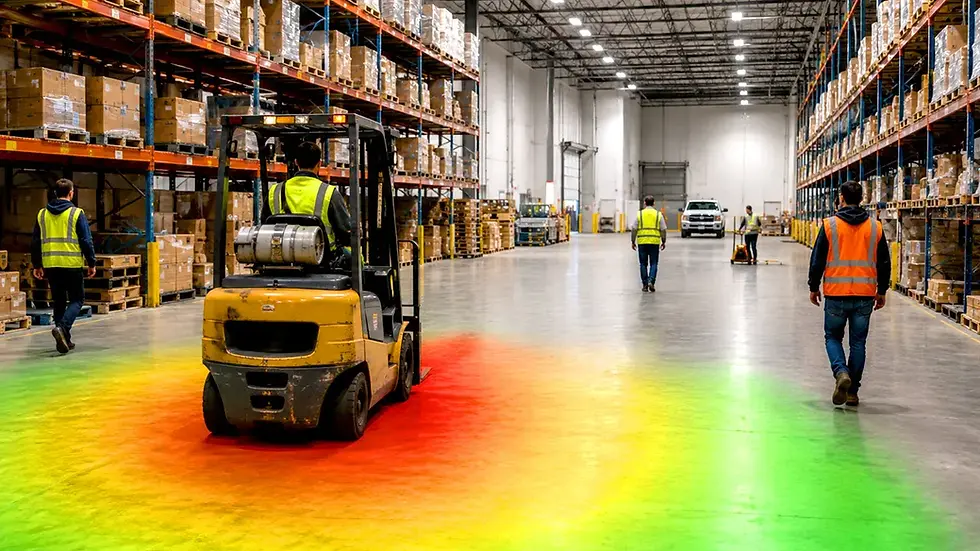
Tag-free systems detect people without requiring any device to be worn. The vehicle carries all the hardware. A pedestrian walking through a facility with no badge, no tag, no wearable at all will still be detected if they enter the system's coverage zone.
This is the defining advantage. In a food processing plant where the permanent workforce is tagged, but a maintenance contractor shows up unannounced, a tag-free system still sees the contractor. In a construction site where workers cycle on and off throughout the day, no enrollment is required.

The trade-off is that tag-free systems depend on their sensors to perform reliably in the actual environment where they're deployed. Cameras struggle in heavy dust, direct sun glare, and steam. Radar can't tell a person from a pallet. LiDAR loses accuracy in rain. Each tag-free technology has a specific environmental condition where its performance degrades, and that condition varies by system.
Camera-based AI detection is the most widely deployed tag-free approach in industrial settings. A camera mounted on the vehicle streams live video to an onboard processor. The processor runs a trained object detection model against each frame, looking for the shape, proportion, and movement patterns of a human being. When the model identifies a person inside a defined zone around the vehicle, it triggers an alert: an audible alarm, a visual warning in the cab, or both.
The quality of the AI model matters enormously here. A system trained primarily on office environments will underperform in a cold-storage warehouse where workers are in heavy gear and partially obscured by shelving. False positive rate matters as much as detection rate. Operators who get repeated false alarms stop trusting the system. Systems that operators stop trusting get disabled.
"The first thing I look at now is false alarm behavior. A system that cries wolf every few minutes is worse than no system at all because it teaches operators to ignore the alerts."
Radar takes a different approach. It transmits radio waves and measures what bounces back. It detects moving mass reliably in conditions where cameras struggle: complete darkness, heavy airborne dust, and outdoor fog. What it cannot do is classify what it detects. Radar knows something moved through its field. It doesn't know if that something is a person, a cart, a forklift, or a piece of falling debris. This is why radar is increasingly used in combination with camera AI rather than as a standalone system: the radar detects in difficult conditions, and the camera confirms the classification.
LiDAR fires thousands of laser pulses per second and builds a precise three-dimensional map of its surroundings in real time. The accuracy is impressive. So is the cost. LiDAR sensors that perform reliably in industrial environments are typically priced well above camera or radar alternatives, which limits their deployment to high-value applications: autonomous ground vehicles, robotic systems, and facilities with the maintenance capacity to keep precision optics clean in dirty environments.
Ultrasonic sensors round out the tag-free category. They operate on simple echo detection, like sonar. Something enters the detection zone, the pulse bounces back faster, and the system registers a nearby object. No classification, limited range, no ability to distinguish a pedestrian from a stack of boxes. They're most common as backup detection aids on vehicles, not as primary pedestrian safety systems.
Tag-required detection: the wearable approach
Tag-required systems place a wireless device on each worker. The vehicle carries a reader. When a tagged worker comes within range, the system triggers an alert. No tag, no detection.
This architecture has real advantages. It performs reliably in environments where cameras and optical sensors struggle. It doesn't matter how dark, dusty, or foggy the facility is. The reader and tag communicate regardless of visual conditions. Detection is fast. Latency between a worker entering the alert zone and the driver receiving a warning is typically low.

The practical problem is compliance. Every person who needs protection must wear a functioning, charged tag. That sounds straightforward until you encounter the actual operating conditions of most industrial facilities.
Contractors bring their own personnel. Vendors drop by unannounced. Temporary workers are enrolled and de-enrolled constantly. Batteries die. Tags get left at home or in the car. Tags get damaged and removed. In most operations, the permanent workforce achieves strong tag compliance. The gap opens at the edges, where the people who aren't yet in the system work alongside those who are.
RFID-based proximity systems are the most established tag-required technology. A low-frequency magnetic field generator mounts on the vehicle. Workers carry a tag, typically worn on a vest or clipped to a belt. When the tag enters the magnetic field, it triggers an alert. The detection zone is stable and relatively predictable. The technology is mature. Costs are lower than camera or UWB alternatives for basic implementations.
Ultra-wideband technology, usually called UWB, represents the high end of the tag-required category. It locates people and vehicles in real time with centimeter-level accuracy. A network of fixed anchors throughout a facility triangulates the position of every tagged device continuously. The system doesn't just know that a person is near a vehicle. It knows exactly where both are, which direction each is moving, and at what speed. That data can drive intersection warnings, blind-corner alerts, and speed enforcement triggers tied to actual proximity rather than proximity estimates.
"When we mapped out where close-calls were actually happening, it wasn't where we expected. The data from the location system showed us three intersections we hadn't flagged in our hazard assessment."
The cost and infrastructure complexity of UWB reflect what it delivers. It requires anchor installation throughout the facility, ongoing network management, and tag issuance to every worker who enters the space. For facilities managing a stable workforce in a complex layout, that investment often makes sense. For facilities with high turnover or frequent outside personnel, the compliance problem reasserts itself.
Bluetooth Low Energy beacons, usually called BLE, occupy a position between RFID and UWB. Wearable devices broadcast a Bluetooth signal continuously. Vehicle-mounted readers pick up that signal and alert the driver when a tagged person is close. The technology is inexpensive to deploy and reasonably easy to manage. Precision is lower than UWB, and BLE signals can experience interference in metal-rich environments. But for facilities that want wearable-based detection without the infrastructure cost of a full UWB network, BLE offers a practical middle ground.

CCTV and fixed-point systems: a different function
CCTV surveillance doesn't belong in the same category as active detection systems, but it's often grouped with them, so the distinction is worth stating clearly. A standard CCTV installation records what happens. It creates a video record that a human can review after an incident. That record has genuine value for investigation, insurance, regulatory response, and the identification of patterns in near-miss behavior. It does not protect anyone in the moment a vehicle and a pedestrian converge.
What changes the function is AI analytics applied to existing camera feeds. A fixed camera with an AI analytics overlay can detect pedestrian presence in a zone and trigger a site-level alert: an audible warning, a light signal, or a gate closure. This is meaningfully different from passive recording. It's closer to a vehicle-mounted camera system in function, though the detection is zone-based from a fixed point rather than moving with the vehicle.
Organizations typically discover that a hybrid approach makes sense: fixed cameras covering critical intersections and high-risk zones, vehicle-mounted detection covering the mobile blind spots that fixed cameras can't follow. Neither covers the full problem alone.
Why Pedestrian Detection Technology Types Matter Now
The category is not new. RFID-based proximity systems have existed in industrial safety for more than two decades. What's changed is the technology's field performance, deployment costs, and the data these systems generate.
Camera AI has improved substantially. Models trained in industrial environments achieve accuracy levels that weren't achievable five years ago. Edge processors mounted on vehicles run inference fast enough that detection and alert happen before a hazard has time to develop. The cost of capable camera systems has dropped to the point where single-machine deployments are realistic for mid-size operations.
At the same time, EHS practice has shifted. The emphasis on leading indicators rather than incident counts means safety teams are looking for systems that generate data on exposure frequency, not just systems that sound an alarm. A detection system that logs every pedestrian event, every alert trigger, and every near-miss gives a safety manager something to work with. That data shows where the exposure is actually concentrated, which is often different from where the hazard assessment says it should be.
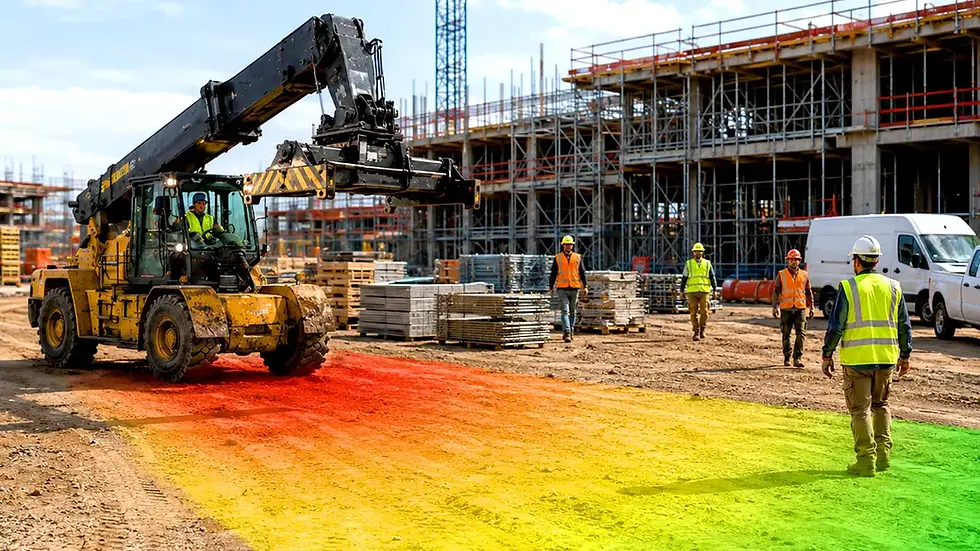
Sensor fusion is the direction the industry is moving. Combining camera AI with radar or LiDAR creates a system in which the camera classifies while the radar or LiDAR detects in conditions where the camera's performance degrades. The combined output is more reliable than either technology alone. This approach is already common in automotive safety systems and is showing up in industrial specifications at larger operations.
The practical implication for safety teams evaluating systems now is that a technology choice made today doesn't need to be the final answer. Starting with a system that generates data reliably under current conditions creates a foundation that can expand as both the facility's needs and the available technology evolve.
Frequently Asked Questions
What is the main difference between camera-based and RFID-based pedestrian detection?
Camera-based systems detect any person who enters the vehicle's coverage zone, with no wearable required. RFID systems detect only workers who are wearing a functioning, charged tag. Camera systems automatically protect untagged visitors and contractors. RFID systems offer reliable detection in low-visibility environments where cameras struggle.
Can one pedestrian detection system work across all facility conditions?
Not reliably. Camera systems degrade in the presence of heavy dust, steam, and direct glare. Radar detects but cannot classify. LiDAR is sensitive to rain and airborne particulates. Tag-based systems are unaffected by environmental conditions but depend entirely on tag compliance. Many facilities use a combination of approaches to cover their specific mix of conditions and personnel.
What does UWB offer that basic RFID does not?
UWB provides real-time centimeter-level location tracking for every tagged device in the facility, not just a proximity trigger. It can power intersection warnings, directional alerts, and speed-zone enforcement tied to actual location data. The tradeoff is higher infrastructure cost and the same tag-compliance dependency that all wearable-based systems share.
Does CCTV count as a pedestrian detection system?
Standard CCTV does not. It records events but does not generate real-time alerts. Fixed cameras with an AI analytics overlay do function as detection systems for defined zones. The distinction matters when specifying systems for active prevention rather than post-incident review.
Author Perspective
I've spent most of my career working around powered industrial vehicles. First in machine control and positioning technology, then in pedestrian detection systems across mining, construction, and logistics operations in North America and internationally. The technology landscape I'm describing now is genuinely different from what was available even five years ago. The accuracy is better. The cost is lower. The data is richer.
What hasn't changed is the implementation gap. The facilities that benefit most from detection technology are often the ones with the most complex operating environments, the highest personnel turnover, and the least capacity to manage a new system's learning curve. That gap is worth acknowledging. A system that performs well in a controlled evaluation but underperforms in daily operations under real shift pressure doesn't solve the problem. You can find more of my thinking on this at https://johnbuttery.com.
The question I'd put to any EHS manager evaluating this category is simple: what happens in your facility to a person who isn't in your system? A contractor who arrived this morning. A supervisor from another site visiting for the afternoon. A vendor dropping off equipment. If the answer is that the detection system doesn't see them, that's the gap worth designing around first.
About Riodatos
Riodatos is a U.S.-based industrial safety technology company headquartered in Arizona, with domestic inventory and direct distribution across the Americas. Our flagship product is the RioV360, a 360-degree AI-powered pedestrian detection system purpose-built for forklifts and heavy equipment. The RioV360 provides full surround camera coverage with in-cab alerts, requires no pedestrian-worn device, and ships as a complete installation kit from Arizona.
We are also an authorized distributor for ZoneSafe and inviol pedestrian and proximity detection systems. We supply, configure, install, and support solutions tailored to the specific equipment mix, traffic patterns, and risk profiles of individual facilities. Our work spans warehousing, manufacturing, construction, and logistics operations across the Americas, with an emphasis on avoiding mismatched technology and overseas fulfillment delays.
Our approach is built around measurable live performance, operator adoption, and scalable deployment across mixed fleets and multi-site programs. Direct pricing, fast U.S. shipping, certified installation, and English/Spanish support mean safety teams can focus on protection rather than procurement logistics. Every engagement starts with a single-machine evaluation in real operating conditions before any fleet commitment is made.
SOURCES
For editorial reference, not for publication
OSHA: Powered industrial truck fatalities and injury estimates: https://www.osha.gov/powered-industrial-trucks
BLS: Occupational injury and fatality data: https://www.bls.gov/iif/
NSC Injury Facts: Workplace injuries by industry: https://injuryfacts.nsc.org/work/industry-incidence-rates/
Quick Read
⚠️ Pedestrian Detection Technology Types Explained 👷 OSHA estimates roughly 85 forklift-related fatalities and 35,000 serious injuries per year in U.S. workplaces alone.
Most happen in facilities that already have safety programs. The problem isn't awareness. It's detection. Specifically, what each system can and can't see.
⚠️ Here's what actually separates these technologies in the field:
📷 Camera AI detects anyone in the zone with no wearable required, but performance drops in heavy dust, glare, or steam
📡 Radar works through darkness and dust but can't tell a person from a pallet; it needs a camera to classify what it finds
🏷️ RFID and UWB tags protect workers reliably in poor visibility, but only the workers wearing a functioning device
🛡️ UWB gives centimeter-level location accuracy for every tagged person (useful for intersection alerts), but requires significant infrastructure and 100% tag compliance to work
📶 BLE beacons cost less to deploy than UWB but are less precise and more prone to interference in metal-heavy environments
🎥 CCTV records what happens; only cameras with AI analytics overlays actually generate real-time alerts
📊 No single technology covers all conditions. The facilities getting the best results are combining approaches rather than betting on one
The right question isn't which technology is best. Which gap in your facility matters most?