

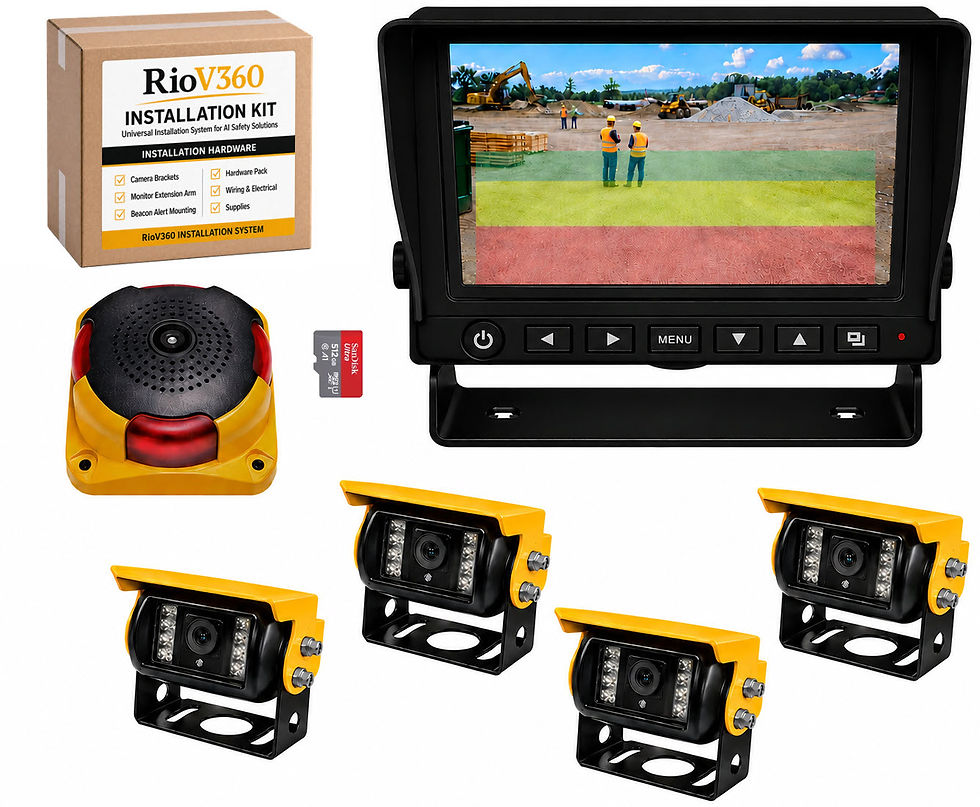
Why RioV360 Works on the Plant Floor
RioV360 — Four cameras. Full 360° surround coverage. When someone enters the danger zone, the operator gets an in-cab alert and an external beacon fires to warn the person on foot. No worker-worn tags, no connectivity required.
📷 360° camera coverage around the truck (1, 2, 3, or 4 cameras) that moves with every forklift, reach truck, and tugger
🔔 Instant in-cab alert + external 120 dB beacon the moment a person, vehicle, or object enters a danger zone
💾 Onboard recording on a 256 GB (upgradable to 512 GB) SD card — pull the card at the end of the shift, no cloud or IT ticket
🔧 Installs across a mixed fleet in a single afternoon.
Fixed Safety Zones Fail on a Moving Plant Floor
On a working floor, the hazard map redraws itself all shift. People move between cells. Trailers get loaded. A forklift backs into an aisle that was clear sixty seconds ago. Painted walkways and fixed guarding cannot keep pace with that.
➜ Yesterday’s “safe zone” is today’s blind spot the moment equipment or people shift.
➜ Shift-to-shift traffic routes push people on foot directly into active forklift lanes.
➜ Forklifts and tuggers reverse with deep rear blind spots. Exactly where workers often cross.
➜ Raised forks and tall loads hide the person standing just past the load.
➜ Order pickers and tuggers leave almost no side or rear visibility in tight aisles.


Manufacturing Floor Safety
I have spent about thirty years around machine control, GNSS, and industrial safety, and the pattern on a plant floor rarely changes. The incident is almost never the truck the operator was watching. It is the one that moved into a spot everyone assumed was clear. I have stood next to forklifts where the operator would have sworn the aisle behind him was empty, then watched a worker step into the exact blind zone the mirrors never covered. Nobody was being careless. The sightline simply did not exist.
Detection That Moves With the Truck
Forklifts do not operate inside a fixed safety zone. Trucks reverse, turn, lift, and move between cells and dock doors throughout the day. RioV360 mounts directly to the truck, so the camera coverage and detection zones move with it.
360° Camera Coverage Around the Truck
Cameras mount around the truck to monitor the areas the operator cannot see directly. The system combines the camera views into one surround image and watches the configured detection zones at the same time.
This gives the operator a clearer view around the truck during reversing, turning, loading, and other close-proximity movements.
🔹 Coverage around the front, rear, and sides of the truck.
🔹 Detection zones configured for the truck's size and operating pattern.
🔹 No pedestrian-worn tags or electronic devices required.
🔹 Suitable for forklifts, reach trucks, tuggers, order pickers, and turret trucks.
🔹 Camera views and alerts remain with the truck as it moves around the floor.
AI That Detects People, Vehicles & Objects — Not Racking, Shadows, or Pallets
Operators only trust alerts they can believe. RioV360 fires only when a person, vehicle, or object enters a danger zone and stays silent for racking, shadows, and shrink-wrapped loads.

Manufacturing Pedestrian Detection System
When a detection occurs, the operator gets an instant visual and audible warning in the cab, with the camera view showing exactly where the person, vehicle, or object is before the truck moves.
🔹 Detects people, vehicles, and objects — ignores racking, shadows, and pallets
🔹 Instant visual + audible alert inside the cab
🔹 Shows exactly which camera triggered so the operator knows where to look
🔹 Configurable detection zones matched to each truck
🔹 Builds operator trust because false alarms stay near zero
The Beacon is the Real Safety Workhorse
Every system focuses on alerting the operator. RioV360 does that, but the external flashing beacon does something more important. It alerts the worker on foot at 120dB the moment they violate safe separation distance. Voice alert. Audible alarm. Flashing red light.
Workers who experience the beacon once change their behavior permanently. They do not cut behind the forklift again. They do not walk through the truck's turning path. Instead they take immediate action to get away from a dangerous situation.
🔴 120dB voice alert + audible alarm + flashing light. All three activate simultaneously on detection
🔌 Plug-and-play. 4-pin aviation connector, connects directly to monitor harness, no configuration required

"No one wants to set off the system."
Different Trucks Create Different Blind Spots
Every truck type has unique hazards. Camera positions and detection zones are configured specifically for the equipment,
not applied as a one-size-fits-all setup.

Equipment-Specific Detection Zones
Forklifts — Large rear blind spots and tight aisle traffic make reversing a major risk. Rear and corner cameras detect a person crossing behind the truck before reverse movement becomes a problem. → Forklift Detection
Reach Trucks — Reaching into racking with a raised load blocks sightlines fast. Surround camera coverage and a configurable rear detection zone give the operator another set of eyes on the danger area. → Reach Truck Detection
Order Pickers — Elevated operators focus on the pick face, not the aisle. Camera detection fills the large rear and side gaps that mirrors and direct sightlines miss. → Order Picker Detection
Telehandlers — Raised booms and loads hide workers near the wheels and base. Cameras monitor the sides and lower areas so the operator is alerted the moment a person enters the danger zone. → Telehandler Detection
Tuggers & Tow Tractors — Long trains and quiet electric drives make tuggers easy to miss in a busy aisle. Cameras monitor the sides and rear so the operator is alerted the moment a person enters the danger zone. → Forklift Detection
RioV360 System — RioV360 System — RioV360 is the same camera-and-AI platform across all of these trucks. Only the camera placement and detection zones change. → RioV360
Built for Dust, Wash-Down, and Vibration
Specifications only matter when the system survives real operations. RioV360 is built for indoor and outdoor use, mixed fleets, cold storage, and trucks that run through dust, wash-down, vibration, and extreme temperatures.
✓ IP69K-rated cameras: Withstand high-pressure wash-down, cold storage, heavy dust, and constant vibration
✓ Onboard SD recording: Pull the card on site. No cloud account or IT ticket required
✓ Wide operating-temperature range: Performs in cold storage, ambient docks, and everything in between.
✓ No Wi-Fi or cloud required: Runs fully onboard without touching plant network infrastructure
✓ AI classification: Detects people, vehicles, and objects while ignoring racking, shadows, and pallets
✓ Truck-mounted installation: Fits a mixed fleet with no devices worn by workers

Prove It on One Truck First
You do not have to commit an entire fleet. Install RioV360 on one truck and run it under your real conditions with your own operators.
A single-truck pilot shows what a specification sheet never can:
🔹 Whether operators trust the alerts
🔹 Whether the detection zones fit your aisles
🔹 Whether false alarms stay low
🔹 Whether the recorded footage is actually useful
On multiple pilots, the moment that convinced teams was not a near-miss. It was pulling the SD card at the end of a shift and seeing how often people walked through aisles everyone assumed stayed empty.
Your safety team also gets real operator feedback before deciding on a larger rollout.

Before You Buy a Pedestrian Detection System Checklist
Use this checklist to evaluate any pedestrian detection system before installing it on your material-handling fleet.
✔️ Does it detect people, vehicles, and objects, or does it respond to all motion, racking, and pallets?
✔️ Will it operate without plant Wi-Fi or cloud connectivity?
✔️ Can recorded video footage be retrieved on the floor without IT assistance?
✔️ Is technical and installation support available in English and Spanish?
➜ If a system cannot meet these requirements, it may not survive the floor or earn operator trust.
✔️ Can the detection zones be configured for each truck?
✔️ Can it be installed across a mixed fleet without excessive downtime?
✔️ Is the equipment rated for wash-down, dust, vibration, and cold-storage use?
✔️ Can you evaluate one system before making a fleet-wide commitment?
➜ Send us your equipment list and we will help map the right configuration.
Common Questions About RioV360
✅ Will it flood operators with false alarms? No. RioV360 classifies people, vehicles, and objects rather than reacting to simple motion. Racking, shadows, pallets, and passing trucks do not trigger it. Detection zones are tuned per truck so operators keep trusting the system shift after shift.
✅ How long does installation take? Most trucks are fitted in a few hours, and a mixed fleet can usually be done across a day rather than pulling trucks out of service. The kit is truck-mounted and needs no plant Wi-Fi, no network setup, and no device worn by the worker.
✅ What does the IP69K rating actually mean? IP69K is the top ingress-protection rating in common use. The cameras are dust-tight and built to take close-range, high-pressure, high-temperature wash-down, along with cold-storage swings and the constant vibration of daily truck use. In practice it means the system is built to survive the same conditions the truck does.
✅ Does it need Wi-Fi or a cloud account? No. The system runs entirely on the truck. Alerts happen in the cab in real time, and event footage records to an onboard SD card you pull on the floor. That matters in plants where IT will not put a moving forklift on the network.
✅ Do we have to commit a whole fleet? No. Start with one truck in your real conditions and evaluate it before scaling. A single-truck pilot tells you whether operators trust the alerts and whether the zones fit your aisles, which no specification sheet can.





Ready to Evaluate Pedestrian Detection on Your Fleet?
See the full RioV360 system, request a budgetary quote, or start with a single-truck pilot on your highest-risk unit.
Get a Quote for Manufacturing Pedestrian Detection
Tell us about your fleet and operating environment. We will respond with a recommended configuration and budgetary price. There is no commitment, just the information you need to evaluate the system.

.webp)
Questions Before You Order
Call John directly: (520) 501-0602 or Email info@riodatos.com