

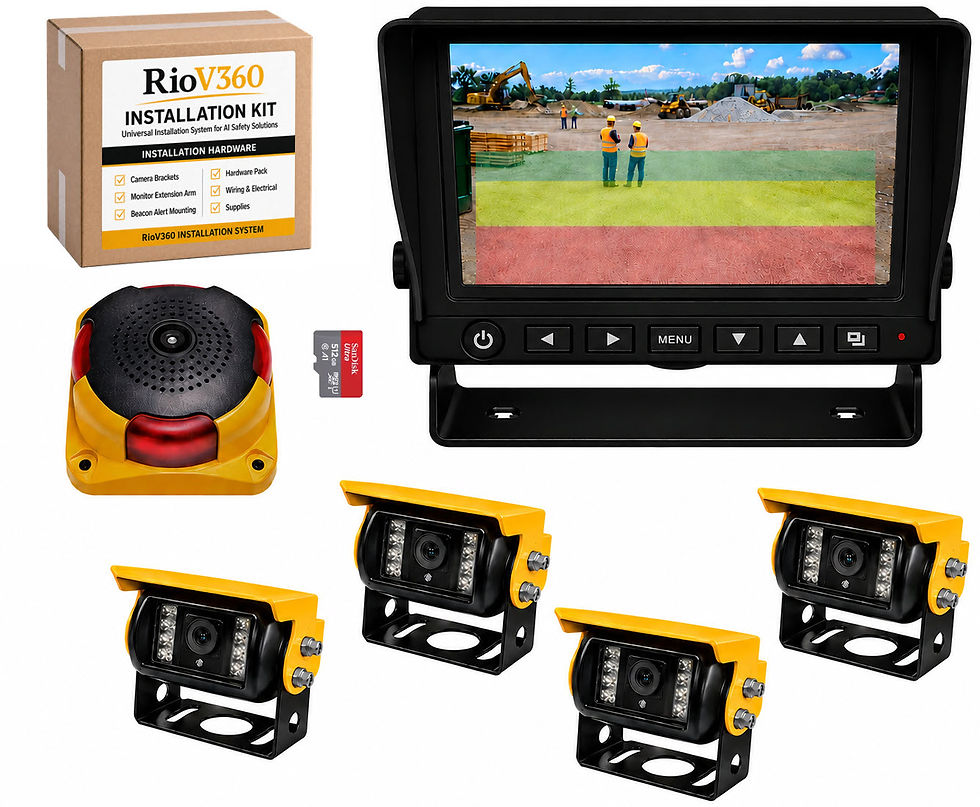
Why RioV360 Works on Active Mine & Quarry Sites
Four reasons it holds up where the ground keeps moving.
📷 360° camera coverage around loaders, haul trucks, and excavators. 1, 2, 3, or 4 cameras.
🔔 In-cab and external flashing beacon alert the second a person enters a danger zone.
💾 Onboard recording on a 256GB (Upgradable to 512GB) SD card. No cloud, no IT ticket.
🪨 Built for dust, darkness, vibration, and wash-down.
The Safe Zone Moves With Every Load
On a working site the hazard map redraws itself all shift. Benches change. Trucks cycle. A loader swings into a space that was clear a minute ago. Painted walkways and fixed barriers cannot keep pace with a quarry that moves under its own machines.
➜ Loaders working stockpiles pivot and articulate into ground that looked clear seconds earlier.
➜ Haul trucks reverse into loading zones where a spotter or maintenance hand may be standing.
➜ Excavators loading trucks swing a counterweight through space the operator cannot see.
➜ Foot traffic around crushers, conveyors, and maintenance areas crosses live equipment lanes.
➜ Dust, low light, and engine noise strip away the cues an operator would normally rely on.


Mining and Quarry Jobsite Safety
I have spent about thirty years around machine control, GNSS, and industrial safety, including years based in Santiago working with copper mines and lithium operations across Chile. One pattern I repeatedly saw on active pit floors was how quickly a clear work area could change. An operator might be focused on the haul truck, bucket, or berm while a pickup, service vehicle, or worker entered the machine’s blind side. The incident is almost never caused by the machine the operator was watching. It is caused by the movement into an area everyone assumed was clear.
Detection That Moves With the Machine
Mining and quarry equipment does not work inside a fixed safety zone. Machines reverse, slew, articulate, and move between benches all day. The detection has to travel with them.

360° Camera Coverage Around the Machine
Cameras mount around the equipment to watch the areas the operator cannot see directly. The system stitches the views into one surround image and monitors the configured danger zones at the same time.
🔹Coverage across the front, rear, and sides of the machine.
🔹 Zones configured for the machine's size and duty cycle.
🔹 No pedestrian-worn tags or devices required.
🔹 Fits loaders, excavators, haul trucks, and telehandlers.
RioV360 Knows a Person From a Pallet
A safety alert only works if the operator believes it. This one fires for people and helps reduce nuisance alerts from dust, shadows, and blowing debris.

AI That Detects People, Not Just Motion
RioV360 is trained to identify people rather than react to movement, so dust, shadows, blowing materials, and passing equipment don't set it off. When a person enters a configured danger zone, the operator gets a visual and audible warning in the cab, with the camera view showing exactly where they are before the machine moves.
🔹 Detects people specifically instead of reacting to all motion.
🔹 Provides visual and audible alerts inside the cab.
🔹 Shows the operator which camera detected the person.
🔹 Supports multiple configurable detection zones.
🔹 Helps operators maintain trust in the warning system.
The Beacon is the Real Safety Workhorse
Every system focuses on alerting the operator. RioV360 does that — but the external flashing beacon does something more important. It alerts the worker on foot at 120dB the moment they violate safe separation distance. Voice alert. Audible alarm. Flashing red light.
Workers who experience the beacon once change their behavior permanently. They do not run behind the excavator again. They do not cut through the operating zone. Instead they take immediate action to get away from a dangerous situation.
🔴 120dB voice alert + audible alarm + flashing light — all three activate simultaneously on detection
🔌 Plug-and-play — 4-pin aviation connector, connects directly to monitor harness, no configuration required

"No one wants to set off the system."
Different Machines Hide People Differently
This is not a single setup applied to every machine. Each type of equipment creates different blind spots, movements, and pedestrian hazards, so the camera positions and detection zones are configured for the machine.

Excavators
The swing radius is the trap. The counterweight can sweep into an area the operator cannot see, even when the path appeared clear seconds earlier.
Rear and side cameras keep the swing area under observation while the machine is slewing. When a worker enters the configured danger zone, the operator receives an alert before the machine reaches them.
Equipment-Specific Pedestrian Detection Applications
Wheel Loaders — Large rear blind spots and tight yard traffic make reversing a major risk. Rear and corner cameras detect a person crossing behind the loader before reverse movement becomes a problem. → wheel loader detection
Dump Trucks — Reversing is one of the highest-risk movements for haul trucks. Surround camera coverage and a configurable rear detection zone give the driver another set of eyes on the danger area. → dump truck detection
Skid Steers — A skid steer may be compact, but visibility behind and beside the machine is limited. Camera detection fills the gaps that mirrors and direct sightlines miss on job sites. → skid steer detection
Telehandlers — The boom and raised load can hide workers standing near the wheels or machine base. Cameras monitor the sides and lower areas so the operator can be alerted when a person enters the danger zone. → telehandler detection
Scrapers — Scrapers are long, fast-moving machines that can be difficult to see around during an active cut. Surround detection zones identify people who move into the machine’s operating path. → scraper detection
RioV360 System — RioV360 is the camera-and-AI platform behind these applications. The same system can be configured for different machines by adjusting camera placement and detection zones. → RioV360
Built for Dust, Wash-Down, and Vibration
RioV360 AI Pedestrian Detection System
Specifications only matter when the equipment survives real conditions. This is gear built for open pits, remote sites, and machines that run through dust, rain, vibration, and swinging temperatures.
✓ IP69K-rated cameras: Built to withstand pressure washing, driving rain, and demanding outdoor conditions.
✓ Onboard SD recording: Retrieve footage directly at the site without a cloud account or IT ticket.
✓ Wide operating-temperature range: Designed for cold mornings, hot afternoons, and changing seasonal conditions.
✓ No Wi-Fi or cloud required: The system operates on remote sites without dependable network infrastructure.
✓ AI person classification: Detects people specifically rather than reacting to every movement, dust cloud, or blowing object.
✓ Equipment-mounted installation: The system can be fitted across a mixed fleet without requiring devices to be worn by workers.

Prove It on One Machine First
You do not have to commit an entire fleet to find out whether the system works. Install RioV360 on one machine and evaluate it under your actual operating conditions with your own equipment and operators.
A single-machine pilot reveals what a specification sheet cannot. You can see whether operators trust the alerts, whether the detection zones fit the work area, whether false alarms remain manageable, and whether the recorded footage provides useful information.
On more than one pilot, the moment that won the crew over was not a near-miss at all. It was pulling the SD card at the end of a shift and seeing, from the machine’s own point of view, how often people were cutting through a zone everyone assumed stayed empty.
The pilot also gives your safety team an opportunity to collect operator feedback and make adjustments before considering a larger deployment.

Before You Buy a Mining or Quarry Pedestrian Detection System
Use this checklist to evaluate whether a system can survive the operating conditions and blind-zone hazards found around loaders, haul trucks, excavators, and quarry processing areas.
✔️ Can it identify people without alarming on every dust cloud, shadow, vehicle, or moving object?
✔️ Will it operate locally when pit Wi-Fi, cellular coverage, or site networks are unavailable?
✔️ Can safety and maintenance teams retrieve recorded footage directly from the machine?
✔️ Is installation and technical support available in English and Spanish?
➜ A mine-site system has to perform throughout the shift, not only during the demonstration. the site or earn operator trust.
✔️ Can detection zones be shaped around reversing lanes, loader articulation, and excavator swing areas?
✔️ Can the same platform be configured for loaders, haul trucks, excavators, and service equipment?
✔️ Are the cameras, connectors, and mounting hardware built for vibration, wash-down, rain, and airborne fines?
✔️ Can one high-risk machine be tested before considering a site-wide rollout?
➜ Send us the machine type and highest-risk movement, and we will recommend a starting configuration.
Common Questions About Mining and Quarry Pedestrian Detection
✅ How does RioV360 perform around quarry dust and changing light?
RioV360 uses AI person classification rather than basic motion detection. Camera placement and detection zones are configured to help reduce nuisance alerts caused by dust, shadows, moving material, and equipment operating outside the designated pedestrian zone.
✅ Which machine should we equip first?
Start with the machine that combines limited visibility with frequent pedestrian exposure. That is often a wheel loader working a stockpile, a haul truck reversing into a loading or dump area, or an excavator operating near spotters and ground crews.
✅ Can the detection zones match different mining hazards?
Yes. Rear zones can emphasize reversing hazards, side zones can cover loader articulation areas, and rear-corner coverage can monitor an excavator’s counterweight and swing radius. The configuration is based on the machine and its normal duty cycle.
✅ Does the system require the mine network or a cloud account?
No. Detection, operator alerts, beacon warnings, and SD recording occur on the machine. Footage can be reviewed on site without sending video through a mine network or cloud platform.
✅ What should we evaluate during a pilot?
Review operator response, alert accuracy, detection-zone placement, performance during dust and low-light conditions, and the usefulness of the recorded footage. A pilot should confirm that the system fits the actual traffic and production pattern before additional machines are equipped.





Evaluating Pedestrian Detection for a Mine or Quarry?
See the complete RioV360 system, request a budgetary quote, or pilot one system on your highest-risk machine
Get a Quote for Mining and Quarry Pedestrian Detection
Tell us about your equipment and operating environment. We will respond with a recommended configuration and a budgetary price. No commitment, just the information you need to evaluate the system.

.webp)
Validate RioV360 During a Real Production Shift
Start with one wheel loader, haul truck, or excavator. Evaluate the system during reversing, loading, stockpile work, shift changes, and maintenance traffic.
Review the alerts and recorded SD footage with operators and the safety team. Then decide whether the configuration should be adjusted, moved to another machine, or expanded across the site.
Questions Before You Order
Call John directly: (520) 501-0602 or Email info@riodatos.com