
AI Camera Pedestrian Detection: A Field-Level Guide

How AI vision systems identify pedestrians in industrial environments and what determines real-world performance

Introduction
A forklift operator has a direct line of sight in one direction. The vehicle behind them, the aisle to their left, and the pedestrian stepping out from behind a rack on their right. None of those are visible from the cab without turning around, and turning around at speed is a hazard. Per OSHA, powered industrial trucks are involved in approximately 85 fatal workplace accidents and nearly 35,000 serious injuries annually in the United States. Blind spots are a primary contributing factor.
AI camera pedestrian detection addresses that gap directly. A system mounted on the vehicle watches the space the operator cannot see and alerts them when a person enters a defined danger zone. The concept is straightforward. The execution involves more variables than most facilities anticipate when they first specify a system.
This article covers how AI camera pedestrian detection works at a technical level, what separates systems that perform reliably in the field from those that don't, and what EHS and operations managers should evaluate before committing to a deployment.
● AI camera systems detect any person in the coverage zone regardless of whether they are wearing any device.
● The quality of the AI model determines how the system behaves in real industrial conditions, not just in controlled testing environments.
● False positive rate matters as much as detection rate. A system that alerts too often trains operators to ignore it.
These aren't minor implementation details. They determine whether a deployed system reduces exposure or becomes background noise that operators work around.
Article Summary
● What it is. A vehicle-mounted camera system watches the operator's blind spots and alerts when a person enters a danger zone. No tag, no wearable, no enrollment on the worker's side.
● What decides performance. The AI model's training, the false-alert rate, and how well the hardware holds up to dust, glare, and washdown. Not the spec sheet.
● The one habit that matters. Test a single machine in your own conditions before any fleet decision. The demo environment rarely matches the morning shift.
How AI Camera Pedestrian Detection Works
The system operates in three functional layers that work together in real time. Understanding each layer helps explain why two camera systems with similar specifications can perform very differently in the same facility.
Layer one: image capture
One or more cameras mount on the vehicle and stream continuous video. Field of view, resolution, frame rate, lens quality, and how well the cameras survive the environment all affect what the system can see and how early it can see it.
Field of view is the first variable that matters operationally. A single rear-facing camera covers the blind spot directly behind the vehicle. A multi-camera installation, typically two to four cameras covering the full vehicle perimeter, sees every approach angle simultaneously. The difference between the two is significant in facilities where pedestrian traffic doesn't come from one predictable direction.
Lens selection affects performance in ways that aren't obvious from a spec sheet. Wide-angle lenses capture more of the surrounding space but introduce distortion at the edges that the AI model must compensate for. Narrow lenses provide better image quality at distance but leave gaps in close-range coverage. Most industrial systems use lenses in the 100-160° range as a practical compromise.
Camera durability belongs in the same conversation as optics. Industrial cameras face dust, vibration, temperature swings, and regular washdown. A unit sealed against dust and rated for high-pressure water keeps producing a clean image in conditions that would fog, corrode, or blind a consumer-grade camera. The detection model can only work with the image it receives. A lens caked in grime or a housing cracked by vibration quietly undermines every layer downstream, and it rarely shows up on a spec sheet.
Frame rate determines how much time the system has to process each image and generate an alert before a hazard develops. Higher frame rates give the AI model more opportunities to confirm a detection before alerting, reducing false positives. Lower frame rates save processing power but can introduce latency in fast-moving situations.
Layer two: the AI inference engine
This is where pedestrian detection happens. An onboard processor runs a trained object detection model against each incoming video frame. The model looks for the visual signatures of a human being: body proportions, movement patterns, the way a person occupies space differently from equipment, materials, or structural elements. Many models also classify other vehicles and equipment, allowing the system to distinguish a person on foot from a passing machine and alert accordingly.
The model is trained on a dataset of labeled images. The breadth and relevance of that dataset to real industrial environments determines how well the model performs outside of controlled conditions.
"We ran a system in a cold-storage environment for thirty days before we understood the training gap. Workers in heavy insulated gear with hoods up look different enough from the training images that detection rates dropped noticeably. The vendor had to retrain the model on our specific environment."
This is one of the most important questions to ask when evaluating any AI camera pedestrian detection system: what environments and worker appearances was the model trained on? A model trained primarily on standard warehouse conditions with workers in summer-weight hi-vis vests will underperform in environments where workers wear cold-weather gear, face shields, or non-standard PPE. It may also underperform when workers are crouched, carrying large objects, or partially obscured by shelving or equipment.

Detection confidence threshold is the second variable in the inference layer. The model assigns a confidence score to each potential detection. A high threshold means the system alerts only when it is very confident that a person is present, which reduces false positives but increases the risk of missing a detection. A lower threshold catches more people but generates more alerts on non-human objects. Most systems allow this threshold to be adjusted during commissioning. Getting it right for a specific facility takes real-world calibration, not just factory settings.
Processing location matters too. Systems that run inference on an onboard edge processor do not depend on network connectivity. Detection and alerting occur in milliseconds, regardless of what the facility's WiFi or cellular infrastructure is doing. Cloud-dependent systems can introduce latency or fail entirely during network outages. For a safety-critical application, edge processing is the more reliable architecture.
Layer three: zone logic and alert output
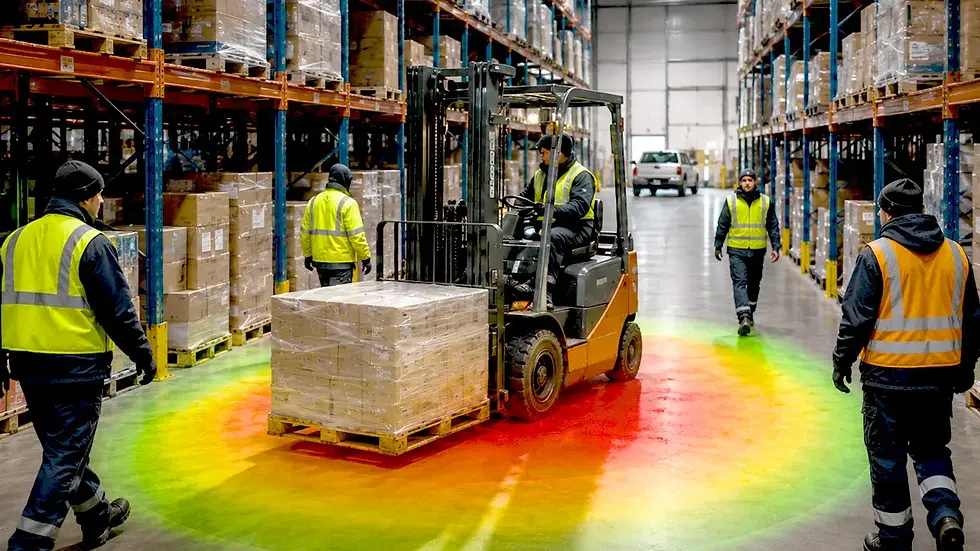
The third layer defines how the system handles a confirmed detection. Most AI camera pedestrian detection systems allow operators to configure one or more detection zones around the vehicle. When a person is confirmed inside a zone, the system triggers an alert.
Zone configuration is the process of tuning the system's behavior to the specific operating environment. A common setup uses two concentric zones: an outer warning zone where the system alerts the operator that someone is nearby, and an inner danger zone where the alert escalates to an urgent warning. Some systems add a third graduated band, and many present each zone on the in-cab display as a color-coded overlay so the operator can read severity. Some systems also alert the pedestrian directly through a strobe light or audible signal mounted on the vehicle exterior.
More advanced systems offer speed-adaptive zone logic, which is a meaningful step beyond fixed zones. In a fixed-zone system, the danger boundary is the same whether the vehicle is crawling at two kilometers per hour or moving at fifteen. In a speed-adaptive system, the zone grows as speed increases, giving the operator more time to react.
The physics is the reason these matters. Stopping distance does not rise in a straight line with speed. It scales roughly as the square of speed, so doubling travel speed can quadruple the distance required to stop. A boundary sized for a slow crawl leaves almost no margin at travel speed, and a boundary sized for travel speed would nag the operator constantly at low speed. Tying the zone to actual vehicle speed keeps the margin honest across both.
"Speed-adaptive zones changed how our operators thought about the system. It wasn't just an alarm anymore. It was giving them information that matched what the vehicle was actually doing."

Alert output format affects operator behavior more than most safety managers expect. An audible tone in the cab alerts the operator. A visual display showing which zone the pedestrian is in tells them something more useful: not just that someone is nearby but roughly where. Systems that combine audio alerts with a live camera feed in the cab give the operator the most complete picture. They can hear the alert and immediately see what triggered it.
Evidence capture is a function that often gets underweighted during the evaluation process. Systems that record video triggered by detection events create a timestamped archive of every near-miss event in the facility. Most units record on a continuous loop, overwriting the oldest footage first, while allowing an operator or a triggered event to lock a clip so it survives that overwrite cycle. Storage capacity decides how many days of multi-camera footage stay available before the loop comes back around.
That data has value beyond the immediate safety function: it shows where exposure is concentrated, which shifts and traffic patterns generate the most events, and what the vehicle and pedestrian were doing at the time of detection. It also has value for incident investigation, insurance, and regulatory compliance.
Key Takeaways
● False positives are the silent killer of these systems. A system that cries wolf too often gets ignored, which makes it worse than having no system at all.
● Environmental limits are real. Heavy dust, direct glare, steam, and low light all degrade camera performance. Know which of these your facility has before you buy.
● Speed-adaptive zones and event-triggered evidence capture separate strong deployments from disappointing ones.
● Camera systems detect anyone in the zone without a tag, and they pair well with radar or RFID in extreme conditions where vision struggles.
Bottom line. Treat the first deployment as a calibration project, not a set-and-forget installation. Facilities that test under real conditions and tune the system achieve higher operator adoption and better safety outcomes.
What Separates Systems in the Field
The three-layer architecture describes how AI camera pedestrian detection works in principle. What separates systems in practice comes down to four factors that only become visible under real operating conditions.
The false positive rate is first, and it is the one most facilities underestimate. A system that fires frequent false alerts on empty spaces, static objects, or reflections teaches operators that the alerts don't mean anything. That learned dismissal doesn't stay contained. It bleeds into real detections. In most operations, a detection system with a high false-positive rate is worse than no system at all because it actively degrades the operator's response to genuine hazards.
Environmental performance is the second. Every camera system has conditions it struggles with, and those conditions are routine rather than exotic. A system that looks flawless in a controlled demonstration can behave differently on a real morning shift, when the dock doors are open and low sun is cutting across the lens at an angle. The demo tells you the ceiling. Your own facility tells you the floor.

Installation quality is third. Camera positioning determines what the system can see. A camera mounted too high loses close-range coverage. A camera angled to capture the vehicle's own structure in the frame creates a constant source of false positives. Lens contamination from dust, mud, or condensation degrades image quality in ways the system may not flag as a fault. The physical install and its upkeep are part of performance, not separate from it.
Operator integration is the fourth. A system that forces operators to change how they work will meet resistance. Systems that deliver information in a format that fits the existing workflow get adopted. A tone. A glance at a display. A light. Systems that demand a separate screen or a complex alert sequence get ignored or quietly disabled.
What we're seeing across facilities is that the evaluation process leans hard on detection specifications and not enough on these four operational factors. A system with strong detection numbers that floods the cab with false positives, fades in dust, was poorly installed, and interrupts the operator's natural workflow will lose to a more modest system that was commissioned correctly and fits how the facility runs.
Why AI Camera Pedestrian Detection Matters Now
The technology has matured significantly in the past five years. AI models are more accurate. Edge processors are faster and cheaper. Multi-camera installations that once required significant custom integration now ship as complete systems. The cost of entry has dropped to the point where a single-machine evaluation is practical before any fleet commitment.
What hasn't changed is the evaluation discipline required to select and deploy a system that performs over time. The facilities getting the most from AI camera pedestrian detection are the ones that tested in real conditions before committing, commissioned the system correctly for their specific environment, and treated operator adoption as part of the deployment rather than an afterthought. The most reliable way to find that out is to run one machine in your own conditions before scaling.
The category is heading toward pairing camera AI with radar or other sensors. It helps to see the two as opposites that cover each other's blind spots. A camera classifies. It can tell a person from a pallet or a passing machine, but it needs usable light and a clean lens to do it. Radar does the reverse. It senses presence and motion through dust, steam, and darkness, but it does not tell you what it detected.
Run them together and the combined output holds up across more of the operating environment than either one alone. That approach is already showing up in specifications at larger operations and will become more common as the technology matures.
AI Camera Pedestrian Detection: Evaluation Checklist
Use this checklist when evaluating systems for your facility.
Category | Evaluation Question | What to Look For |
AI Model | What environments was the model trained on? | Cold storage, dust, PPE variety |
False Positives | What is the false positive rate in your conditions? | Test in real conditions, not a demo |
Processing | Does inference run on the edge or in the cloud? | Edge means no network dependency |
Coverage | How many cameras cover which zones? | Full perimeter vs rear-only |
Zone Logic | Are zones fixed or speed-adaptive? | Speed-adaptive preferred |
Evidence Capture | Does the system record triggered events? | Timestamped video archive |
Installation | Who commissions the system in live conditions? | Vendor or certified installer on-site |
Environment Test | Has it been tested in your actual facility? | Dust, glare, steam, low light |
Operator Adoption | How does the alert format fit operator workflow? | Audio plus visual display preferred |
Pilot Scope | Can you start with a single-machine evaluation? | Commit after a real-conditions test |
Frequently Asked Questions
How does AI camera pedestrian detection differ from RFID proximity systems?
AI camera systems detect any person entering the coverage zone through video analysis. No wearable device is required. RFID proximity systems detect only workers wearing a functioning tag. Camera systems automatically protect untagged contractors, visitors, and temporary workers. RFID systems perform reliably in environmental conditions where cameras struggle, including heavy dust, darkness, and steam.
What is a false positive in a pedestrian detection system and why does it matter?
A false positive is an alert triggered by something that is not a pedestrian: a static object, a reflection, an environmental condition. False positives matter because operators who experience frequent false alerts develop a habit of dismissing or ignoring them. That learned dismissal applies to both real and false detections. Managing false positive rate is as important as managing detection rate when evaluating any AI camera system.
What environmental conditions affect the performance of AI camera pedestrian detection?
Camera systems degrade in heavy airborne dust, direct sun glare, steam from washdown operations, and very low light conditions. Performance varies by system depending on sensor quality and how the AI model was trained. Evaluating a system in the actual environmental conditions of the target facility before deployment is the most reliable way to understand real-world performance.
What is speed-adaptive zone logic in a pedestrian detection system?
Speed-adaptive zones expand the detection boundary as vehicle speed increases, giving the operator more time to respond at higher speeds. Fixed-zone systems use the same detection boundary regardless of speed. Because stopping distance increases with roughly the square of speed, speed-adaptive logic maintains a realistic safety margin in a mixed-speed operating environment where a fixed boundary cannot.
Author Perspective
AI camera pedestrian detection is the technology I've spent the most time with in industrial environments. What I've learned is that the specification process and the deployment reality are two different things. A system that meets every evaluation criterion in a controlled demonstration can still underperform in a facility with morning sun glare through dock doors, seasonal workers in non-standard gear, and operators who were never properly trained on what the alerts mean.
The facilities that get consistent results treat the first deployment as a calibration exercise, not a final installation. They watch false positive rates in the first weeks. They adjust detection thresholds based on real conditions rather than factory defaults. They track where alerts cluster and use that data to improve both the settings and the facility's traffic management. More of my thinking on this is at johnbuttery.com.
The evidence capture function is the piece I'd encourage more safety teams to take seriously during evaluation. The alert is the immediate safety function. The recorded data is what turns a detection system into an operational intelligence tool. Knowing which intersection generates the most pedestrian events, which shift carries the highest exposure frequency, and what the vehicle was doing at the moment of each detection gives a safety team something to act on beyond the individual incident.
About Riodatos
Riodatos is a U.S.-based industrial safety technology company headquartered in Arizona. We supply, configure, install, and support AI camera and proximity detection systems for forklifts and heavy equipment. We ship from our domestic inventory and offer direct pricing, certified installation, and technical support across the Americas.
Every engagement starts with a single-machine evaluation in real operating conditions, so a safety team can see measurable performance before any fleet or multi-site commitment.

Sources
---

