
CCTV AI Safety: The Tech Every EHS Team Must Add in 2026
- John Buttery

- Jun 18
- 12 min read
One of the fastest safety upgrades many facilities can evaluate in 2026 runs on cameras they already own.

Introduction
Most facilities already have the hardware. Cameras sit in nearly every dock, aisle, and yard. The footage rolls all day, and almost nobody watches it until something goes wrong.
That is the gap. Cameras record. They do not warn, count, or learn. A supervisor reviews a clip after an injury, after a damaged rack, or after a near miss that someone happened to report. The visibility was always there. The intelligence was not.
CCTV AI safety closes that gap. It takes the camera feeds a site already runs and adds software that watches them in real time, flags risky patterns, and turns raw video into something an EHS team can act on before an incident happens. In many facilities, that means no new poles, no major rewiring, and little change to how the floor operates.
The thesis of this article is simple. One of the highest-leverage safety moves available to many operations in 2026 is not buying more equipment. It is putting intelligence behind the cameras already on the wall.
✓ The footage exists, but no one can watch every feed at once, so exposure goes unseen until it becomes an injury.
✓ Safety data today is almost entirely lagging. Teams measure what has already happened instead of what is about to happen.
✓ The barrier was not the cameras. It was the cost and labor of human eyes watching every feed at once, and AI is now making that barrier much easier to overcome.
These are not new problems. What is new is that the technology to address them is practical, deployable, and producing real field data.
Key Terms Used in This Article
CCTV AI safety: Real-time AI software added to existing camera feeds so safety teams can identify risk patterns before they become incidents.
AI video analytics workplace safety: The broader category of tools that analyze video for unsafe conditions, exposure frequency, and coaching opportunities.
CCTV AI pedestrian detection: Camera-based detection focused on workers entering vehicle lanes, restricted zones, blind corners, docks, aisles, and other high-risk areas.
AI-powered CCTV forklift safety: The use of existing CCTV feeds to identify pedestrian-and-forklift exposure around industrial equipment.
CCTV AI safety pilot warehouse 2026: A contained evaluation in one high-traffic warehouse zone before a broader rollout.
The Numbers Behind the Risk
Safety leaders do not need convincing that the floor is dangerous. They need the exposure quantified because that is what moves a budget. The recognized sources tell a consistent story.
➜ The U.S. Bureau of Labor Statistics recorded 5,070 fatal work injuries in 2024, which works out to a worker dying from a work-related injury roughly every 104 minutes.
➜ In 2024, 84 workers died in incidents involving forklifts, order pickers, or platform trucks, according to BLS data compiled by the National Safety Council.
➜ OSHA estimates that forklifts are involved in about 34,900 serious injuries and 61,800 non-serious injuries each year in the United States.
➜ Roughly 36 percent of forklift fatalities involve pedestrians, per OSHA, which is the exact pedestrian-and-vehicle conflict that camera-based detection is built to catch.
➜ Contact incidents, the BLS category that includes being struck by or caught in equipment, were the leading cause of days-away-from-work cases in 2023 and 2024, with 860,050 cases requiring days away, restriction, or transfer.
➜ The National Safety Council and Liberty Mutual put the cost of the most disabling workplace injuries to employers at more than 58 billion dollars a year, which is more than one billion dollars every week.
Here is the through line.
The events doing the most damage, pedestrian conflict and being struck by equipment, are exactly the patterns a camera can see, and a person cannot watch for around the clock. The data has been telling safety teams where to look for years. The missing piece was something that could watch consistently and turn what it saw into useful safety action.
What CCTV AI Safety Actually Does on the Floor
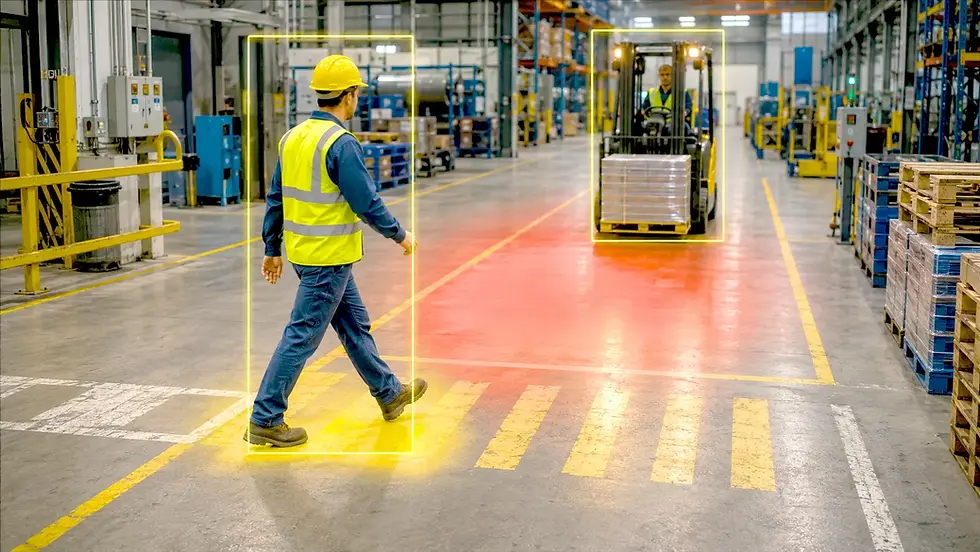
Strip away the marketing, and the function is concrete. The system reads existing camera streams and recognizes situations a human reviewer would flag if that reviewer could watch every feed all the time. A person on foot drifts into a forklift lane. A worker enters a restricted zone. Missing PPE appears at a station that requires it. A pallet is stacked in a way that blocks an egress path. This is where AI video analytics for workplace safety becomes practical. The software detects the pattern, logs it, and can alert in real time.
What we see across facilities is a shift in the measures safety teams use. Instead of counting incidents after the fact, they start counting exposure frequency.
🔹How many times this week did someone cross into the active zone?
🔹How often did the pattern that precedes a collision occur?
🔹How many docks, aisles, or intersection exposures were visible before anyone reported a near miss?
That is the move from lagging indicators to leading indicators, and it changes the entire conversation a safety manager has with leadership.
It runs on infrastructure you already own
This is the part that lands with operations leaders. The cameras are installed. The cabling is run. The system integrates with existing feeds and can process video to meet the facility’s operational requirements. For a CEO, this can mean a lower-friction path than many traditional safety technology projects. The floor operates much as it did yesterday, except that the camera coverage now produces safety intelligence rather than passive recordings.

It produces operational intelligence, not just alerts
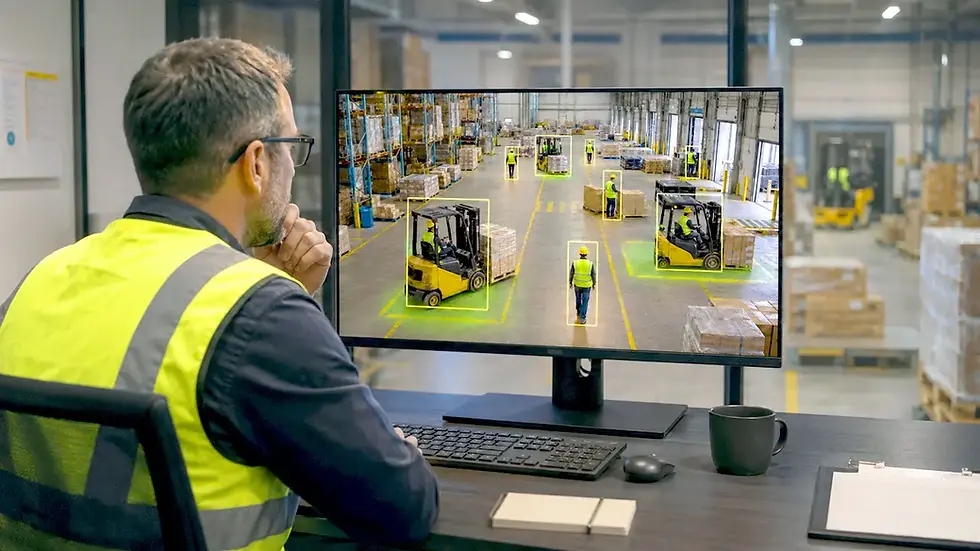
Real-time warnings matter, but the greater value lies in the data trail. Over weeks, the system builds a map of where exposure clusters, which shifts carry more risk, and which intersections generate the most close calls. In many operations, that map reveals risk hot spots nobody had quantified before. You stop guessing where to put resources. You aim them.
It coaches behavior instead of punishing it
The strongest programs use the footage to coach, not to catch. A short clip of a near miss, shown to the crew the next morning, does more to change behavior than a written policy ever will. The camera is not there to discipline. It is there to show people what they could not see from inside the cab or behind the pallet.

The platforms competing in this space
The category has filled out fast. A growing field of vision platforms now approaches the same problem from different angles. Some process video on-site, while others process it in the cloud. Some focus on pedestrian-and-vehicle conflict, while others lead with PPE compliance, ergonomics, or general AI video analytics for workplace safety. The differences matter more than the marketing suggests, so it pays to compare before shortlisting.
A simple way to compare the categories is to ask five questions.
🔸 Does it work with the cameras already installed?
🔸 Does it detect pedestrian-and-vehicle conflict in the specific zones that matter?
🔸 Does it process video on-site or in the cloud?
🔸 Does it support coaching and leading-indicator reporting?
🔸 Does it fit the facility’s lighting, camera angles, traffic flow, and privacy requirements?
Those questions matter more than the brochure.
Riodatos works as a partner on the inviol platform in this category, so when a team wants to move past reading and see one of these systems running on a real floor, we can help set that up instead of handing over another brochure.
Why CCTV AI Safety Belongs in Your 2026 Plan
Here is the catch with safety budgets. Every dollar competes with production, and "we might prevent something" is a weak argument against "this will ship product today." CCTV AI safety can win that argument because it does not have to create a major tradeoff. It does not have to slow the line, add headcount, or start with a large hardware project. In the right facility, it can use existing assets and begin producing measurable leading indicators within weeks.
That combination is rare, and decision-makers understand it quickly. In recent conversations with CEOs at large operations, the reasons for moving forward were consistent. Limited operational disruption. No major procedural overhaul. A contained way to test the technology before any broader commitment. Just intelligence layered onto cameras the company already paid for. When the friction is low and the visibility is high, the decision becomes easier.
A concise list of what makes the approval fast:
🔹 Little or no new hardware to specify, source, or install in many facilities.
🔹 No change to how operators, drivers, or crews do their jobs.
🔹 Insights arrive as leading indicators, not as a post-incident report.
🔹 The footage serves as both a coaching tool and a record of disputes.
🔹 A pilot can run in one zone before any site-wide commitment.
If you sit on an EHS or operations team, CCTV AI safety should be on your 2026 evaluation list. The technology has moved from promising to practical, and the operations that evaluate and adopt it early can start building a data advantage that their peers may spend years trying to match.
This is especially true for teams searching for AI video analytics for workplace safety, CCTV AI pedestrian detection, or AI-powered CCTV forklift safety, all of which can be tested in one controlled area before a larger commitment. This is a good moment to bring it into your planning conversations.
Author Perspective
I have spent close to thirty years in industrial safety and machine control, much of it watching good teams do everything right and still get surprised by an incident nobody saw coming. The hard truth is that human attention does not scale. A safety manager cannot stand at every blind corner. A supervisor cannot watch forty feeds at once. For most of my career, that was simply the ceiling, and we worked under it.
What changed is that the ceiling moved. The cameras were always able to see. Now the software behind them can understand, and that understanding at scale is what safety teams have wanted for decades. I wrote a field guide for exactly this decision, Preventing Pedestrian Collisions: EHS Guide to Forklift Safety Systems, with an entire chapter devoted to CCTV AI safety systems and a framework for evaluating and validating detection technology before a full rollout. I keep writing about where this is heading at johnbuttery.com, because the move from reaction to prediction is the most important change in this field in a generation, and I would rather operators hear it framed honestly than sold.

Why This Matters Now
Safety has lived on lagging indicators for too long. Recordable rates, incident counts and claims filed. All of it measures the past. None of it tells a manager what will happen on the floor this afternoon. The reason was practical. You could not measure exposure in real time without an impossible amount of human attention.
That constraint is gone. CCTV AI safety lets a team measure leading indicators directly, shifting the conversation from explaining last quarter's injuries to preventing next quarter's. Organizations often discover that the patterns preceding serious incidents were already happening quietly, in plain view of cameras nobody was watching. Once you can see those patterns, you can act on them. That is the whole point, and it is why this belongs in the 2026 planning conversation rather than the maybe pile.
"The footage was never the problem. We had years of it. We just never had a way to watch all of it at once, and that turned out to be everything."
The Riodatos Role
The right way to bring this in is the same as you would any safety technology. Prove it in live conditions before you scale it. Start with one zone or one high-traffic area, run it against your real traffic and your real crews, and measure what it surfaces. A focused pilot tells you more in two weeks than a vendor deck tells you in two months, and it lets the floor build trust in the system before it goes site-wide.
That is the practical value of a CCTV AI safety pilot that warehouse teams can run in 2026: one area, real traffic, real crews, and measurable exposure data. Before that, it helps to know the landscape. We keep a running rundown of the leading CCTV AI safety platforms on the market so teams can see how the approaches differ before they commit to one.
That is how we work with operations evaluating this category. We help a team stand up a contained evaluation, watch the leading indicators it produces, and decide based on field behavior rather than promises. If you want to see how a CCTV AI safety pilot would look in your facility, the fastest path is a short conversation.
You can reach us through riodatos.com/contact and we will set up a demo with the right experts for your environment. We would rather show you the technology working on a real floor than talk about it in the abstract.
Frequently Asked Questions About CCTV AI Safety
What is CCTV AI safety?
CCTV AI safety is software that adds real-time intelligence to the camera feeds a facility already runs. Instead of passively recording, the system reads each feed, recognizes risky patterns such as a person crossing into a vehicle lane, and can alert in the moment. It turns existing footage into leading indicators an EHS team can act on before an incident.
Do I need to buy new cameras or hardware?
Not always. The premise of CCTV AI safety is that many cameras are already installed. The software connects to existing feeds, so there may be no new wiring, no shutdown, and no major capital project for many operations. Some sites add or move a camera to cover a specific blind spot, but the starting point is the infrastructure you already own.
How is this different from the security cameras we already run?
Security cameras record. They do not understand what they see. A CCTV AI safety layer adds recognition and alerting, so footage stops being something you review after an incident and becomes something that warns you before one. The hardware can be identical. The intelligence behind it is what changes.
What can CCTV AI safety detect?
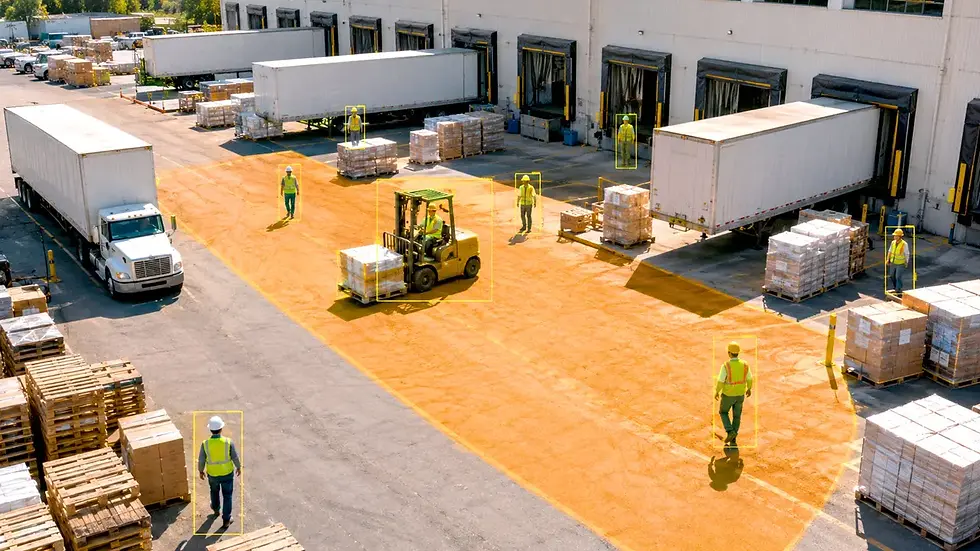
Common detections include pedestrian-vehicle conflicts, entry into restricted zones, missing PPE at stations that require it, and blocked egress paths. Exact capabilities vary by platform, so comparing options is worth the effort. For some facilities, the priority is CCTV AI pedestrian detection. For others, it may be AI video analytics for workplace safety across multiple risk categories. The shared goal is measuring exposure frequency, the patterns that precede incidents, rather than counting incidents after they happen.
How fast can we get started, and how do we know it works?
Pilot it. Run the system in one high-traffic zone against your real traffic and your real crews, then look at what it surfaces over a few weeks. A contained pilot shows the leading indicators in live conditions and lets the floor build trust before any site-wide rollout. You can start that conversation through riodatos.com/contact.
Conclusion
The safety teams that win in the next few years will not be the ones with the biggest budgets. They will be the ones who saw earlier than their peers that the visibility they needed was already in place and waiting for intelligence. CCTV AI safety is not a moonshot. It is a practical upgrade to assets a facility may already own, and it moves a program from reacting to predicting.
For EHS leaders evaluating AI video analytics for workplace safety, CCTV AI pedestrian detection, or AI-powered CCTV forklift safety, the best first step is not a full rollout. It is a focused pilot in one real operating zone.
The cameras have been watching for years. The only question left is whether anything is learning from what they see.
"You do not get safer by recording more. You get safer the day something finally understands what the camera is looking at."
About Riodatos
Riodatos is a U.S.-based industrial safety technology company headquartered in Arizona, with domestic inventory and direct distribution across the Americas. As an authorized distributor for inviol proximity detection systems, we bring deep expertise in pedestrian and vehicle safety to facilities operating forklifts and heavy equipment.
We supply, configure, install, and support inviol solutions tailored to the specific equipment mix, traffic patterns, and risk profiles of individual facilities. Our work spans warehousing, manufacturing, construction, and logistics operations across the Americas, with an emphasis on matching the right configuration to each site and eliminating overseas fulfillment delays.
Our approach is built around measurable live performance, operator adoption, and scalable deployment across mixed fleets and multi-site programs. Direct pricing, fast U.S. shipping, certified installation, and English/Spanish support mean safety teams can focus on protection rather than procurement logistics. Every engagement starts with a contained evaluation in real operating conditions before any facility-wide commitment is made.
Quick Read
⚠️CCTV AI Safety: The Tech Every EHS Team Must Add in 2026. 🦺 Your facility already records hours of footage every day, and almost none of it gets watched until after someone gets hurt. The cameras were never the problem.
🔎The missing piece was something that could watch every feed at once and warn you before the incident. That piece now exists, and it is why more EHS and operations leaders are evaluating CCTV AI safety, AI video analytics workplace safety, and CCTV AI pedestrian detection in 2026.
▪ The hardware may already be on the wall. CCTV AI safety adds intelligence to cameras you already own, often with no new poles and no major rewiring.
▪ It can run with limited disruption to the floor. No broad shutdown, no major retraining program, and a contained pilot before any larger commitment.
▪ It converts passive footage into leading indicators, so you measure exposure before it becomes an injury.
▪ The same clips that flag a near miss become your best coaching tool the next morning.
▪ Many sites identify risk hot spots that they had not previously quantified within the first few weeks.
▪ You can prove it in one zone before committing the whole facility, which is why a CCTV AI safety pilot warehouse project is often the right first step.
📊 The teams evaluating this now are starting to build a data advantage that their competitors may spend years trying to match.
➜ Is your 2026 safety plan still based on last year's incidents, or is it finally monitoring this afternoon's risk?
---
#CCTV #AISafety #EHS #ForkliftSafety #WarehouseSafety #IndustrialSafety #AI #ComputerVision #LeadingIndicators #SafetyLeadership #PedestrianDetection #VideoAnalytics


