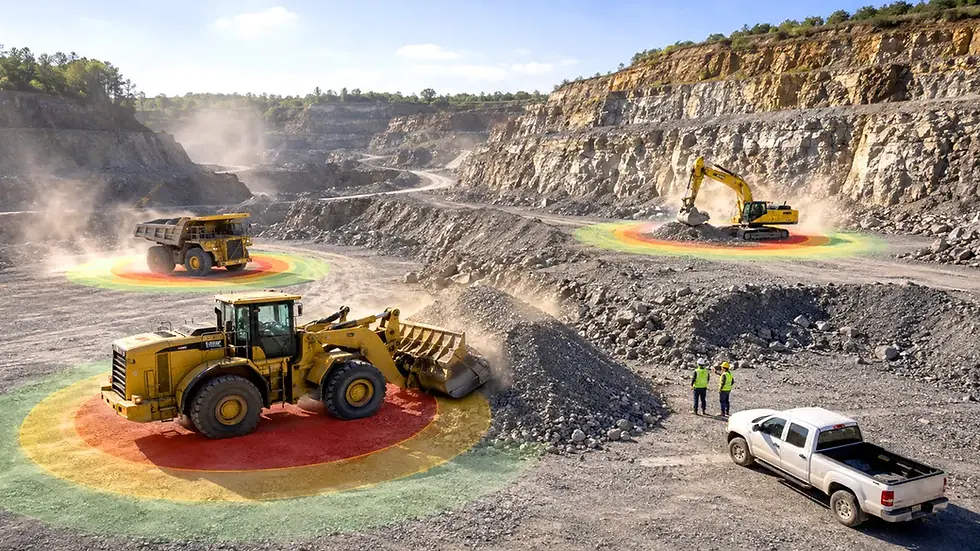
Cloud Video Storage on Industrial Pedestrian Detection Systems

A connected safety camera is easy to buy. The part that follows the purchase order is a stream of recorded footage that has to live somewhere, and cloud video storage is rarely the simple convenience it appears to be in the brochure.

Introduction
The demo makes it look effortless. A camera sees a person, an alert fires, and clips flow up to a tidy dashboard you can review from anywhere. Modern, clean, done.
Then the recordings start piling up. Every machine, every shift, every day, feeding footage of your people into a system that keeps it somewhere off-site. That is the quiet reality of cloud video storage on a pedestrian detection system. It is not a feature you switch on and forget. It is an ongoing obligation that extends to legal, IT, and labor questions the sales conversation never raised.
This is a companion to a broader look at the subscription and video liabilities that come with connected safety hardware. Here the focus narrows to one piece of that puzzle. Where does the video go, who is responsible for it once it lands there, and what does that responsibility cost?
What Cloud Video Storage Changes About a Detection System
A camera that records locally is a tool. A camera that streams footage to an off-site archive is a data pipeline, and pipelines have owners, costs, and rules.

The shift is easy to miss because nothing in the cab looks different. The change happens behind the scenes, in whose name the footage sits and who has to answer for it.
The Video Becomes a Corporate Record
Once recordings of your workforce are captured and kept, they stop being casual footage. They are a corporate record. That record can be requested in a dispute, reviewed in a claim, or examined after an incident. The moment cloud video storage enters the picture, your Legal Department has a stake in a purchase that started as a safety upgrade. Recorded people, kept over time, is a legal matter whether anyone planned for it or not.
Where the Footage Physically Lives
Cloud is a comfortable word. It suggests the video is simply somewhere safe. In practice, it lives on specific servers owned by a specific company, often in a location the buyer never asks about.

Many connected systems send video segments off the machine to the provider's servers for analysis, and those servers often reside in another country. That single detail changes the whole conversation. Footage of your people becomes data held by a foreign company, under a foreign legal system, moving across borders on someone else's schedule and security. It is one thing to run a camera on your own site. It is another to hand recordings of your workforce to an archive you do not control and cannot audit.
The Cost Nobody Quotes Up Front
Storage is not free, and it does not stay flat. As machines multiply and footage accumulates, the recurring cost of holding all that video keeps climbing. Retention rules, data volume, and access all feed the bill. What looked like a modest monthly number at signing tends to grow quietly, and it never really ends as long as the cameras keep recording.
The Liabilities That Ride Along With Cloud Video Storage
Owning off-site video is not a single decision. It is a set of ongoing responsibilities, and each one lands on a different desk. Before signing, these are the questions worth putting on the table.
How long is footage retained, and who sets and enforces that schedule?
Who can view the archive, from where, and is every access logged?
How is the video protected in transit and at rest, and who is liable if it leaks?
Under whose laws is the footage stored, and does it cross a border to get there?
Can stored clips be used in productivity or disciplinary decisions, and does that trigger bargaining?

Retention and Legal Discovery
A retention schedule sounds like a small setting. It carries real weight. Keep footage too briefly, and it can look like you disposed of evidence. Keep it too long, and every clip becomes discoverable in a dispute or claim. Someone has to own that schedule and defend it, and organizations typically discover this only after the archive is already full. Cloud video storage makes the question unavoidable because the system retains everything by default unless a policy says otherwise.
Breach Exposure and Chain of Custody
Any archive of footage is a target and a responsibility. If the store is breached, recordings of your people are exposed, and the liability follows the data. There is also the quieter matter of chain of custody. If a clip is ever going to matter in a proceeding, someone has to show it was captured, stored, and handled in a way that holds up. That is hard to guarantee when the footage resides on a third-party's servers and passes through systems you cannot see.
Cross-Border Transfer and Jurisdiction
When video leaves the country for analysis or storage, jurisdiction gets tangled. Different regions govern recorded personal data differently, and moving footage of your workforce across a border can pull in rules the buyer never intended to sign up for. For many operations, learning that the video travels overseas is the moment the evaluation stops. Rightly so. A safety benefit does not usually justify handing worker recordings to another legal system.
Union and Privacy Considerations
Stored, reviewable video of how people work can be read as employee monitoring. That reading matters in a unionized environment, where data related to productivity or discipline can trigger bargaining obligations and grievances. Cloud video storage raises the stakes because the footage is now retained, searchable, and shareable rather than gone at the end of a shift. A tool bought to protect people can become a labor question the first time a stored clip gets used the wrong way.
Author Perspective
I have spent about thirty years around machine control, GNSS, and industrial safety, and I have watched the difference between a safety tool people trust and a data system people quietly resent. Cloud video storage sits right on that line. Handled well, footage can be genuinely useful. Handled as an afterthought, it becomes a liability the buyer never priced in.
My honest bias, earned over time, is to keep the video under the customer's control. Local recording that stays on the equipment and on your network answers most of these questions before they are asked. There is no border to cross, no foreign archive to audit, and no third party holding recordings of your people. More of how I think about this is at johnbuttery.com.
Why This Matters Now
Safety teams are moving from lagging measures to leading ones, and that shift is worth making. Exposure frequency and human-machine behavior tell you more than counting incidents after the fact. A pedestrian detection system is a good way to make that exposure visible.

Here is the catch. Operational intelligence only helps if the data behind it does not create a bigger problem than the one it solves. A dashboard full of exposure events means little if legal freezes the rollout over where the footage lives, or if the recurring storage bill outgrows the safety budget. Where the video is kept is part of the decision, and it deserves more weight than it usually gets.
The Riodatos Approach: Prove It on One Machine First
The clearest way to answer all of this is to skip the brochure and put one unit on your worst machine. Not the whole fleet. One machine, in live conditions, run by your operators, with the video recorded and held under your control rather than routed to someone else's archive. Watch how it performs, how it gets serviced, and whether it keeps the footage where it belongs.
That is the whole idea behind a single-machine evaluation. Reduce the risk of a rollout that looks clean on paper and then runs into storage costs or legal questions by proving the system in the field first. You can start by validating one machine first, reach a person directly through contact, or book time at calendly.com/john-buttery-riodatos/30min. Test the reality your team will live with, including who ends up holding the video.
Conclusion
Here is the honest bottom line. Cloud video storage on a pedestrian detection system is not a convenience you switch on and forget. It is an ongoing obligation, with recurring costs, retention duties, breach exposure, and a jurisdiction question the moment footage of your workers leaves the country. That weight lands on legal and IT long after the safety win is booked, and it does not go away as long as the cameras keep recording.
In industrial equipment, the strongest position is also the simplest. Keep the video where you can account for it, on your own site and under your own control, so the footage protects your people instead of becoming something you manage and answer for year after year.
"The best footage policy is the one you can explain to your own lawyer without flinching."
About Riodatos
Riodatos is a U.S. company based in Arizona with domestic inventory on the shelf, and the maker of RioV360, an AI 360-degree pedestrian detection system built for heavy equipment and mixed industrial fleets. RioV360 gives operators in-cab alerts and onboard recording, with the footage kept on your own site and under your control.
We supply, configure, install, and support it across warehouses, factories, construction sites, quarries, and logistics operations throughout the Americas, tailored to your specific equipment, traffic, and site risks. The clearest way to see it is a RioV360 PILOT unit, a single machine put to work in your real conditions at pilot pricing, so you can prove adoption and service before scaling a fleet.
Free quotes, direct pricing, fast U.S. shipping, certified installation, and English and Spanish support keep the whole thing practical and let safety teams focus on protecting people.