
Mining and Quarry Pedestrian Detection at Active Sites
- John Buttery

- 2 days ago
- 10 min read
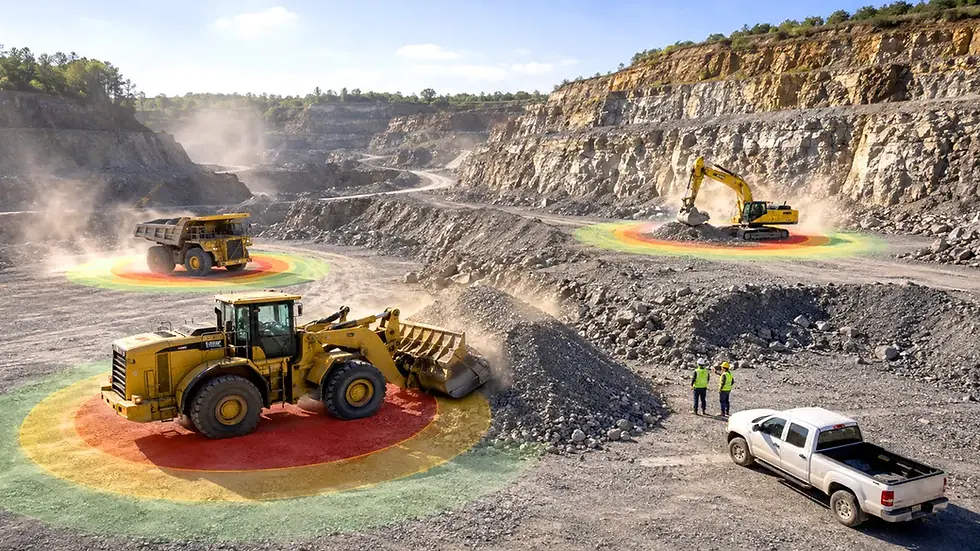
Why the clear zone on an active pit floor never stays where you painted it, and what it takes to keep detection traveling with the machine.
Introduction
A quarry does not hold still. The bench you walked this morning is a different shape by lunch, and the lane that was clear a minute ago now has a loader articulating through it. That is the part a lot of safety plans underestimate.
Painted walkways and fixed barriers assume the hazard stays put. On a working site it never does. The ground moves under its own machines, the traffic pattern rewrites itself load by load, and the one area everyone agreed was safe becomes the one nobody is watching. This is the practical problem behind mining and quarry pedestrian detection, and it is why detection tied to a fixed point on the ground tends to fall behind the work.
The thesis here is simple. If the hazard travels with the machine, the detection has to travel with it too.
→ The hazard boundary is not a line on a map. It moves with every reversing truck, every loader articulation, and every excavator swing.
→ The failure is rarely the machine the operator was watching. It is the movement into the blind side that both people assumed was clear.
→ Fixed infrastructure cannot keep pace with a site that redraws itself all shift, so the detection has to ride on the equipment instead.
These are not new problems. What is new is that the technology to address them is practical, deployable, and producing real field data from the machine's own point of view.
Why the Clear Zone Won't Stay Where You Put It
In most operations, the hazard map is drawn once and then treated as permanent. Reality does not cooperate. A loader pivots into space that reads as empty. A haul truck reverses into a loading zone where a maintenance hand is standing. An excavator swings a counterweight through ground the operator cannot see from the cab.
What we're seeing across sites is that the incident is almost never the machine the operator was watching. The operator is focused on the bucket, the berm, the truck he is loading. The exposure comes from movement into the blind side, an area both people assumed was clear. Dust, low light, and engine noise take away the cues a person would normally rely on, so the assumption goes unchallenged until it is too late.
"You watch the load, not the guy who just walked in behind you. That is the whole problem in one sentence."
That is the gap mining and quarry pedestrian detection has to close. Not by mapping the site once, but by riding along with the equipment and reading the danger zone in real time, wherever the machine happens to be.

Different Machines Hide People Differently
Here is where a single boilerplate setup falls apart. Each machine type creates its own blind spots, its own movements, its own way of putting a person out of sight. Detection that ignores that is detection that fires late or fires wrong.
The RioV360 AI Pedestrian Detection System is the same camera-and-AI platform underneath, but the camera placement and detection zones get shaped to the machine and its duty cycle. That distinction matters more on a pit floor than almost anywhere else.
Excavators and the Swing Radius
The swing radius is the classic trap. The counterweight sweeps into an area the operator has no line of sight to, even when the path looked clear seconds earlier. Rear and side coverage keeps the swing area under watch while the machine is slewing, and the alert reaches the operator before the machine reaches the person. This is the core of excavator pedestrian detection, and it is usually where the hardest arguments about false alarms get settled.
Wheel Loaders, Haul Trucks, and Reversing Ground
Reversing is where the exposure concentrates. A wheel loader carries large rear blind spots and works tight yard traffic, so someone crossing behind it during a reverse is a real problem, which is what wheel loader pedestrian detection is built around. Dump trucks share the same pattern at a bigger scale, and surround coverage with a configurable rear zone gives the driver another set of eyes on the danger area through dump truck pedestrian detection.
Compact and Long Machines Alike
Small does not mean simple. A skid steer is compact but nearly blind behind and beside, and camera coverage fills the gaps mirrors miss, which is the case for skid steer pedestrian detection. A telehandler hides workers near the wheels and base under its boom and raised load, so side and lower coverage does the work in telehandler pedestrian detection.
Scrapers require long-range pedestrian detection
Scrapers run long and fast during a cut and are hard to see around, and surround zones pick up people moving into the operating path through scraper pedestrian detection.
The common thread across all of them is that the zone is configured for how that machine actually moves, not for a diagram. That is the difference between an alert an operator trusts and one he learns to ignore.

The Alert Only Works If People Believe It
A detection system lives or dies on trust. If it fires on every dust cloud, shadow, and passing truck, operators tune it out inside a week, and then it is just a light nobody looks at.
This is why person classification matters more than motion sensing on a mine site. The system is trained to identify people specifically, so blowing material, moving equipment, and shifting light do not set it off the same way raw motion detection would. When a person does enter a configured zone, the operator gets a visual and audible warning in the cab, plus the camera view showing exactly where the person is. Belief in the alert is not a soft benefit. It is the whole mechanism.
There is a second half to this that most systems underplay. The operator alert protects against the operator's mistake. The external beacon protects against the pedestrian's. When someone on foot violates safe separation, the beacon hits them with a voice alert, an audible alarm, and a flashing light at once. People who experience that once tend to change their behavior for good.
"No one wants to set off the alarm twice. The first time is usually enough to end the shortcut for good."
What the Field Actually Demands
Specifications only matter once the hardware survives the conditions. Open pits, remote sites, wash-down bays, and machines that run through dust, rain, vibration, and swinging temperatures. That is the environment the gear has to hold up in, not a lab.
A few things separate equipment built for this from equipment that merely claims to be:
→ Cameras rated for pressure washing, driving rain, and constant vibration, not just splash resistance.
→ Onboard SD recording so footage comes off the machine on site, with no cloud account and no IT ticket.
→ Local operation that does not depend on pit Wi-Fi or cellular coverage that may not exist.
→ Person-specific AI classification instead of a motion trigger that alarms on every dust cloud.
→ Equipment-mounted installation that fits a mixed fleet without asking workers to wear anything.
Notice what is not on that list. Nothing here depends on the network holding up, a subscription staying active or a worker remembering to clip on a tag. On a remote site, every one of those dependencies is a point of failure. The less the system needs from the outside, the more it holds up through the shift.

An Operator's View of the Same Problem
I have spent close to thirty years around machine control, GNSS, and industrial safety, including years based in Santiago working with copper and lithium operations across Chile. The pattern I saw over and over on active pit floors was how fast a clear work area could stop being clear. An operator would be locked onto the haul truck or the berm while a pickup, a service vehicle, or a worker slipped into the machine's blind side.
That experience shaped how I think about this now. The failure is rarely a careless operator or a reckless worker. It is two people each making a reasonable assumption about a space that changed between them. Technology does not fix judgment, but it can put a second set of eyes exactly where human attention runs out. If you want the longer version of how I got here and why I ended up focused on this specific problem, it is on my personal site.
Why This Matters in Mining and Quarry Pedestrian Detection
Leading indicators are the whole point. For a long time, safety on these sites has been measured after the fact, by the incidents and near-misses that got reported. The recorded footage from a machine's own point of view changes that. It shows how often people cut through a zone everyone assumed stayed empty before anything goes wrong.
Organizations typically discover this the first time they pull an SD card at the end of a shift. The value is not the near-miss you catch. It is the exposure frequency you finally get to see and act on. That shift, from reacting to what already happened to reading what is about to happen, is why mining and quarry pedestrian detection is worth the attention it is getting from EHS and operations teams right now.
Prove It on One Machine First
You do not have to commit a fleet to find out whether this fits your site. Put the system on one machine and evaluate it under your real conditions, with your operators and your traffic. A single-machine pilot reveals what a spec sheet cannot: whether operators trust the alerts, whether the zones fit the work area, whether false alarms stay manageable, and whether the footage is actually useful.
This is the honest way to buy something like this. Run it live, review the alerts and the recorded footage with your safety team, and only then decide whether to adjust the configuration or expand it. If you want to talk through your equipment list and highest-risk movement first, reach out with the machine type and we will recommend a starting configuration. A short call usually settles more than a brochure ever will, and if you would rather see the full specs and a budgetary price, the RioV360 quote and specs page is the place to start.

The Role We Play
Our part is straightforward. We help you validate the system on real ground before you scale it, so the decision rests on what you saw during a production shift rather than what a data sheet promised. Start with one high-exposure machine, watch how it performs during reversing, loading, stockpile work, shift changes, and maintenance traffic, and let the live results drive the next step.
That is deliberately a low-risk way in. One machine, real conditions, real operators, and a clear look at whether the configuration reduces exposure before another dollar goes toward it. You can validate a single unit first, contact us with your equipment details, or book a 30-minute call to map it to your site.
What It Comes Down To
The recurring lesson on these sites is that the danger is not the machine in front of the operator. It is the movement into the space between people, the space that quietly changed while both of them were doing their jobs. A fixed safety plan cannot keep up with ground that redraws itself all shift. Detection that rides on the machine can.
Get that right, and the payoff is not just fewer incidents. It is the ability to see exposure as it happens and act before it becomes a report. That is a better position for any safety team to work from.
"A spec sheet cannot tell you whether the crew will trust the alert. One dusty afternoon shift will."
Common Questions About Mining and Quarry Pedestrian Detection
How does the system perform around quarry dust and changing light?
It uses AI person classification rather than basic motion detection, so it responds to people instead of reacting to every dust cloud, shadow, or moving object. Camera placement and detection zones are configured for the machine to help keep nuisance alerts manageable in real pit conditions.
Which machine should we equip first?
Start with the machine that combines limited visibility with frequent pedestrian exposure. That is often a wheel loader working a stockpile, a haul truck reversing into a loading area, or an excavator operating near spotters and ground crews. A single-machine pilot on that unit tells you the most, fastest.
Does the system automatically stop the machine when it detects someone?
No, and it is worth being clear about that. RioV360 is a warning system. It alerts the operator in the cab and warns the worker on foot through the external beacon, but it does not brake or disable the machine, and it does not replace site traffic management. It gives people the information and the seconds to act, which is where most of these incidents are actually won or lost.
Does it need the mine network or a cloud account?
No. Detection, operator alerts, beacon warnings, and SD recording all happen on the machine. Footage can be reviewed on site without sending video through a mine network or cloud platform, which matters on remote sites where the network may not be dependable.
About Riodatos
Riodatos is a U.S.-based industrial safety technology company headquartered in Arizona, with domestic inventory and direct distribution across the Americas. Our flagship product is the RioV360, a 360-degree AI-powered pedestrian detection system purpose-built for forklifts and heavy equipment. The RioV360 provides full surround camera coverage with in-cab alerts, requires no pedestrian-worn device, and ships as a complete installation kit from Arizona.
We are also an authorized distributor for Proxicam, ZoneSafe, and inviol pedestrian and proximity detection systems. We supply, configure, install, and support solutions tailored to the specific equipment mix, traffic patterns, and risk profiles of individual facilities. Our work spans warehousing, manufacturing, construction, and logistics operations across the Americas, with an emphasis on avoiding mismatched technology and overseas fulfillment delays.
Our approach is built around measurable live performance, operator adoption, and scalable deployment across mixed fleets and multi-site programs. Direct pricing, fast U.S. shipping, certified installation, and English and Spanish support mean safety teams can focus on protection rather than procurement logistics. Every engagement starts with a single-machine evaluation in real operating conditions before any fleet commitment is made.
Summary: Mining and Quarry Pedestrian Detection at Active Sites
⚠️ On an active quarry, the clear zone never stays where you painted it; the bench changes and the trucks cycle and the one area everyone assumed was clear is the one nobody is watching, which is exactly where people get hurt.
Here is what that means for how you detect them.
The hazard travels with the machine, so the detection has to travel with it too, not sit on a painted line.
Each machine hides people differently, so excavator swing, loader reversing, and telehandler blind zones each need their own configuration.
Person classification, not motion sensing, is what keeps operators trusting the alert instead of tuning it out.
The external beacon changes the behavior of the worker on foot, not just the operator in the cab.
Local recording and no-network operation matter more on a remote site than any spec on paper.
Pulling the SD card after a shift shows exposure frequency you never knew you had.
The danger is not the machine in front of the operator. It is the space between people that changed while nobody was looking. Which of your machines would show you the most if you pulled its footage tonight?


