Pedestrian Detection System for Heavy Equipment: RioV360

Heavy equipment creates some of the most difficult pedestrian safety challenges in construction, roadwork, cement plants, mines, industrial facilities, logistics yards, and infrastructure projects.

Introduction
Operators may be surrounded by large blind spots. Workers move between machines. Contractors enter active work areas. Dust, darkness, noise, vibration, rain, and constantly changing site conditions can make conventional mirrors and backup cameras inadequate as the only source of awareness.
An AI pedestrian detection system for heavy equipment changes that equation by actively analyzing the area around the machine and warning the operator when a person enters a defined detection zone.
RioV360 takes that concept much further.
RioV360 combines four rugged AI cameras, 360° perimeter awareness, configurable detection zones, real-time operator alerts, an external 120 dB pedestrian warning beacon, infrared night detection, and four-channel video recording in one complete heavy-equipment safety platform.
It works directly on the machine.
There is no cloud platform, no Wi-Fi requirement, no cellular connection, no RFID tag, no worker wearable, and no recurring software subscription.
AI Pedestrian Detection System for Heavy Equipment Built Around the Machine
RioV360 is an AI pedestrian detection system for heavy equipment, designed around the realities of mobile industrial machines rather than a generic surveillance-camera architecture.
Every standard RioV360 Heavy-Duty system uses four high-definition AI cameras positioned to monitor the equipment perimeter.
Typical coverage includes:
Front of the machine
Rear of the machine
Left side
Right side
Together, the cameras provide 360° awareness around the equipment and help monitor areas that may be difficult or impossible for the operator to see directly.
Each standard camera provides:
1920 × 1080 HD resolution
130° viewing angle
AI person detection
AI vehicle detection
Infrared night capability
Automatic IR-CUT day/night switching
0 LUX operation with infrared enabled
IP69K environmental protection
IK06 impact resistance
The objective is not simply to give the operator another camera image. The objective is to provide the operator with an intelligent detection system that continuously monitors the areas surrounding the machine.
Four AI Cameras Create 360° Heavy-Equipment Awareness
Heavy equipment rarely has only one blind spot.
A dump truck may have vulnerable areas along both sides and behind the vehicle. An excavator may have people entering the swing area from several directions. A concrete mixer can have personnel working around the front, sides, rear discharge area, and surrounding site. A skid loader may constantly change direction in a crowded work zone.
RioV360 addresses these conditions with four simultaneous AI camera views.
The system can display:
Single-camera view
Dual-camera view
Triple-camera view
Quad-camera view
The operator can therefore see multiple areas around the machine while the AI independently analyzes those camera feeds for pedestrians.
This combination of live visibility plus active AI detection gives RioV360 capabilities well beyond those of a conventional rearview or backup camera.

Real-Time AI Person Detection
RioV360 performs AI detection locally on the machine.
The camera feeds are analyzed in real time so the system can identify people entering monitored areas around the equipment.
The system processes video at up to 25 frames per second per channel, enabling continuous pedestrian detection while the equipment is in use. Unlike systems dependent on RFID tags or electronic transponders, RioV360 uses visual AI.
The pedestrian does not need to carry anything.
There is no requirement for:
RFID tags
Electronic badges
Smart vests
Worker transponders
Special helmets
Connected PPE
Phone applications
That matters on sites where many different people may approach equipment.
Employees may understand the site's safety technology, but subcontractors, visitors, delivery drivers, temporary workers, and other personnel may not be carrying special electronic devices.
RioV360 detects the person visually.
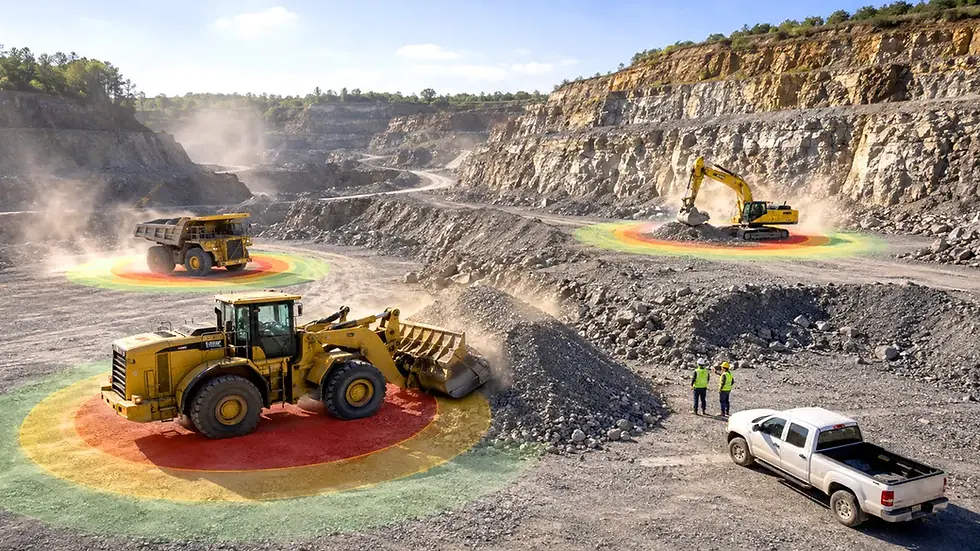
Configurable Red, Yellow and Green Detection Zones
Not every machine has the same risk areas, and not every side of a machine needs the same detection distance. RioV360 therefore allows detection zones to be configured independently by camera.
Available zones can be organized into graduated:
Green Detection Zones
Used for broader awareness areas around the machine.
Yellow Detection Zones
Used for closer areas where operator attention becomes increasingly important.
Red Detection Zones
Used for the most critical defined areas around the equipment.
Detection distances can be configured within approximately 0 to 5 meters, depending on the camera, machine geometry, operating environment, and application. This configuration capability is especially important on mixed fleets.
An excavator can be configured differently from a water tanker. A skid loader can be configured differently from a road roller. A concrete mixer can be configured differently from a dump truck.
RioV360 adapts the detection system to the machine instead of forcing every machine into an identical detection pattern.
Intelligent Person and Vehicle Classification
A modern industrial safety camera needs to understand more than motion.
Construction and industrial environments contain:
Traffic cones
Piles of material
Barriers
Equipment
Buildings
Tools
Spoil
Machinery
Vehicles
Moving shadows
Workers
RioV360 uses AI classification to identify relevant objects within the camera image.
Available detection includes:
Pedestrian detection
Vehicle detection
Configurable object-detection modes
Person-class AI helps separate pedestrians from normal site objects. Combined with configurable detection zones, this can help create a more useful alert environment for the operator.
Operator Alerts Plus External Pedestrian Warning
One of the most important RioV360 capabilities is that awareness is not limited to the equipment operator. When a pedestrian is detected, the operator can receive an immediate warning through the RioV360 in-cab monitor.
The system provides:
On-screen visual alerts
Built-in audible operator alarm
Live camera view
Detection-zone indication
RioV360 also includes an external 120 dB warning beacon.
The external device can provide:
Voice warning
Audible alarm
Flashing light
That means a person outside the machine can also receive a warning. This creates two layers of awareness: the operator is alerted inside the cab, and the pedestrian can be alerted outside the machine. In noisy industrial environments, that distinction matters.

Rugged IP69K Cameras Designed for Harsh Sites
Heavy-equipment cameras live a much harder life than ordinary security cameras.
They may be exposed to:
Dust
Mud
Rain
Concrete residue
Wash-down
Gravel
Flying rock
Vibration
Heat
Cold
Machine movement
Accidental impact
RioV360 cameras carry an IP69K rating for demanding environmental conditions.
They are also rated IK06 for impact resistance.
The cameras operate across a wide industrial temperature range and use sealed connections designed for mobile equipment.
RioV360 adds another important physical protection feature.
Heavy-Duty Steel Camera Guards
Every RioV360 Heavy-Duty camera can be protected by a steel guard that wraps around the camera housing.
The guard helps protect the camera from:
Rock
Debris
Machine contact
Material impact
Harsh jobsite conditions
AI performance does not matter if a camera gets destroyed during normal equipment operation. The RioV360 Heavy-Duty system is designed with that reality in mind.
Infrared Pedestrian Detection at Night and in Low Light
Construction does not always stop when daylight disappears. Mining, road construction, infrastructure work, industrial loading, cement production, and logistics operations may continue through evening and night shifts.
RioV360 cameras include:
Built-in infrared
0 LUX capability with infrared enabled
Automatic IR-CUT
Automatic day/night switching
This enables the system to continue providing camera visibility and AI detection in extremely low-light conditions. The same system that monitors the machine during the day can continue working when the jobsite gets dark.
Four-Channel 1080p Video Recording Is Standard
RioV360 is not only an AI detection system. It is also a four-channel mobile video recording platform. All four cameras can record simultaneously.
Standard capabilities include:
1920 × 1080 recording
25 FPS per channel
H.264 recording
Four simultaneous channels
Date and time stamps
Local microSD storage
Up to 512 GB storage
With a standard 512 GB industrial storage card, RioV360 can provide approximately 56 hours of continuous four-camera recording. That creates a valuable record of what happened around the machine.
Recorded video can help organizations review:
Near misses
Pedestrian incidents
Vehicle contact
Equipment accidents
Property damage
Material damage
Jobsite disputes
Safety investigations
Theft
Vandalism
Operator training opportunities
The storage card can be removed for review on a computer. There is no mandatory cloud-storage service.

No Cloud, No Wi-Fi and No Subscription
Some industrial safety technologies require an entire communications infrastructure before the first machine can operate. RioV360 does not. All primary AI processing and recording take place locally on the machine.
RioV360 does not require:
Cloud processing
Wi-Fi
Cellular service
Internet access
User accounts
Cloud video storage
RFID infrastructure
Worker wearables
Recurring AI subscriptions
This makes the system well suited for remote and difficult environments. Consider a road-construction crew operating miles from a fixed facility, an excavator working at a temporary site, a concrete mixer moving throughout an industrial plant, or equipment working inside a large quarry.
The machines may not always have reliable connectivity. RioV360 does not need it to perform its primary AI detection, warning, and recording functions.
No Recurring Software Fee
The absence of a required cloud platform has another advantage. RioV360 does not require an ongoing software subscription for its core detection and recording functions.
That can make total system cost easier to understand when deploying pedestrian detection across many machines.
A fleet of five machines does not create five new monthly AI subscriptions, and a fleet of 50 machines does not create 50 mandatory cloud accounts. The system's core intelligence stays on the equipment.
7-Inch Weatherproof In-Cab Monitor
The RioV360 operator interface is a rugged 7-inch IPS display.
Specifications include:
1024 × 600 resolution
Four-channel AHD 1080p / 720p input
Built-in microphone
Built-in speaker
Sunshade
H.264 video capability
Playback
Single-camera display
Dual-camera display
Triple-camera display
Quad-camera display
The monitor provides the operator with both live camera visibility and AI alerts.
A monitor extension mount can also be included to improve positioning inside the machine cab.
This allows the display to be located where it is visible without unnecessarily obstructing the operator's normal field of view.
8–32 VDC Operation for Mixed Fleets
Heavy-equipment fleets often contain machines from multiple manufacturers and multiple electrical architectures. RioV360 operates across an 8 to 32 VDC range.
This makes the platform compatible with many:
12V machines
24V machines
Construction vehicles
Industrial equipment
Commercial vehicles
Specialized mobile equipment
A consistent safety platform across a mixed fleet can simplify training, installation practices, spare parts, service, and operator familiarity.
One RioV360 Platform Across Many Machine Types
One of the strengths of RioV360 is its ability to provide a common AI-based pedestrian-detection platform across a mixed fleet of heavy equipment. A single construction, roadwork, cement, or industrial operation may use dramatically different types of equipment, including:
Skid loaders
Dump trucks
20-ton excavators
Buses and personnel vehicles
Truck-mounted attenuators
Water tankers
Concrete mixers
Pneumatic tire rollers
Roller compactors
These machines perform completely different jobs and have different cab positions, blind spots, dimensions, operating patterns, and work environments. Yet they share the same fundamental safety challenge: people work around moving equipment.
RioV360 provides a common AI detection, warning, visibility, and recording architecture that can be configured around the specific geometry and operating environment of each machine.

Complete Professional Heavy-Equipment Installation System
A heavy-equipment pedestrian detection system requires much more than cameras and a monitor. A professional installation also requires the correct brackets, protective guards, power connections, sealed wiring, harnesses, connectors, cab mounting hardware, external warning equipment, storage, configuration, and detection-zone setup.
RioV360 is supplied as a complete professional installation package. A typical system can contain approximately 20 different installation items and 125 individual parts, helping installers deploy the system as a complete package rather than assemble a solution from unrelated components.
Standard equipment can include:
Four AI cameras
Four heavy-duty steel camera guards
7-inch operator monitor
Monitor mounting system
External 120 dB warning beacon
AI processor
Four-channel recorder
512 GB storage
Sealed wiring harness
Aviation-grade connectors
Camera mounting hardware
Installation accessories
No-drill mounting options where appropriate
This is particularly important for fleet deployments. A system intended for heavy equipment must not only perform well on paper; it must also be practical to install, configure, maintain, and support in the field.
Professional Camera Aiming and Detection-Zone Configuration
Camera placement has a major effect on system performance. A camera mounted a few inches higher, lower, farther forward, or at a different angle can produce a significantly different field of view.
RioV360 installations therefore consider:
Machine geometry
Operator visibility
Common pedestrian approach areas
Equipment attachments
Camera height
Camera angle
Cable routing
Detection distance
Worksite conditions
Red, yellow, and green zone placement
Camera aiming and detection-zone configuration can be validated on the actual machine so that the installation reflects the equipment's real operating environment rather than relying on a generic configuration.
Why 360° Coverage Matters More Than a Rear Camera
A rear camera solves one visibility problem, but heavy equipment rarely has only one blind spot.
A worker may approach from the side of a dump truck. An excavator may rotate while people are present in the surrounding work area. A loader may reverse and turn repeatedly. A concrete mixer may have personnel working near the cab, sides, and rear discharge area. A roller may change direction continuously throughout the shift.
The four-camera RioV360 architecture is designed to provide awareness around the entire perimeter of the equipment, rather than concentrating on only one direction.
That is an important distinction between a conventional backup camera system and an integrated 360° AI pedestrian detection system.
AI Detection Plus Video Documentation
RioV360 performs two important functions simultaneously.
Real-Time Safety Awareness
AI continuously analyzes the camera feeds and can alert the operator when a pedestrian is detected inside a configured zone.
Post-Event Documentation
The same cameras continuously record activity around the equipment, creating video that can be reviewed later.
This combination gives safety and operations teams information both during and after an event. An EHS manager can investigate an incident, a supervisor can review a near miss, a fleet manager can evaluate equipment damage, and a safety team can use actual recorded events for operator coaching.
One camera infrastructure therefore supports both active pedestrian awareness and incident documentation.

RioV360 Features at a Glance
A standard RioV360 Heavy-Duty configuration can provide:
AI Detection
AI pedestrian detection
AI person classification
Vehicle detection
On-device AI processing
Real-time detection
25 FPS processing per channel
360° Awareness
Four AI cameras
Front camera
Rear camera
Left-side camera
Right-side camera
130° camera field of view
Simultaneous four-camera operation
Configurable Safety Zones
Green detection zones
Yellow detection zones
Red detection zones
Individual camera configuration
Approximately 0–5 meter configurable detection range
Operator Awareness
7-inch IPS monitor
Live video
Visual detection alerts
Audible alerts
Single-camera view
Dual-camera view
Triple-camera view
Quad-camera view
Pedestrian Warning
External 120 dB beacon
Voice alert
Audible warning
Flashing visual warning
Rugged Equipment
IP69K cameras
IK06 impact rating
Heavy-duty steel camera guards
Sealed connections
Industrial wiring
Wide operating-temperature range
Wash-down capability
Night Operation
Infrared illumination
0 LUX operation
Automatic IR-CUT
Automatic day/night switching
Video Recording
Four simultaneous channels
1080p recording
25 FPS per channel
H.264 format
512 GB local storage
Approximately 56 hours recording
Date and time stamps
On-device playback
Infrastructure
No Wi-Fi required
No cellular service required
No cloud required
No RFID required
No worker wearables required
No mandatory software subscription
Fleet Compatibility
8–32 VDC system
Suitable for many 12V machines
Suitable for many 24V machines
Configurable for mixed fleets
Frequently Asked Questions About RioV360
What is an AI pedestrian detection system for heavy equipment?
An AI pedestrian detection system for heavy equipment uses cameras and artificial intelligence to identify people around mobile machinery and provide alerts when pedestrians enter defined areas around the machine. RioV360 combines AI pedestrian detection with four-camera perimeter visibility, operator alerts, external pedestrian warnings, configurable detection zones, and video recording.
Does RioV360 require RFID tags or worker wearables?
No. RioV360 uses camera-based AI person detection, so workers do not need RFID tags, electronic badges, transponders, smart vests, connected PPE, or other special electronic devices.
Does RioV360 require Wi-Fi?
No. RioV360 performs its primary AI processing locally on the machine and does not require Wi-Fi for normal pedestrian detection and recording.
Does RioV360 require cellular service?
No. Cellular connectivity is not required for normal AI detection, warning, or local video recording.
Does RioV360 require a cloud platform?
No. AI processing and video recording occur locally on the equipment.
Is there a mandatory monthly software subscription?
No. RioV360 does not require a recurring cloud or AI subscription for its core pedestrian-detection, warning, and recording capabilities.
Does RioV360 record video?
Yes. RioV360 can record all four camera channels simultaneously in 1080p at up to 25 frames per second per channel.
How much video can RioV360 store?
With the standard 512 GB industrial storage card, a four-camera RioV360 configuration can provide approximately 56 hours of continuous recording.
Can recorded video be reviewed after an incident?
Yes. RioV360 video is date and time stamped and can be reviewed following near misses, pedestrian incidents, equipment contact, property damage, accidents, safety investigations, or other events.
Does RioV360 work at night?
Yes. RioV360 cameras include built-in infrared illumination, 0 LUX operation with infrared enabled, and automatic IR-CUT day/night switching.
Are RioV360 cameras waterproof?
RioV360 cameras carry an IP69K environmental rating and are designed for demanding outdoor, dusty, wet, and wash-down environments.
Are the cameras protected against impact?
Yes. The cameras carry an IK06 impact rating, and RioV360 Heavy-Duty configurations include heavy-duty steel guards that help protect the camera housing and lens from rock, debris, and equipment contact.
Can RioV360 detect vehicles as well as pedestrians?
Yes. The system supports AI person and vehicle detection modes.
Can the detection distance be adjusted?
Yes. Detection zones can be configured by individual camera across an approximately 0–5 meter range, depending on the machine and operating environment.
Can each side of the machine have different detection zones?
Yes. Each camera can be configured separately, allowing front, rear, left-side, and right-side detection areas to be adjusted for the geometry and application of the machine.
Can RioV360 warn the pedestrian outside the machine?
Yes. The standard external 120 dB warning beacon can provide audible, visual, and voice alerts to personnel outside the equipment.
Does RioV360 warn the operator?
Yes. The operator receives real-time visual alerts through the in-cab monitor as well as an audible warning.
Can RioV360 be installed on an excavator?
Yes. RioV360 can be configured for excavators and other heavy construction equipment, with camera locations and detection zones selected around the machine's geometry and operating pattern.
Can RioV360 be installed on a dump truck?
Yes. Four-camera coverage can help address the multiple blind areas around large dump trucks while also providing AI pedestrian detection and video recording.
Can RioV360 be installed on a concrete mixer?
Yes. RioV360 can provide AI pedestrian detection, perimeter camera coverage, operator and pedestrian warnings, and video recording on concrete mixers and similar industrial vehicles.
Can RioV360 be installed on a skid loader?
Yes. The system can be configured around the compact dimensions, visibility limitations, and operating patterns of skid loaders and compact construction equipment.
Can RioV360 be used on road-construction equipment?
Yes. Applications can include rollers, compactors, truck-mounted attenuators, water tankers, loaders, excavators, and other roadwork equipment.
Does RioV360 work on both 12V and 24V equipment?
RioV360 operates across an 8–32 VDC input range, making it suitable for many 12V and 24V machines.
One System. Multiple Layers of Heavy-Equipment Awareness.
RioV360 brings several safety and operational capabilities together in one platform.
Detect: AI identifies pedestrians around the equipment.
See: Four cameras provide 360° perimeter visibility.
Alert: The operator receives real-time audible and visual warnings.
Warn: An external beacon can alert personnel outside the machine.
Record: Four camera channels continuously document activity around the equipment.
Review: Recorded video can support near-miss reviews, incident investigation, training, and documentation.
Operate anywhere: No Wi-Fi or cloud connection is required for the system's core functions.
Deploy across the fleet: One platform can be configured for multiple categories of heavy equipment.
Built for Construction, Cement, Roadwork and Industrial Fleets
RioV360 is designed for organizations operating equipment in environments where people and machines work in close proximity.
Potential applications include:
Construction
Cement production
Concrete operations
Mining
Aggregates
Quarry operations
Road construction
Highway maintenance
Infrastructure projects
Utilities
Industrial facilities
Manufacturing
Warehousing yards
Ports
Logistics
Municipal fleets
Heavy-equipment rental fleets
The machines and operating environments may change, but the need for better visibility and pedestrian awareness remains.
Evaluate RioV360 on Your Heavy Equipment
The best way to determine the correct camera locations and detection-zone configuration is to evaluate the actual machine and its operating environment.
RioDatos can help assess:
Equipment type
Machine dimensions
Existing blind spots
Camera locations
Detection-zone requirements
Monitor location
External beacon placement
Installation requirements
Fleet standardization opportunities
RioV360 can be deployed on a single machine, as a pilot installation, or across a mixed fleet. For companies evaluating an AI pedestrian detection system for heavy equipment, RioV360 combines intelligent detection, rugged hardware, 360° awareness, pedestrian warnings, operator alerts, and local video documentation in one integrated platform.