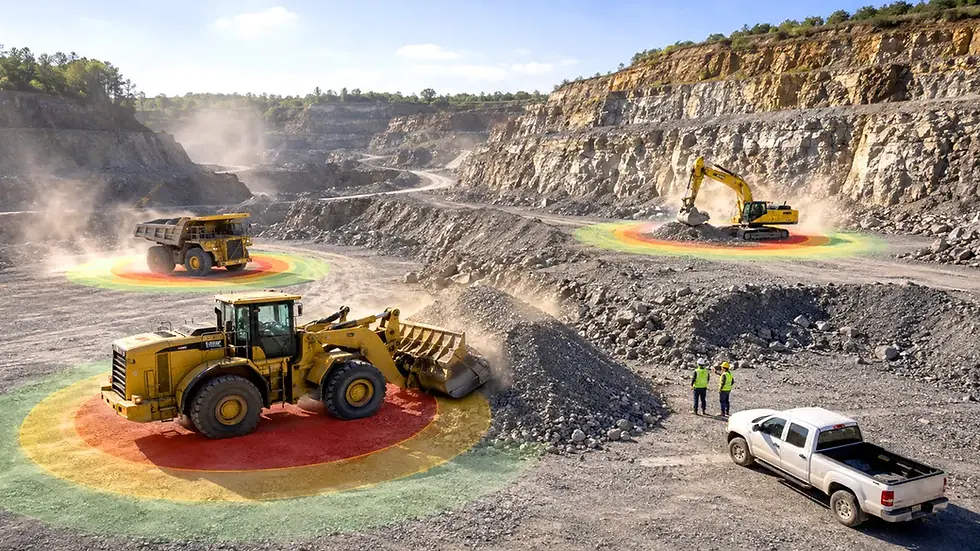
Skid Steer Safety Camera System for the Pivot Zone
- John Buttery

- 2 days ago
- 11 min read
Why the smallest machine on the site hides more people than the big ones, and what it takes to watch the space it pivots into.

Introduction
Ask any crew which machine worries them, and almost nobody points at the skid steer. It is small, familiar, and usually working off in a corner. That is exactly why it catches people out.
The operator runs the attachment from the front while the entire rear half of the machine sits hidden behind the engine compartment. Lift arms and the attachment wall off the side views, which is precisely where a groundman stands to guide material or swap a coupler. Then the machine pivots inside its own footprint, and the rear counterweight sweeps a full circle before anyone can step clear. A big blind zone in a small frame is a bad combination, and it is the whole reason a skid steer safety camera system exists.
The thesis here is simple. On a machine that turns inside its own length, the detection has to turn with it.
→ The blind zone is not a corner of the machine. It is the entire rear and both sides, built into how the operator sits and where the arms reach.
→ The danger rarely comes from the machine the operator is watching. It comes from the pivot into a space a groundman already decided was clear.
→ A backup alarm that runs all day stops meaning anything by mid-shift, so the warning has to be tied to an actual person, not a gear selection.
These are not new problems. What is new is that the technology to watch those exact zones is practical, mountable on a compact machine, and producing real footage from the machine's own point of view.
What a Skid Steer Safety Camera System Actually Has to Do
A skid steer never works inside a fixed safety zone. It reverses, spins in place, and jumps between piles all shift. That movement is the point, and it is what makes this machine different from almost anything else on site. The coverage has to sit where the operator cannot see and stay useful while the whole machine rotates.
What we're seeing across sites is that the incident is almost never a surprise about the machine itself. Everyone knows the skid steer is there. The exposure comes from the pivot, the reverse, and the attachment change, three movements that happen constantly and put a person behind the machine at the worst possible second.
The Compact Machine, the Uncompact Blind Zone
A skid steer looks easy to see around. It is not. The operator enters and exits from the front and has no direct line to anything behind the seat. The moment the operator sits down, the engine compartment completely blocks the rear. This is the core of any skid steer pedestrian detection setup, and it is why a generic reversing camera falls short. One fixed view does not cover a machine whose danger zone is the entire back half.
The Pivot Inside Its Own Footprint
Here is the part that separates a skid steer from a loader or a truck. It turns inside its own length. The rear counterweight does not track backward in a straight line; it sweeps a full circle, and it does that in seconds. A person standing in a spot that was safe a moment ago is suddenly inside the swing. Detection zones have to be shaped for that pivot radius, not for a rectangle behind the machine.
Ground Crew and the Attachment Change
Skid steers invite people to walk up close. The attachment changes all day, and every change brings a groundman in to check a coupler, clear a jam, or guide the next pick. The operator is locked on the work up front. The worker steps in behind. Both are doing their job, and neither is watching the space between them. That is the moment the camera and the alert have to cover.
Backup Alarms Nobody Hears Anymore
Constant backup alarms turn into background noise. On a busy site where every machine beeps on reverse, people stop reacting inside an hour. A warning that fires on gear selection cannot fix that, because it fires whether or not anyone is actually there. The alert has to mean a person is in the zone, or it becomes one more sound the crew has learned to ignore.
"Everyone worries about the excavator. The machine that gets someone is the little one parked in the corner."

The Alert Only Works If the Operator Still Believes It at 2 p.m.
A safety alert lives or dies on trust. If it fires on dust off the tracks, shadows from the lift arms, and every pallet that swings past, the operator tunes it out before lunch. Then it is just a light nobody checks.
This is why person classification matters more than motion sensing on a skid steer. The system is trained to identify people, so blowing debris, moving material, and shifting light do not set it off the way raw motion detection would. When a person does enter a configured zone, the operator gets a visual and audible warning in the cab, plus the camera view showing exactly which corner or side picked them up before the machine pivots. Belief in the alert is not a soft benefit. It is the entire mechanism.
There is a second half most systems skip. The in-cab alert covers the operator's mistake. The external beacon covers the pedestrian's. When someone on foot steps into the danger zone, the external beacon hits them with a loud voice alert, an audible alarm, and a flashing light all at once. A worker who gets that once tends to stop walking behind a pivoting skid steer for good.
"After the tenth beep of the shift, the alarm stops meaning anything. That is when the camera has to do the work."

What the Machine's Daily Life Demands
Specifications only matter once the hardware survives the way a skid steer actually lives. Tight quarters, constant vibration, dust, mud, and an end-of-day wash-down. A lab rating does not tell you much about that.
A few things separate a system built for this from one that only claims to be:
→ Cameras rated for pressure washing and driving rain, not just splash resistance, because this machine gets hosed down daily.
→ Onboard SD recording so footage comes off the machine on site, with no cloud account and no IT ticket.
→ Local operation that does not depend on site Wi-Fi or cellular coverage the jobsite may not have.
→ Person-specific AI classification instead of a motion trigger that alarms on every dust cloud and swinging bucket.
→ Compact, equipment-mounted hardware that fits a small machine and a mixed fleet without asking anyone to wear a tag.
Notice what is not on that list. Nothing here depends on the network staying up, a subscription staying active, or a groundman remembering to clip on a device. On a remote site every one of those is a point of failure. The less the system needs from outside the machine, the more of the shift it actually covers.
An Operator's View of the Same Problem
I have spent close to thirty years around machine control, GNSS, and industrial safety. The skid steer taught me the same lesson over and over. The operator is dialed into the attachment while a groundman steps in behind to change a coupler or guide the next load, and the machine turns into a space both of them had already written off as clear. It is never carelessness. It is two reasonable people making the same assumption about a spot that changed between them.
That is why I keep coming back to the machine's own point of view. A spec sheet cannot tell you how often that pivot-into-clear-space is happening on your site. The footage can. Put the camera where the operator's eyes cannot go, tie the alert to an actual person, and you close the gap that judgment alone keeps missing. If you want the longer version of how I ended up focused on this, it is on my personal site.
Why This Matters Now
For a long time, safety on these machines got measured after the fact, by the incidents and near-misses that made it into a report. Footage from the machine's own corner changes that. It shows how often people cut through a zone everyone assumed stayed empty before anything goes wrong.
Organizations typically discover this the first time they pull an SD card at the end of a shift. The value is not the one near-miss you happen to catch. It is the exposure frequency you finally get to see and act on. That shift, from reacting to what already happened to reading what is about to, is why a skid steer safety camera system is getting real attention from EHS and operations teams right now.
The Same Platform Covers the Rest of the Fleet
Most contractors do not run a skid steer alone. It works alongside loaders, trucks, and handlers, and the blind zones change with each one. The same RioV360 platform gets configured per machine, so the skid steer is usually the starting point rather than the whole job.
→ Wheel loaders carry large rear blind spots in tight yard traffic, which makes reversing the main risk. See wheel loader pedestrian detection.
→ Dump trucks put a driver high above a reverse path where a person is easy to miss. See dump truck pedestrian detection.
→ Excavators swing a cab and counterweight through a full circle, not just when tracking. See excavator pedestrian detection.
→ Telehandlers hide workers near the wheels and base under a boom and raised load. See telehandler pedestrian detection.
→ Scrapers run long and fast during a cut and are hard to see around. See scraper pedestrian detection.

Prove It on One Skid Steer First
You do not have to equip a fleet to find out whether this fits your site. Put the system on one skid steer or compact track loader and run it under your real conditions, with your operators and your traffic. A single-machine pilot shows what a spec sheet cannot: whether operators trust the alerts, whether the zones fit the pivot and the attachment work, whether false alarms stay manageable, and whether the footage is actually useful.
This is the honest way to buy something like this. Run it live, review the alerts and the recorded footage with your safety team, then decide whether to adjust the zones or move to another machine. If you want to talk through your attachments and the highest-risk movement first, reach out with the model and we will map a starting configuration. A short call settles more than any brochure, and if you would rather see the full specs and a budgetary price, the RioV360 quote and specs page is the place to start.

The Role We Play
Our part is straightforward. We help you validate the system on a real machine before you scale it, so the decision rests on what you saw during a production shift rather than what a data sheet promised. Start with one high-exposure skid steer, watch it through reversing, attachment work, tight-quarter maneuvering, shift changes, and yard traffic, and let the live results drive the next step.
That is a deliberately low-risk way in. One machine, real conditions, real operators, and a clear look at whether the configuration reduces exposure before another dollar goes toward it. You can validate a single unit first, contact us with your equipment details, or book a 30-minute call to map it to your site.

What It Comes Down To
The recurring lesson on these machines is that the danger is not the skid steer everyone can see. It is the pivot into the space behind it, the space that quietly changed while the operator worked the attachment and a groundman stepped in. Judgment alone keeps missing that gap because both people are being reasonable. A camera tied to a real person does not.
Get that right and the payoff is not just fewer incidents. It is finally seeing how often the near-miss was there all along, and acting on it before it becomes a report. That is a better place for any safety team to work from.
"You cannot see the exposure until you watch a shift from the machine's own corner. Then you cannot unsee it."
Common Questions About a Skid Steer Safety Camera System
How does a skid steer safety camera system handle the dust and changing light these machines create?
It uses AI person classification rather than basic motion detection, so it responds to people instead of reacting to dust off the tracks, shadows from the lift arms, or moving material. Camera placement and detection zones are set for the specific machine, which keeps nuisance alerts manageable through a real shift.
Does the system automatically stop the skid steer when it detects someone?
No, and it is worth being clear about that. It is a warning system. It alerts the operator in the cab and warns the worker on foot through the external beacon, but it does not brake or disable the machine, and it does not replace spotters or site traffic rules. It gives both people the information and the seconds to react, which is where these incidents are usually won or lost.
Can the detection zones actually match the way a skid steer pivots and works?
Yes. Rear zones focus on the engine-compartment blind spot, side zones cover the lift-arm and attachment areas, and corner zones watch the exact path of the pivot. Everything is shaped for the machine's real duty cycle rather than a generic box behind the machine.
Does it need site Wi-Fi or a cloud account?
No. Detection, in-cab alerts, the external beacon, and SD recording all happen on the machine. You pull the SD card on site and review footage without a network or cloud login, which matters on remote jobsites where coverage is not dependable.
About Riodatos
Riodatos is a U.S.-based industrial safety technology company headquartered in Arizona, with domestic inventory and direct distribution across the Americas. Our flagship product is the RioV360, a 360-degree AI-powered pedestrian detection system purpose-built for forklifts and heavy equipment. The RioV360 provides full surround camera coverage with in-cab alerts, requires no pedestrian-worn device, and ships as a complete installation kit from Arizona.
We are also an authorized distributor for Proxicam, ZoneSafe, and inviol pedestrian and proximity detection systems. We supply, configure, install, and support solutions tailored to the specific equipment mix, traffic patterns, and risk profiles of individual facilities. Our work spans warehousing, manufacturing, construction, and logistics operations across the Americas, with an emphasis on avoiding mismatched technology and overseas fulfillment delays.
Our approach is built around measurable live performance, operator adoption, and scalable deployment across mixed fleets and multi-site programs. Direct pricing, fast U.S. shipping, certified installation, and English and Spanish support mean safety teams can focus on protection rather than procurement logistics. Every engagement starts with a single-machine evaluation in real operating conditions before any fleet commitment is made.
Summary: Skid Steer Safety Camera System for the Pivot Zone
⚠️ Ask any crew which machine worries them, and almost nobody points at the skid steer, yet it pivots inside its own footprint while the operator sits low behind lift arms that erase the rear and side views, which is exactly where a groundman steps in to change an attachment.
Here is why the smallest machine on the site hides the most people.
The blind zone is built into the machine. The engine compartment hides the entire rear the moment the operator sits down.
It pivots inside its own length, so the rear counterweight sweeps a full circle in seconds, not a straight line back.
The danger almost always shows up during an attachment change, when a groundman steps into a space everyone had decided was clear.
Constant backup alarms turn into background noise, and people stop reacting to them by mid-shift.
Person classification, not motion sensing, is what keeps the operator trusting the alert at 2 p.m.
Pulling the SD card after a shift shows how often people cut through a zone you assumed stayed empty.
The danger is not the machine you are watching. It is the corner it just pivoted into. Which skid steer on your site would show you the most if you pulled its footage tonight?
#skidsteer #compacttrackloader #constructionsafety #pedestriandetection #ehs #heavyequipment #workplacesafety #jobsitesafety #safetytechnology #proximitydetection