
RioDatos Blog
40 Facts About AI Pedestrian Detection for Forklifts and Heavy Equipment
August 7, 2026 • John Buttery, CEO of RioDatos
Forklifts still strike people in blind zones every year, and these 40 facts lay out exactly what detection technology can and cannot do about it.
HOW DETECTION WORKS
1. AI pedestrian detection is a specialized form of real-time object detection and multi-frame tracking.
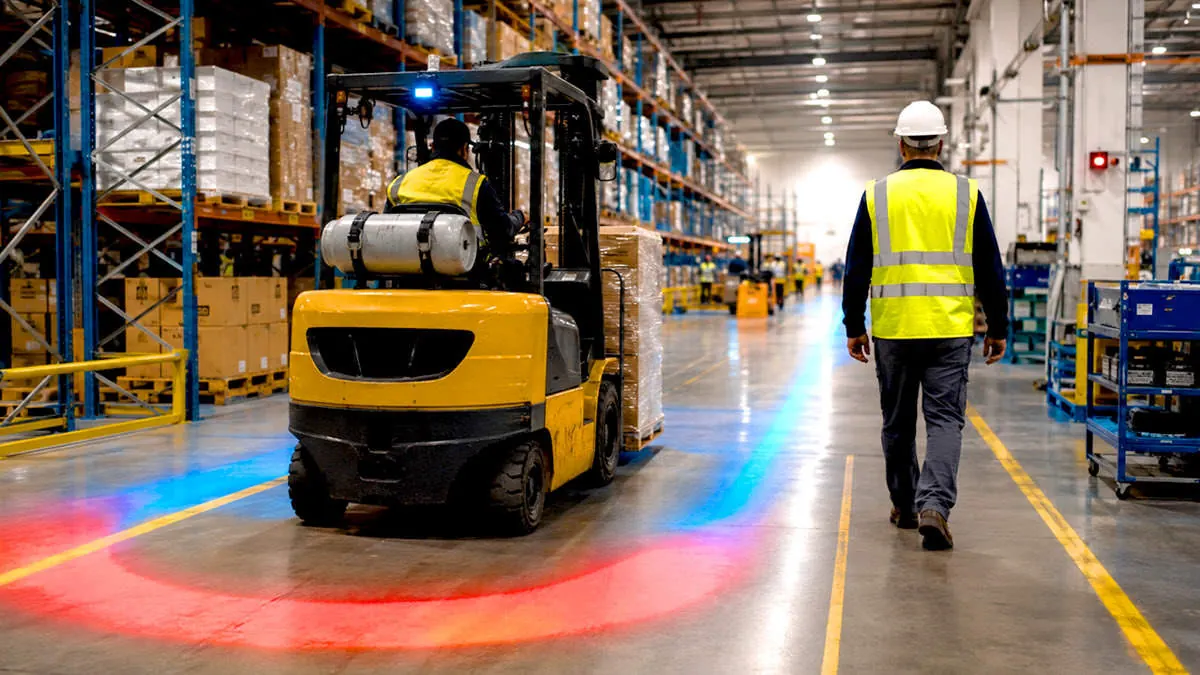
Computer-vision models locate and classify people within individual camera frames and then track them across successive frames to maintain continuity of identity and trajectory. Modern industrial systems commonly use optimized YOLO-family or SSD-based architectures running at 30 to 60 frames per second on edge hardware.
2. An AI-enabled camera system differs fundamentally from a standard vehicle camera or monitor.
A conventional camera supplies visibility or recording only. An AI system continuously analyzes every frame, distinguishes human form from background objects and other vehicles, and generates automated alerts without requiring the operator to watch a screen at all times.
3. Systems employ several distinct sensor technologies, each with different detection physics.
Visible-light cameras, infrared/thermal cameras, millimeter-wave radar, lidar, ultra-wideband (UWB), radio-frequency identification (RFID), and combinations of these sensors are all used. Each modality has different strengths in lighting, weather, dust, and occlusion conditions.
4. Vision-based AI systems detect pedestrians who are not wearing any tags or transmitters.
Camera systems identify people from visual appearance, shape, and motion. This covers visitors, contractors, temporary workers, and any employee who is not carrying a tag, common real-world gaps in pure tag-based systems.
5. UWB and RFID proximity systems normally require wearable tags on every pedestrian.
Readers or anchors on the vehicle or worksite detect only tagged individuals. An untagged person remains invisible to the system, creating a compliance and visitor-management requirement.
BLIND SPOTS, COVERAGE, AND THE LIMITS OF DETECTION
6. Blind spots are a primary technical and operational reason these systems are installed.
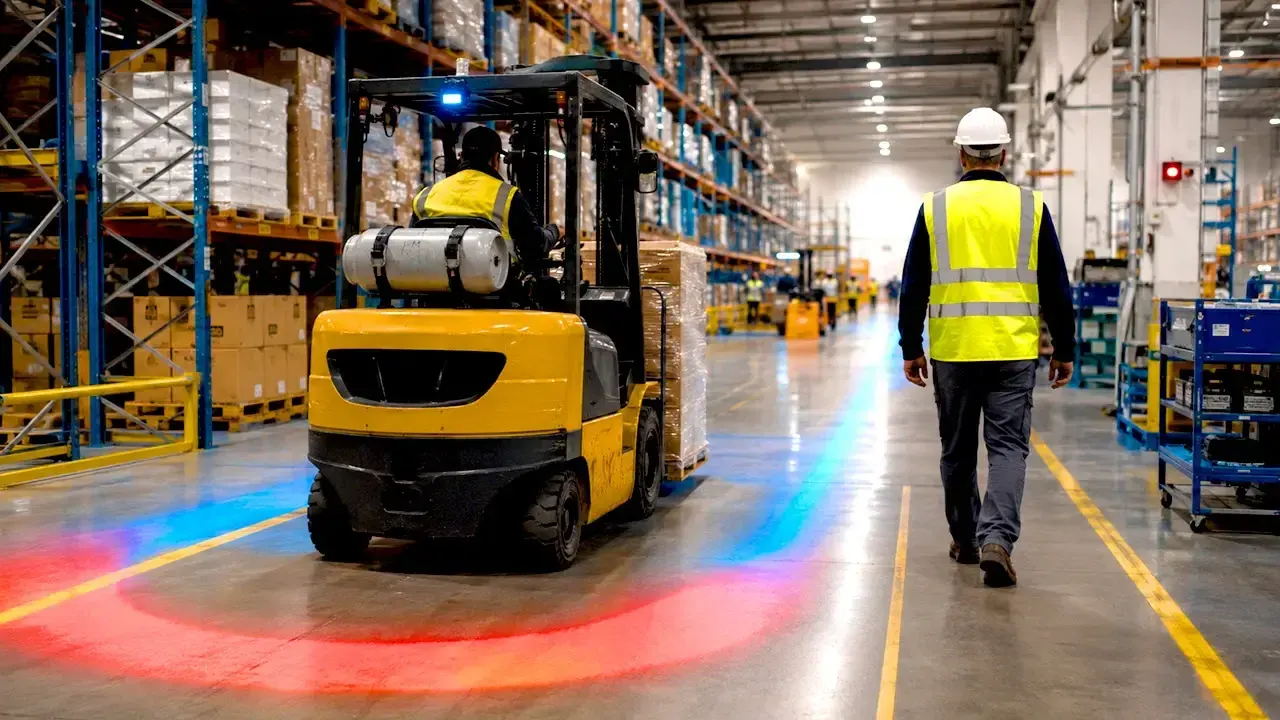
The mast, overhead guard, counterweight, carried load, and vehicle structure of a counterbalanced forklift create large zones the operator cannot see. Heavy equipment such as wheel loaders and excavators have even larger multi-directional blind zones created by the machine geometry itself.
7. Camera mounting position, height, angle, field of view, and cleanliness determine what the system can actually see.
A single rear camera covers only part of the risk envelope. Two- to four-camera installations (front, rear, left, right) or true 360° configurations substantially reduce uncovered areas. Dirt, condensation, or physical obstruction on the lens immediately degrades performance.
8. Occlusion: partial or complete hiding of a pedestrian, is one of the central unsolved technical challenges.
Loads, columns, racking, other vehicles, stockpiles, and even other people routinely hide part or all of a pedestrian. Research datasets specifically annotate occlusion levels (none, partial 0 to 50%, strong 50 to 100%). Multi-camera views and temporal tracking improve results but cannot detect a fully hidden person.
9. Visible-light camera performance varies significantly with lighting conditions.
Darkness, glare, strong backlighting, high-contrast shadows, and rapid transitions between indoor and outdoor environments all affect detection confidence. The same system can produce different results on different shifts or at different times of day.
10. Infrared cameras and multi-sensor fusion measurably improve performance in difficult visual conditions.
Thermal imaging detects heat signatures independent of visible light. Radar and lidar add range and velocity data that are relatively robust to dust, fog, and lighting extremes. Fusion reduces single-sensor failure modes but still requires site-specific validation.
11. Small or distant pedestrians occupy fewer image pixels and are therefore harder to detect reliably.
As distance increases, target size shrinks, motion blur and vibration become more problematic, and classification confidence drops. Most industrial systems are optimized for practical ranges of approximately 5 to 12 meters (16 to 40 feet).
ACCURACY, ERROR TYPES, AND WHY YOU VALIDATE ON SITE
12. Every detection system produces both false positives and false negatives.
A false positive is an alert when no pedestrian hazard exists. A false negative is a missed detection when a pedestrian is present. High false-positive rates train operators to ignore warnings; high false-negative rates leave hazards unaddressed. Both error types must be measured under real operating conditions.
13. Detection accuracy figures published by manufacturers or demonstrated under controlled conditions must be validated at the actual worksite.
Controlled demos cannot reproduce every combination of lighting, clothing (including heavy insulated gear), pedestrian posture, vehicle speed, load position, weather, dust, background clutter, and machine configuration. NIST's Artificial Intelligence Risk Management Framework (AI RMF) explicitly recommends evaluation under conditions similar to real deployment.
14. AI system performance must be monitored continuously after installation.
Camera positions shift, lenses accumulate dirt, software is updated, backgrounds change, new equipment is introduced, and work practices evolve. Performance can degrade without ongoing monitoring of detection rates, false-alarm frequency, near-miss logs, and video events. The NIST AI RMF emphasizes post-deployment monitoring for exactly these reasons.
ZONES, STOPPING DISTANCE, CONTROLS, AND REGULATION
15. Detection and warning zones must be engineered to match the specific machine kinematics and operating envelope.
A sit-down counterbalanced forklift, reach truck, order picker, wheel loader, excavator, telehandler, and articulated haul truck create completely different risk geometries. Zones must account for travel direction, turning radius, rear swing, articulation, attachments, typical speeds, and how pedestrians actually move around that machine.
16. Detection range is not equivalent to safe stopping distance.
A fully laden approximately 2.5-tonne forklift traveling at 6 km/h (roughly walking pace) still requires on the order of 3 to 3.2 meters total stopping distance (reaction plus braking) under ideal dry, level conditions. At higher speeds the distance increases nonlinearly. Operator reaction time alone is commonly 1 to 1.5 seconds. Warning distance must exceed stopping distance plus system latency plus a safety margin.
17. Systems can be configured for operator warning only or for interaction with machine controls.
Alert-only systems use in-cab LED/buzzer combinations, external beacons, monitors, or haptic feedback. More advanced integrations can request automatic speed reduction or braking when the vehicle control system is designed and validated to accept those signals.
18. An alert-only system remains an operator-assistance technology under OSHA rules.
The operator retains full responsibility for observing the environment and responding. Installation of cameras or alarms does not alter the training and competence requirements of 29 CFR 1910.178.
19. Automatic slowdown or stopping elevates the detection system to a safety-related control function.
When the system initiates or contributes to automatic machine movement or braking, it falls under the principles of ISO 13849-1 (design of safety-related parts of control systems) and ISO 13849-2 (validation). Driverless industrial trucks and their systems are addressed by ISO 3691-4. Proper risk assessment, architecture, and validation by qualified personnel are required.
20. Technology does not replace fundamental traffic controls and hierarchy of controls.
OSHA continues to recommend physical separation of forklifts and pedestrians wherever feasible, dedicated pedestrian walkways, traffic control measures, and thorough training. AI detection is an additional layer, not a substitute. Regulatory applicability must be evaluated for the specific equipment type (powered industrial trucks versus earthmoving or over-the-road vehicles).
COST, INSTALLATION, ARCHITECTURE, AND SPEED
21. Typical commercial hardware pricing for mature retrofit AI camera systems in 2026 falls in the $1,500, $3,000 range per vehicle for complete multi-camera kits.
This range commonly includes cameras, processing unit, in-cab alerts, external beacons, mounting hardware, and basic installation materials. Some entry configurations and subscription models start lower; more complex 360° or control-integrated systems sit at the upper end or higher.
22. Installation time for plug-and-play or modular systems is frequently reported as 1 to 2 hours per vehicle with minimal production disruption.
Systems that avoid deep integration into the vehicle's control network can be fitted during normal maintenance windows.
23. Edge (on-vehicle) processing is the dominant architecture for safety-critical industrial use.
Inference occurs locally so that detection continues even if facility Wi-Fi or cellular connectivity is lost. Cloud connectivity, when present, is typically used for optional analytics, video review, and fleet reporting rather than for the real-time detection loop itself.
24. Detection latency on current-generation edge systems is commonly targeted under 100 to 200 milliseconds, with some documented values around 130 milliseconds.
At typical warehouse speeds this corresponds to only a short distance of vehicle travel before an alert is generated.
25. Camera counts in practical deployments range from a single rear camera to two-, three-, or four-camera 360° configurations.
A single rear camera addresses the classic backing blind spot. Full perimeter coverage is required when lateral approaches and multi-directional movement are significant risks.
REAL-WORLD PERFORMANCE, DATA, AND FIELD BEHAVIOR
26. Manufacturer-stated detection accuracy under good conditions frequently falls in the 92 to 99% range.
Real-world figures depend heavily on environment, clothing, occlusion, and calibration. After a learning or calibration period (often 2 to 4 weeks), well-tuned systems can achieve low false-positive rates (target <5% in many specifications).
27. Multispectral research datasets created specifically for forklift environments contain tens of thousands of frames (for example, 19.4 k frames with 20.2 k annotated pedestrians) and explicit occlusion labels.
These datasets enable more relevant model training than generic automotive pedestrian datasets.
28. Industrial deployments of AI or layered (AI + UWB/radar) systems have reported near-miss reductions commonly in the 50 to 75% range, and a small number of published multi-site programs have reported no forklift-pedestrian accidents during their monitoring period.
Layered architectures have shown higher overall coverage than single-technology approaches in published case summaries.
29. Environmental ratings for industrial cameras are frequently IP67 or IP69K, with operating temperature ranges such as, 20 °C to +70 °C (, 4 °F to +158 °F).
These ratings address dust, high-pressure wash-down, and temperature extremes common in warehouses, cold storage, yards, and outdoor operations.
30. Power is typically drawn from the vehicle's battery (commonly 12 to 80 V DC input ranges).
Systems are designed to operate whenever the machine is powered, providing continuous protection rather than only when reverse is selected.
31. Configurable multi-zone alerting (warning zone versus danger/exclusion zone) is a standard feature.
Zones can be shaped to the vehicle's travel path and site procedures. Escalating alerts (visual first, then audible, then external) help manage operator response without creating constant noise.
RECORDING, CLOTHING, VIBRATION, AND INTEGRATION
32. Onboard video recording of detection events provides objective evidence for near-miss analysis, training, and incident investigation.
This data often reveals higher blind-zone exposure frequencies than traditional observation or reporting systems had previously measured.
33. Clothing and personal protective equipment can affect detection performance.
Heavy insulated gear with hoods, bulky high-visibility clothing against reflective backgrounds, or unusual postures can reduce confidence until the model is fine-tuned on site-specific imagery.
34. Vibration, camera movement, and rapid changes in vehicle direction introduce additional challenges for both detection and tracking.
Robust industrial mounting and temporal consistency checks in the software mitigate these effects.
35. False-positive sources that systems learn to suppress include cardboard boxes, pallet stacks, static infrastructure, empty high-visibility vests, and certain mechanical motions of other equipment.
Successful calibration reduces these over time; inadequate calibration produces alarm fatigue.
36. Speed-related interaction is important: many systems are optimized for typical warehouse speeds (often ≤8 km/h or lower in pedestrian zones).
Higher speeds reduce available reaction time for both the system and the operator.
37. Integration with existing traffic management (floor markings, convex mirrors, speed limits, one-way aisles) multiplies effectiveness.
Detection technology works best as part of a complete hierarchy of controls rather than in isolation.
STANDARDS, PILOTS, AND CONTINUOUS IMPROVEMENT
38. Regulatory and standards context includes OSHA 29 CFR 1910.178, NIOSH forklift safety recommendations, NIST AI RMF for trustworthy AI, ISO 13849 for safety-related control systems, and ISO 3691-4 for driverless industrial trucks.
Applicability depends on whether the system is alert-only or participates in automatic control functions.
39. Pilot programs under real operating conditions remain the recommended evaluation method before fleet-wide rollout.
A single-vehicle or small-fleet pilot lasting several weeks to a few months generates site-specific data on detection rate, false-alarm frequency, operator acceptance, and near-miss trends that no specification sheet can provide.
40. Continuous improvement cycles using the system's own event logs, video, and near-miss counts turn the technology into a data source for broader safety management.
Facilities frequently discover previously unmeasured exposure patterns and then adjust procedures, layouts, or training accordingly.
The Blind Zone Is Where People Get Hurt
The operator cannot see everything. The mast, the load, the counterweight, and the machine frame all hide people who are standing exactly where they should not be. That is the problem this technology is built to reduce.
- Forklifts and heavy equipment carry large, fixed blind zones created by the machine itself.
- Pedestrians account for a significant share of powered industrial vehicle incidents.
- Untagged visitors and contractors are the people most often missed by tag-only systems.
- A camera that only records does nothing to warn an operator in the moment.
- Detection range is not the same thing as safe stopping distance.
These 40 facts about AI pedestrian detection for forklifts and heavy equipment come straight from OSHA, NIOSH, BLS, NIST, ISO, and peer-reviewed research. No hype, no rankings. Just what the field data shows.
What AI Pedestrian Detection Systems for Forklifts and Heavy Equipment Actually Do
AI pedestrian detection systems combine cameras (visible-light or infrared), radar, lidar, ultra-wideband (UWB), RFID, or multi-sensor fusion with onboard deep-learning software to identify people near forklifts, reach trucks, order pickers, wheel loaders, excavators, telehandlers, skid steers, haul trucks, and other mobile industrial equipment. Depending on configuration, the system can display the detected person on an in-cab monitor, trigger audible, visual, or haptic warnings, record timestamped video of the event, count near-misses, or (when properly engineered and validated) send control signals for automatic slowdown or braking.
These systems are supplemental protective layers. They do not replace trained and competent operators, physical separation of pedestrians and vehicles, marked walkways, traffic management plans, safe operating procedures, or site-specific risk assessments. OSHA's powered industrial truck standard (29 CFR 1910.178) continues to require operator training and competence regardless of any detection technology installed.
The Numbers Behind the Investment - Core statistics driving adoption
OSHA has estimated approximately 85 forklift-related fatalities and 34,900 serious injuries annually in the United States, with immediate costs historically cited around $135 million. Historical NIOSH analysis of 1,021 forklift fatalities (1980 to 1994) found that pedestrians struck by forklifts accounted for 20% of deaths.
More recent BLS data show continued annual forklift-related fatalities in the dozens (84 involving forklifts, order pickers, or platform trucks in 2024, up from 67 in 2023). In detailed studies, pedestrians have been involved in roughly 20 to 35% of powered industrial vehicle incidents. Pedestrian injuries linked to forklifts have shown a median of 20 days away from work.
KEY TAKEAWAY
There is no universally "best" pedestrian detection technology. Camera-based AI provides tagless detection and visual evidence. UWB and RFID supply reliable proximity when tag compliance is high. Radar, lidar, infrared, and sensor fusion address environmental gaps.
The optimal choice depends on the specific machines, environment, pedestrian density and behavior, required coverage, desired alert method, and whether automatic control intervention is intended.
A properly designed pilot under actual operating conditions, followed by ongoing monitoring aligned with NIST AI RMF principles, is the evidence-based path to effective deployment. Costs for mature retrofit multi-camera systems typically fall in the $1,500, $3,000 range per vehicle in 2026.
AUTHOR PERSPECTIVE
I have spent more than 30 years around machine control, precision positioning, and industrial safety technology. The pattern rarely changes. A spec sheet promises 99 percent, then the first cold-storage shift or a worker in a bulky insulated coat tells a different story. That gap is why I push validation before fleet rollout, every time.
The technology is genuinely useful. It is also not magic. Treat it as one layer over training, separation, and traffic control, prove it on one machine, and let the operators see it work. More on how I think about this at https://johnbuttery.com.
"The best system is the one you have already watched perform in your own aisles, in your own conditions, on your own worst shift."
ABOUT RIODATOS
RioDatos is a U.S.-based industrial safety technology company headquartered in Arizona, with domestic inventory and direct distribution across the Americas. Our flagship product is the RioV360, a 360-degree AI-powered pedestrian detection system purpose-built for forklifts and heavy equipment. The RioV360 provides full surround camera coverage with in-cab alerts, requires no pedestrian-worn device, and ships as a complete installation kit from Arizona.
Our approach is built around measurable live performance, operator adoption, and scalable deployment across mixed fleets and multi-site programs. Direct pricing, fast U.S. shipping, certified installation, and phone, email and Teams support mean safety teams can focus on protection rather than procurement logistics. Every engagement starts with a single-machine evaluation in real operating conditions before any fleet commitment is made.
REFERENCES
- Occupational Safety and Health Administration, Powered Industrial Trucks Standard (29 CFR 1910.178) and Powered Industrial Trucks eTool, Pedestrian Traffic section.
- National Institute for Occupational Safety and Health (NIOSH), Alert: Preventing Injuries and Deaths of Workers Who Operate or Work Near Forklifts (DHHS Publication 2001-109) and related FACE investigations.
- U.S. Bureau of Labor Statistics, Census of Fatal Occupational Injuries and Injuries, Illnesses, and Fatalities program data (multiple years through 2024).
- Collins et al., "Fatal occupational injuries associated with forklifts, United States, 1980 to 1994," American Journal of Industrial Medicine (1999).
- Collins et al., studies of powered industrial vehicle injuries in automobile manufacturing (American Journal of Industrial Medicine).
- National Institute of Standards and Technology, Artificial Intelligence Risk Management Framework (AI RMF 1.0) and associated Playbook.
- ISO 13849-1:2023 and ISO 13849-2:2012 (safety-related parts of control systems); ISO 3691-4:2023 (driverless industrial trucks).
- Choi et al., "Multispectral Benchmark Dataset and Baseline for Forklift Collision Avoidance," Sensors / PMC (2022).
- Peer-reviewed computer-vision, sensor-fusion, and industrial proximity research; manufacturer technical specifications and field deployment case data from 2025 to 2026.
SUMMARY
40 Facts About AI Pedestrian Detection for Forklifts and Heavy Equipment
OSHA still counts roughly 85 forklift-related fatalities a year in the US, and pedestrians struck by forklifts have historically made up about 20% of the deaths, yet most buyers pick a detection system off a spec sheet that was never tested in their own aisles.
I pulled together 40 verified facts on what these systems actually do, where they fail, and what they cost. Here is what most people get wrong.
Camera AI detects untagged visitors and contractors; tag-only systems never see them.
Detection range is not stopping distance, and a warning inside the stop zone is useless.
Edge processing keeps the detection loop alive when the Wi-Fi drops.
Manufacturer accuracy of 92 to 99% shifts hard once real clothing, dust, and occlusion enter the picture.
Layered AI plus UWB or radar has cut near-misses 50 to 75% in reported deployments.
Mature retrofit kits run $1,500: $3,000 per vehicle in 2026, installed in 1 to 2 hours.
A single-machine pilot generates the only numbers a spec sheet can never give you.
If you are scaling a safety technology across a fleet, are you buying the demo or the field data? Prove it on one machine first.
Pilot One Unit: $500 Off
Test RioV360 AI pedestrian detection on your highest-risk machine before a fleet rollout. In-stock units ship from Arizona in 2 business days.
More Articles
November 7, 2026
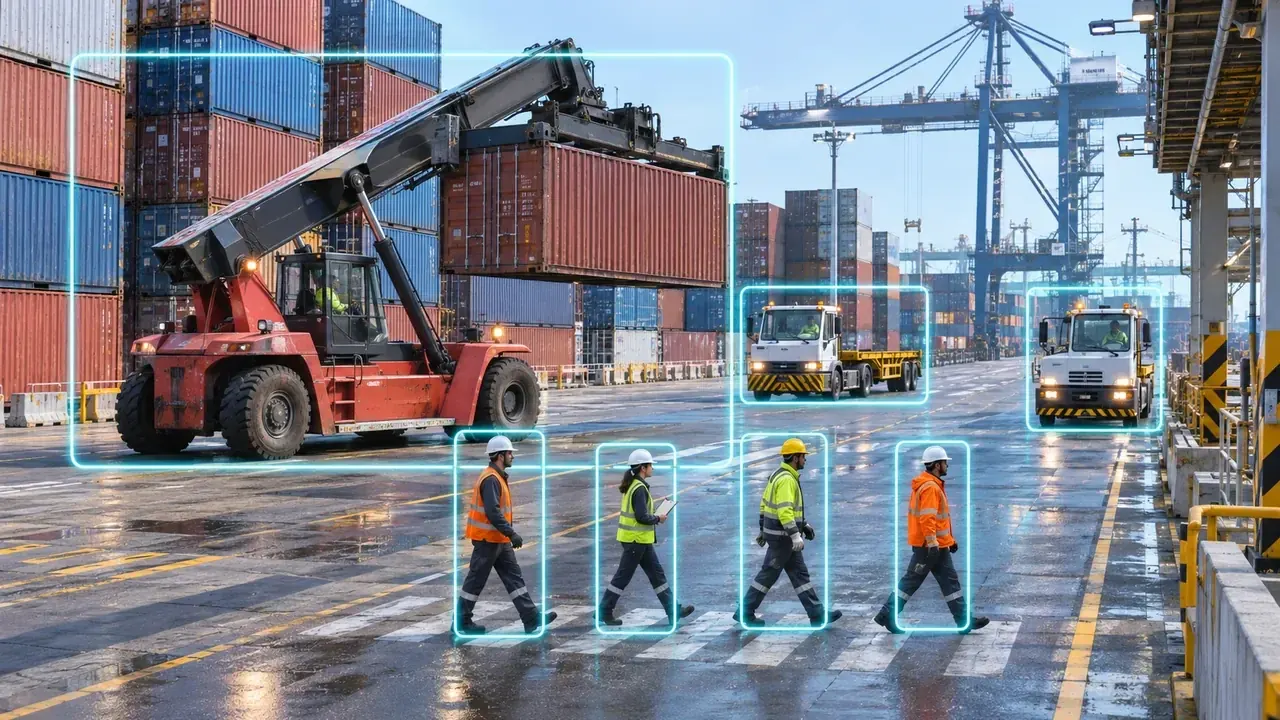
AI Pedestrian Detection for Ports: What the Numbers Show
AI pedestrian detection for ports targets the 23% of port deaths from vehicle and pedestrian impact. See the data, machine blind spots and field...
Read more →
November 6, 2026
Wheel Loader Pedestrian Detection for Waste Transfer Stations
Wheel loader pedestrian detection for waste transfer stations: 360° recorded video, AI alerts from 0 to 5 m, and a one-machine pilot for your tip...
Read more →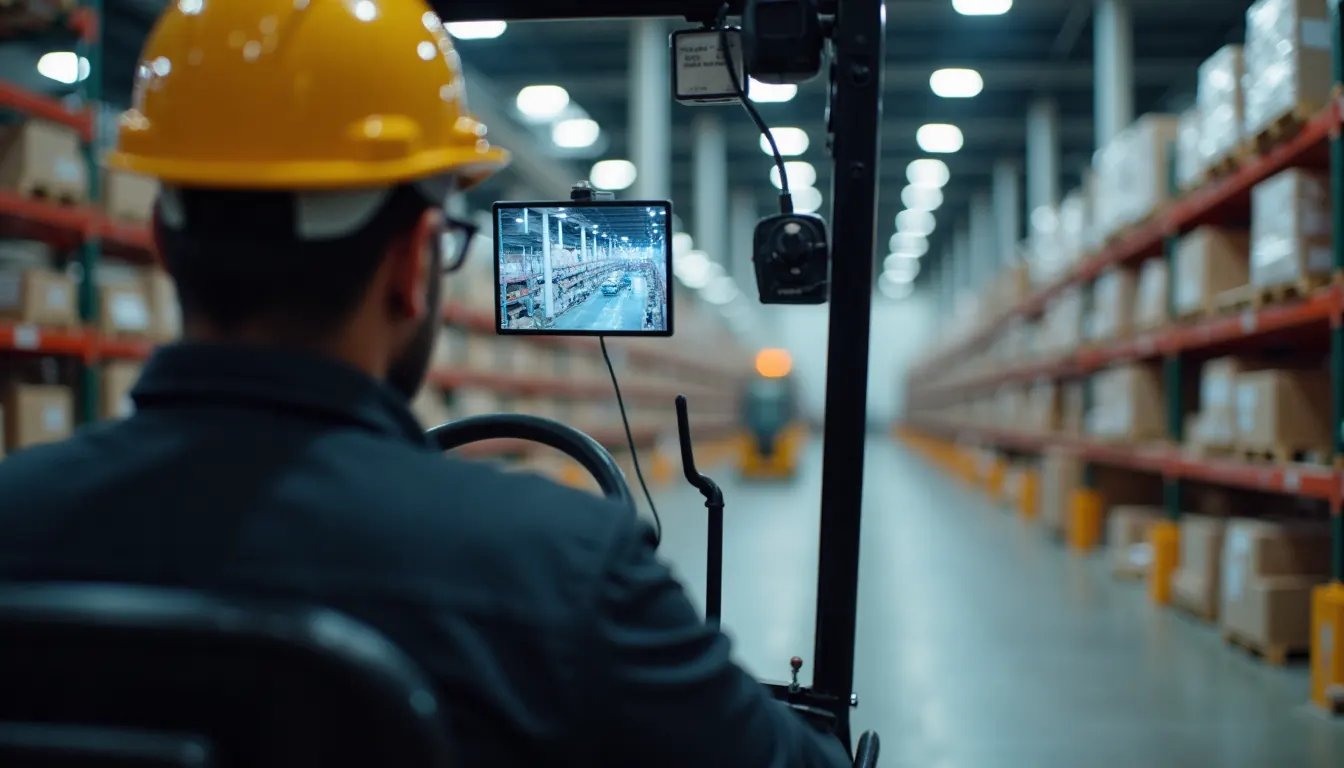
November 3, 2026
Benefits of 360 Forklift Camera Benefits
Forklifts are essential in many industrial operations, but they also pose significant safety risks. Blind spots and limited visibility can lead to...
Read more →