
RioDatos Blog
Forklift Speed Reduction or Alerts: Choosing Pedestrian Detection
November 11, 2026 • John Buttery, CEO of RioDatos
Some pedestrian detection systems slow the forklift when a person is close. Others warn the operator and the person on foot. Here is how to decide which one your site needs.
Two Ways to Prevent a Collision
Every forklift pedestrian detection system starts the same way: it detects a person near the truck. What happens next splits the market in two.
- Warning systems alert people. The operator gets a visual and audible alarm in the cab, and in some systems the person on foot hears an alarm or sees a light.
- Intervention systems also connect to the truck's controls to limit speed, cut acceleration or stop travel when a person is in the danger zone.
When Automatic Speed Reduction Makes Sense
Intervention is worth the extra work in a few situations:
- Very narrow aisles and high-density pick zones where an operator has almost no time to react.
- Sites with a history of collisions where alerts alone have not changed behavior.
- Fleets standardized on one truck brand that already supports a speed-control input.
What Speed Reduction Costs You
Speed control is not a bolt-on. It has to be wired into the truck's controller, which brings questions most buyers do not see until the install:
- Integration per model. Each truck brand and controller is different. Mixed fleets mean multiple integrations.
- OEM and warranty review. Changing how a truck accelerates or brakes can need dealer or manufacturer sign-off.
- Productivity. A truck that slows every time someone walks past in a busy aisle slows the whole operation, and operators start looking for ways around it.
- Price. Systems with machine integration usually cost more per truck and take longer to install.
When Alerts Are the Right Starting Point
For most mixed fleets, the fastest risk reduction is a reliable alert that operators trust, a warning that reaches the person on foot, and video of what happened. That combination changes behavior on both sides of the encounter, and the video turns near misses into coaching.
An alert only works if people trust it. The biggest failure in any system is nuisance alarms: a detector that sounds off for racking, pallets and shadows gets ignored or unplugged. AI cameras that recognize people, rather than any object, are what keep alerts credible.
Where RioV360 Fits
RioV360 by RioDatos is a warning system. Up to four AI cameras detect people in zones you set from 0 to 5 m. The operator gets an in-cab alert, the person on foot gets a 120 dB voice alert and flashing light, and every camera records 1080p video on board. It does not wire into drive controls, so it installs in under 2 hours on any forklift running 8 to 32 V DC, with no integration project.
That makes it a practical first layer: prove the alerts on your highest-risk truck with a PILOT unit, review the video, then decide whether any truck needs intervention as well.
A Simple Decision Path
- Map where people and trucks meet: docks, crossings, blind corners, narrow aisles.
- Put detection, two-way alerts and recording on the highest-risk trucks first.
- Review a month of video and alerts. Look for repeat locations and behaviors.
- Fix layout and traffic rules where the video shows patterns.
- Add speed control only where alerts and layout changes have not been enough.
Frequently Asked Questions
Do forklift pedestrian detection systems slow the truck?
Some do. Intervention systems connect to the truck's controller to limit speed or stop travel. Warning systems like RioV360 alert the operator and the person on foot without changing how the truck drives.
Is automatic speed reduction required by OSHA?
No. OSHA 1910.178 requires safe operation and training, but does not require a specific detection or speed-control technology.
Does speed control slow down operations?
It can. In busy aisles a truck may slow often, which affects throughput and can push operators to work around the system.
What is the advantage of a warning system?
Faster install with no controller integration, works across mixed fleets, and, with an external beacon, warns the person on foot as well as the operator.
Pilot One Unit: $500 Off
Test RioV360 AI pedestrian detection on your highest-risk machine before a fleet rollout. In-stock units ship from Arizona in 2 business days.
More Articles
November 7, 2026
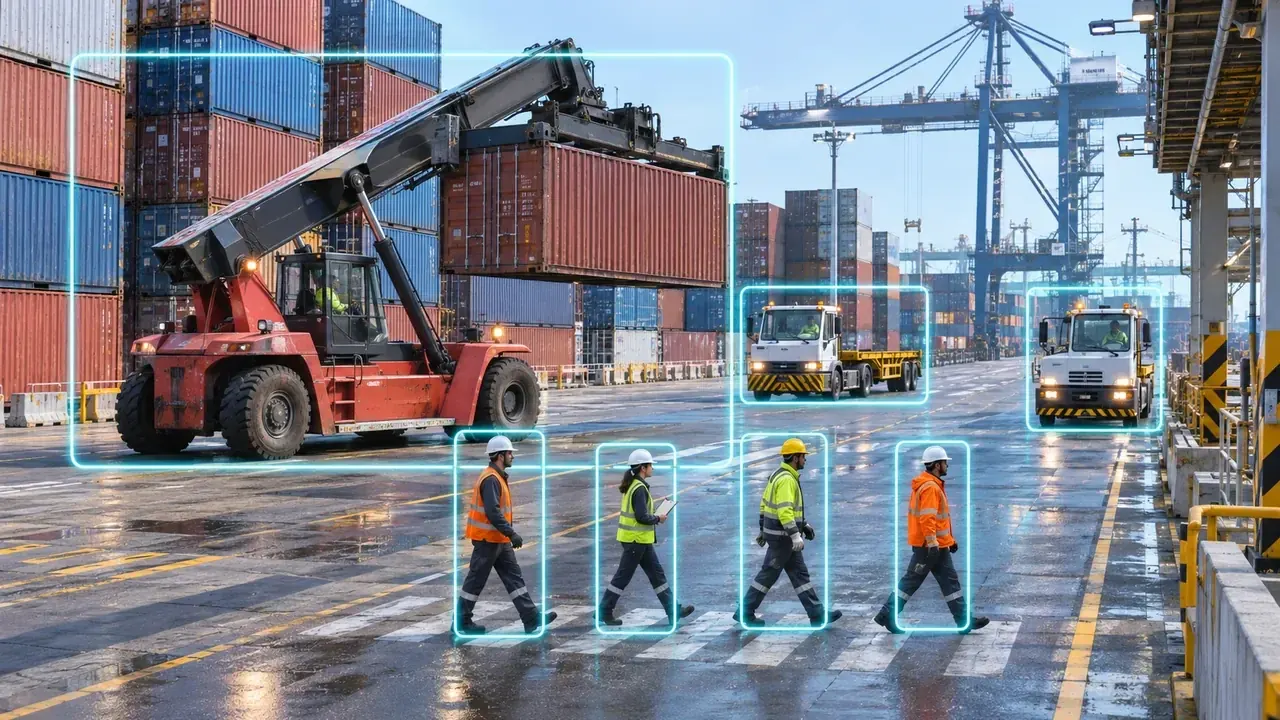
AI Pedestrian Detection for Ports: What the Numbers Show
AI pedestrian detection for ports targets the 23% of port deaths from vehicle and pedestrian impact. See the data, machine blind spots and field...
Read more →
November 6, 2026
Wheel Loader Pedestrian Detection for Waste Transfer Stations
Wheel loader pedestrian detection for waste transfer stations: 360° recorded video, AI alerts from 0 to 5 m, and a one-machine pilot for your tip...
Read more →
November 3, 2026
Benefits of 360 Forklift Camera Benefits
Forklifts are essential in many industrial operations, but they also pose significant safety risks. Blind spots and limited visibility can lead to...
Read more →