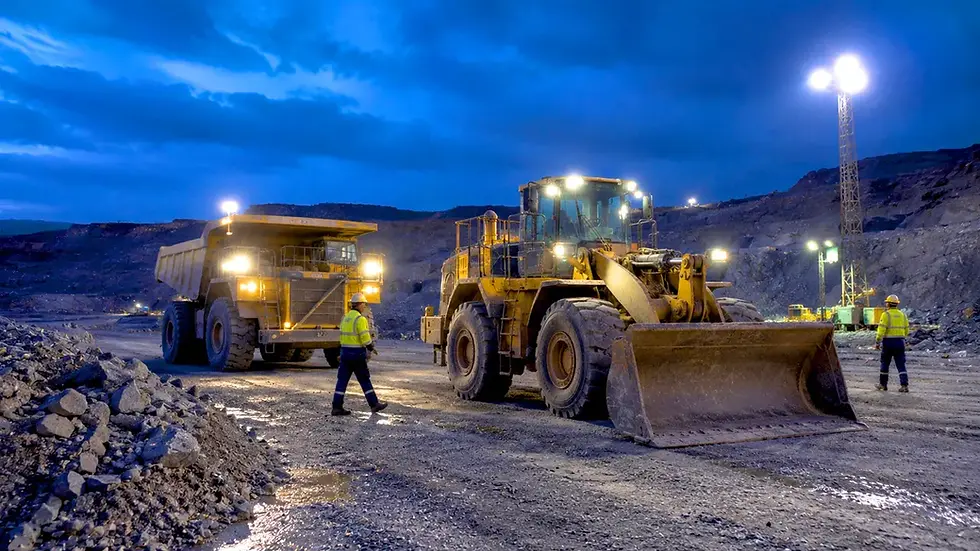
Heavy-Duty Forklift Pedestrian Detection: What 30-Ton Machines Demand
- John Buttery

- Jun 25
- 11 min read
How high-capacity lift trucks in lumber mills, steel mills, ports, and pipe yards create blind-zone exposure that standard safety protocols don't address — and what works in the field.

Introduction
There's a category difference between a 5,000-pound warehouse forklift and a 60,000-pound heavy lift truck in a pipe yard or lumber operation. Most safety programs don't reflect that difference. The hazard profiles, blind zones, and pedestrian exposure patterns are fundamentally different — but a lot of facilities treat them the same way.
In high-capacity operations, the margin for error is smaller, and the consequences of a close call are more severe. A heavy-duty forklift moving a load of steel pipe or a bundle of timber creates exposure zones that a supervisor watching from a distance or a standard backup camera simply cannot cover. What we're seeing across facilities is that the safety gap shows up not in rules or training, but in real-time visibility during load movement.
This article looks at where heavy-duty forklift pedestrian detection matters most, why exposure patterns differ in this machine class, and what a practical evaluation entails before committing to a site-wide deployment.
Heavy-Duty Forklift Pedestrian Detection Starts With Understanding the Exposure
Not all forklift hazards are the same. At 15,000 to 125,000 pounds, these machines generate blind zones and counterweight swing arcs that are categorically larger than anything a standard 5,000-pound IC truck creates. Operators sit higher. Loads are heavier and wider. The counterweight extends further behind the machine. And in many cases, the facilities themselves — lumber yards, port terminals, steel mills, pipe handling areas — mix ground crews and lift equipment in shared corridors where physical separation isn't always possible.
The Blind Zone Problem at High Capacity
The mast-forward blind spot on a heavy lift truck is significant, especially when the load is elevated. An operator trying to see around a bundle of 40-foot timber or a loaded pipe cradle has their forward sightline essentially blocked during travel. Rear visibility isn't better. The counterweight on a 30-ton machine extends far enough behind the rear axle that a worker crouching or moving laterally can disappear from every mirror, camera, and sightline simultaneously.
Standard backup cameras help with straight-line reversing. They don't help with the wide counterweight sweep that happens during a repositioning turn, and they don't cover the lateral blind zones on either side of the machine during forward travel with an elevated load.
Shared Corridors and Mixed Traffic
Ports are a good example of where the exposure frequency is highest. Loading docks and terminal floors mix spotters, riggers, and equipment operators in the same lanes. The machine that's moving loaded containers at 20 miles per hour shares space with workers flagging trucks, checking paperwork, and walking between tasks. The discipline required to keep everyone separated is real — but it's also inconsistent. Shift changes, production pressure, and unfamiliar ground crews create exposure windows that protocol alone can't close.
The same pattern shows up in steel mill coil storage areas, pipe yard staging lanes, and lumber yard sorting operations. The machine is doing its job. The worker is doing their job. And the gap between them is sometimes measured in feet, not the safe distances a traffic management plan assumes.

Why Standard Protocols Don't Scale
Spotter systems work until they don't. A single spotter managing a large machine in a busy yard is watching one quadrant of a 360-degree exposure zone. RFID proximity alert systems require every ground worker to wear a tag consistently, every shift — which is a behavioral compliance problem, not a technology problem. Tag-based systems also alert the operator only after the worker has already entered the detection zone. In a high-capacity machine moving at operating speed, the stopping distance doesn't leave much room.
The more consistent approach is a detection system that doesn't depend on what the worker is wearing or carrying. That's where AI-based visual detection changes the math.
What RioV360 Does in These Environments
RioV360 is a four-camera 360-degree AI pedestrian detection system designed for vehicle-mounted use in industrial environments. It detects people using visual AI, no tags, no wearables, no site-wide infrastructure required. The cameras cover the full perimeter of the machine, including the counterweight zone, the mast-forward area, and both lateral sides during travel.
Specifically for heavy-duty forklift applications, the system addresses several exposure patterns that single-camera or spotter-dependent approaches miss.
The in-cab display is a 7-inch color monitor that shows a full 360-degree view, with AI-highlighted alerts when a person or another vehicle is detected. The alert triggers both a visual warning on the monitor and an audible signal inside the cab. An external flashing beacon and a 120-decibel external alarm directly warn the ground worker. That external alert matters in high-noise environments like steel mills and port terminals, where a worker may have no other way to know the machine is reacting to their presence.
Recording runs continuously to a 512GB SD card, roughly ten full workdays of loop storage. There's no cloud dependency, no subscription, and no connectivity requirement. For remote lumber operations, intermodal yards with inconsistent signals, and facilities where IT won't allow cloud-connected equipment on the network, local recording is a practical advantage. Footage is available for incident review, near-miss documentation, and operator coaching.
That recording capability changes how facilities handle near-miss reviews and operator coaching. When an event occurs, safety managers can pull footage from the same shift and walk through exactly what the system detected and when. That's a different conversation from a verbal debrief or a written incident report. Operators respond differently when the review is grounded in what the camera actually captured. Training sessions built around real footage from the operation tend to land harder than any scenario-based exercise.
The cameras are IP69K rated, which covers rain, mud, pressure washing, and temperature extremes. In a lumber yard operating in the Pacific Northwest in January or a port terminal getting washed down between shifts, that rating matters. Standard automotive-grade cameras don't last long in those conditions.
The installation kit is engineered for large equipment frames. Brackets, cabling, and hardware are sized for vibration levels and frame dimensions that a system designed for warehouse forklifts won't accommodate cleanly.
More information on the system is available at riodatos.com.

Industry Environments Where the Exposure Pattern Is Highest
Heavy-duty forklift pedestrian detection isn't uniformly critical across all applications. The exposure frequency is highest where machine size, shared corridor traffic, and inconsistent pedestrian separation converge.
Ports and Container Terminals
Port terminals operate 24 hours, with mixed crews across multiple shifts. Container handlers and breakbulk forklifts work alongside spotters, checkers, and maintenance crews in lanes that are sometimes marked and sometimes not. Night operations reduce visual contrast between the machine and the worker. Shift changes create a few minutes where workers are moving between positions and machine operators are still getting oriented. Those windows are where exposure frequency is highest.
Steel Mills and Metal Processing Facilities
Coil storage areas and shipping floor operations mix overhead crane work with forklift traffic and floor-level workers. The combination of overhead load paths, forklift travel lanes, and maintenance personnel moving between tasks creates a layered exposure environment. Heavy forklifts moving 30-ton coil loads on extended load centers have forward sightlines that are blocked for most of the loaded travel distance.
Lumber Mills and Building Materials Operations
Outdoor lumber yards present variable footing, low-light conditions during early and late shifts, and ground crews working at ground level while operators are seated 10 to 12 feet above them. Narrow stacking lanes in a busy yard leave minimal separation. Workers sorting or grading material often have their backs to approaching traffic.
Pipe Yards and Heavy Manufacturing
Pipe facilities handle long, heavy loads that extend well beyond the machine's footprint. Operators managing a 40-foot concrete pipe on custom fork extensions have essentially zero forward sightline. Ground crews managing end alignment and pipe placement are directly in the forward work zone during the most demanding part of the operation.

Testing Before Scaling: The Single-Machine Evaluation
"We picked the one machine that created the most exposure and started there. That's how you find out what the system actually does in your conditions."
Organizations typically discover that a single-machine pilot on the highest-risk unit in the fleet provides more actionable information than any amount of spec review. Running a system on the machine that operates in the most challenging environment,the heaviest loads, the tightest lanes, and the most pedestrian traffic shows whether the detection works in the conditions that matter, not in ideal circumstances.
If you're managing a fleet of heavy-duty forklifts and want to evaluate whether RioV360 fits your operation, the right starting point is one machine, one environment, real conditions. Riodatos supports single-unit evaluations specifically for this reason. You can also contact us directly or schedule a 30-minute conversation to talk through your site conditions before committing to anything.
The evaluation generates footage, detection data, and operator feedback from your actual environment. That's the information worth having before scaling to a full fleet.
A facility that starts with one unit typically reaches a scaling decision faster than one that evaluates the technology through product demos or reference calls alone.
The pilot machine generates real questions — about mounting locations, alert sensitivity in their specific environment, how operators respond on that shift, and what the footage shows during the first week. Those questions get answered in the field, not in a spec sheet. By the time a broader deployment is on the table, the EHS team and operations management are working from direct experience rather than assumptions.
A Note on Operator Adoption
"The operators told me they noticed it within the first hour. Not as an annoyance — as a backup to what they were already trying to do."
Systems that alert too frequently lose operator trust fast. In heavy industrial environments, operators already manage enough information. A system that fires on a fence post or a shadow creates alert fatigue, which leads to ignored warnings.
The AI detection in RioV360 is trained to distinguish people and vehicles from background objects. In a busy port or steel mill, that distinction matters. An operator who learns the system is reliable starts using it as an actual input, not as background noise they've learned to tune out.
Operator adoption is a leading indicator of whether a safety system is actually doing anything. A system that operators trust creates a behavioral feedback loop — operators respond to alerts, ground workers learn the external beacon means something, and the exposure events that matter start getting avoided. Compliance-only approaches create paperwork. This creates behavior.

Why This Matters Now
The EHS conversation around heavy equipment has shifted. The focus used to be almost entirely on lagging indicators: incidents, recordables and near-miss counts. What organizations are pushing toward now is exposure frequency: how often are people and machines sharing space in conditions where a close call is possible? That's a leading indicator, and it's measurable.
AI-based detection systems generate that data as a byproduct of operation. Every detection event, every alert trigger, every time the system identifies a pedestrian in a zone where the operator may not have seen them, that's operational intelligence. It tells EHS teams where exposure is concentrated, which shifts are generating the most events, and which machines are generating the most alerts. That information is actionable in a way that incident reports aren't.
For heavy-duty forklift operations, where the consequences of a missed detection are severe, moving from reactive documentation to active exposure measurement is the shift worth making.
If your fleet includes high-capacity machines in environments with shared pedestrian traffic, it's worth understanding your current exposure frequency. Explore the RioV360 system at riodatos.com or reach out to start a conversation about what a field evaluation would look like for your operation.
Author Perspective
I've spent 30 years working with positioning, machine control, and industrial safety technology across sectors including mining, construction, and heavy manufacturing. Most of that time has been spent close to the machines, not in boardrooms or conferences, but on job sites, in equipment cabs, and on shop floors where the gap between what a safety policy says and what actually happens in a production environment is visible and sometimes uncomfortable.
What I keep coming back to is that the highest-risk exposure events in heavy industrial operations are almost never the dramatic ones that end up in incident reports. They're the near-misses that don't get reported, the moments where a worker walked through a zone during a machine repositioning because it's faster and they've done it a hundred times, and the machine operator who glanced left when the person came from the right. The exposure frequency in most operations is higher than the incident rate suggests. The question is whether you're measuring it.
More of my thinking on industrial safety and the shift from lagging to leading indicators is at johnbuttery.com.
Conclusion
Heavy-duty forklift pedestrian detection is not a product category that gets enough serious attention relative to the actual exposure it's designed to address. These machines create blind zones, counterweight sweep arcs, and mast-forward sightline blocks that standard camera systems and spotter protocols were never designed to handle. The industries that operate them, ports, steel mills, lumber yards, pipe facilities, run under conditions that are demanding on equipment and the people working around it.
"The risk isn't in the incident. It's in the hundred exposures that didn't become incidents — and the assumption that the next one won't either."
Starting with a single-machine evaluation in your highest-risk application is the practical path. It generates real data from real conditions, creates operator feedback you can use, and gives your EHS team a defensible basis for a broader deployment decision.
About Riodatos
Riodatos is a U.S.-based industrial safety technology company headquartered in Arizona, with domestic inventory and direct support. We build and supply AI-powered pedestrian detection systems purpose-built for the most demanding vehicle and pedestrian safety applications in warehouses, factories, construction sites, ports, and logistics operations across the Americas.
Our flagship system, RioV360, delivers 360-degree AI pedestrian detection for forklifts and heavy equipment — no tags, no wearables, no cloud dependency. For facilities that manage radio-frequency detection needs, RioRAD extends that coverage. Every deployment is configured for the site's specific equipment, traffic patterns, and risk profile. We provide direct pricing, fast domestic shipping, certified installation support, and English and Spanish customer service so that safety teams can focus on protection, not procurement.
If you're evaluating systems for your fleet, our dealer program is available for safety distributors and equipment dealers looking to add proven pedestrian detection to their offering. Our emphasis is measurable live performance, operator adoption, and scalable deployment across mixed fleets and multi-site operations.
Publishing Assets
Keyword Phrase: heavy-duty forklift pedestrian detection
Meta Description: Heavy-duty forklift pedestrian detection in lumber mills, steel mills, ports, and pipe yards — how AI-based 360° systems address blind zones standard protocols can't cover. (158 chars)
SEO Description: Heavy-duty forklifts operating at 15,000 to 125,000 lbs create blind zones and counterweight sweep arcs that standard cameras and spotter systems can't cover. This article examines the pedestrian exposure patterns specific to high-capacity lift trucks and how AI-based 360° detection — like RioV360 — addresses the gap across ports, steel mills, lumber yards, and pipe handling facilities. (328 chars)
Excerpt: In lumber mills, steel mills, ports, and pipe yards, heavy-duty forklift pedestrian detection addresses exposure that standard protocols miss. At 30,000 to 125,000 pounds, these machines create blind zones and counterweight sweep arcs that spotters, mirrors, and backup cameras can't cover. This article breaks down where the exposure frequency is highest and what a practical single-machine evaluation looks like before scaling across a fleet. (444 chars)
Slug: heavy-duty-forklift-pedestrian-detection
Quick Read
🛡️ Heavy-Duty Forklift Pedestrian Detection: Why This Machine Class Needs a Different Approach ⚠️ A 60,000-pound pipe handler and a 5,000-pound warehouse forklift are not the same safety problem. Most safety programs treat them as such.
🚜 At 15,000 to 125,000 lbs, these machines create blind zones that standard backup cameras and spotter systems were never designed to handle.
👷♂️ Key exposure patterns to understand:
Mast-forward sightlines disappear with a full load — the operator is essentially blind ahead during loaded travel
Counterweight sweep arcs during repositioning turns are large enough to catch a worker who stepped back from the direct travel path
Shared corridors in ports, steel mills, and lumber yards put pedestrians in zones that traffic management plans assume are separated
Spotter protocols require consistent human behavior every shift — that's a compliance model, not a detection model
AI-based 360° systems like RioV360 detect people without tags, wearables, or site infrastructure
A single-machine pilot on the highest-risk unit generates real field data before any fleet-wide commitment
The incidents in these environments aren't random. They're the product of exposure frequency that most operations aren't measuring.
---
#heavy-dutyforklifts #pedestrian #detection #industrialsafety #forkliftsafety #ehs #manufacturing #ports #steelmill #lumberyards #rioV360